Human in the loop AI is an architecture where people actively validate, correct, or approve model outputs before they go live. That matters because 70% of teams have already deployed AI in marketing production, yet 88% still need moderate to substantial human editing before shipping work, and only 29% consider their AI use fully embedded in workflow (marketing production report).
AI can accelerate output, but it can't replace judgment when the cost of being wrong is high. Human review is the difference between fast drafts and reliable decisions, especially in brand, compliance, and customer-facing work.
Table of Contents
- Why Human Oversight Still Matters in the Age of AI
- Defining Human in the Loop AI
- The Technical Architecture of HITL Systems
- Human in the Loop vs Fully Automated Approaches
- How Exerta Can Help
- Benefits and Limitations of HITL AI
- Practical Use Cases and Examples
- Implementation Guidance and Metrics to Track
- Conclusion - Balancing Speed and Judgment
Why Human Oversight Still Matters in the Age of AI
One of the hardest lessons from production AI is that speed does not equal readiness. Teams can ship more AI-generated output and still spend serious time fixing it before launch. That means the bottleneck has moved, not disappeared.
The genuine risk shows up in the handoff. In one marketing team I worked with, an AI-drafted email looked polished until brand review caught missing context about the offer and a tone that would have confused existing customers. The draft was fast, but the context was thin, and the fix would have cost more if it had gone out unchanged. That kind of failure is why human checks matter most in brand, compliance, and customer-facing work.
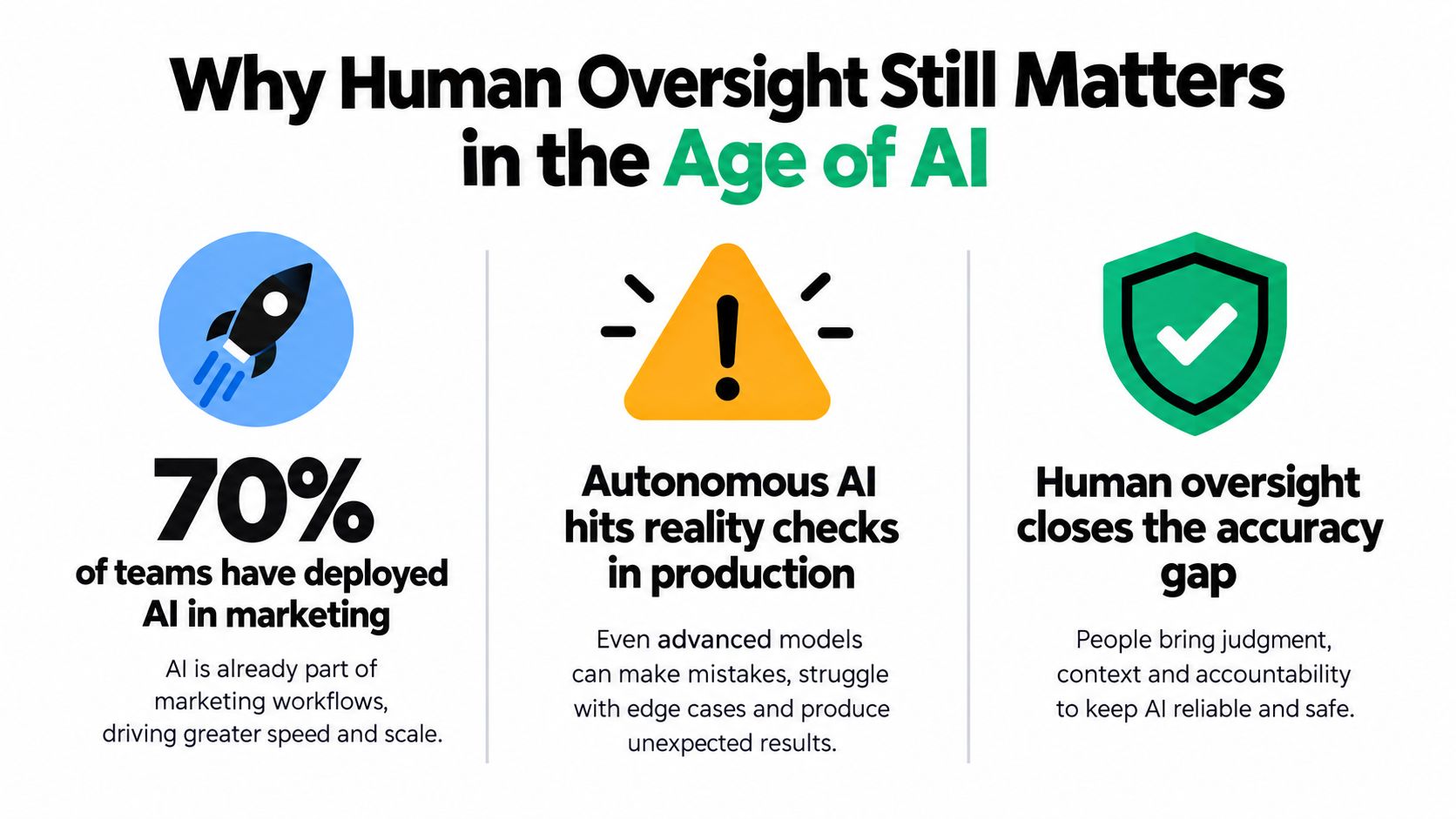
The common mistake is treating oversight as a temporary crutch until the system gets “smart enough.” Human-in-the-loop AI is a design choice, not a patch. It protects reliability when the model is fast but still weak on judgment, missing context, or policy boundaries.
The deeper failure mode is human behavior. Automation bias shows up when reviewers trust output because it looks polished, and the “human in the dark” problem appears when people are asked to approve work without enough context to challenge it. In both cases, the review step becomes a ceremony instead of a control. That is how teams end up with a loop in name only.
A better setup gives reviewers clear decision rights, visible inputs, and enough context to catch bad assumptions early. If a bad output would create rework, legal exposure, or customer confusion, someone still needs to stop it before it ships.
Treat humans as part of the production system, not as cleanup at the end. That is the difference between AI that helps a team move faster and AI that multiplies mistakes.
Defining Human in the Loop AI
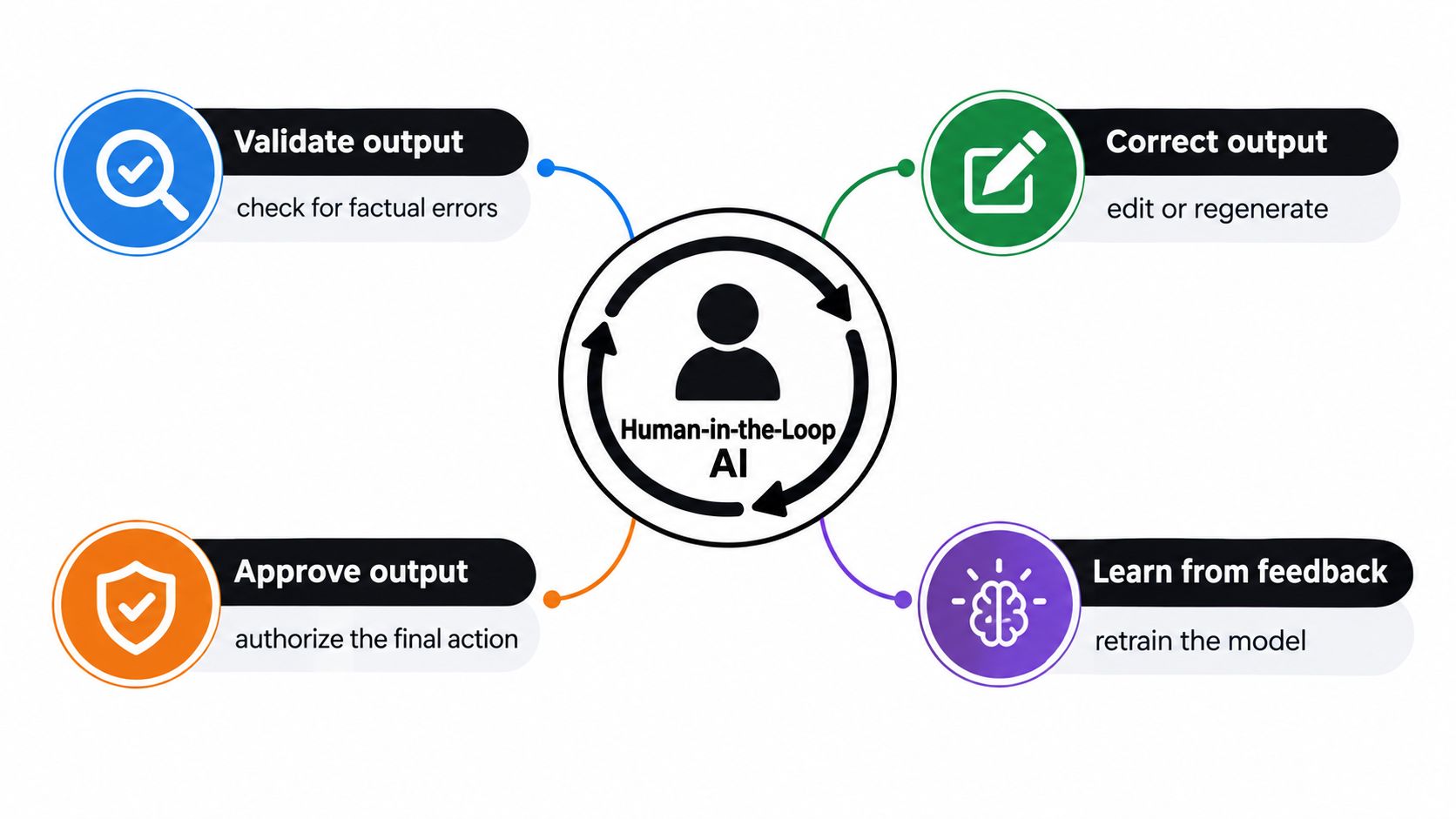
Human in the loop AI means a person actively validates, corrects, or approves outputs before action is taken. The point is active judgment. A person is not standing by as decoration, they are intervening where a bad call would matter.
What the loop actually includes
A practical HITL setup can include several human touchpoints, depending on risk and workflow design:
- Validate output: check whether the result is factually or contextually sound.
- Correct output: edit, rewrite, or regenerate when the model misses the mark.
- Approve output: give the final go-ahead before something ships or triggers action.
- Learn from feedback: feed corrections back into future model behavior or rules.
The concept goes beyond editorial review. A systematic review traces the roots of this approach back to cybernetic research in the 1940s and 1950s, where feedback-control principles shaped modern HITL design (systematic review). That matters because HITL is an operating model, not a bandage for weak AI. Human judgment changes how the system behaves across the pipeline.
What HITL is not
HITL does not mean humans must touch every step. That would slow throughput and create bottlenecks. It also does not mean the system is broken. In many workflows, the AI should draft first, and humans should step in only where uncertainty, risk, or policy requires it.
The cleanest way to frame it is simple. AI does the scaling, humans do the deciding. The loop exists because the decision boundary is where judgment still matters.
The Technical Architecture of HITL Systems
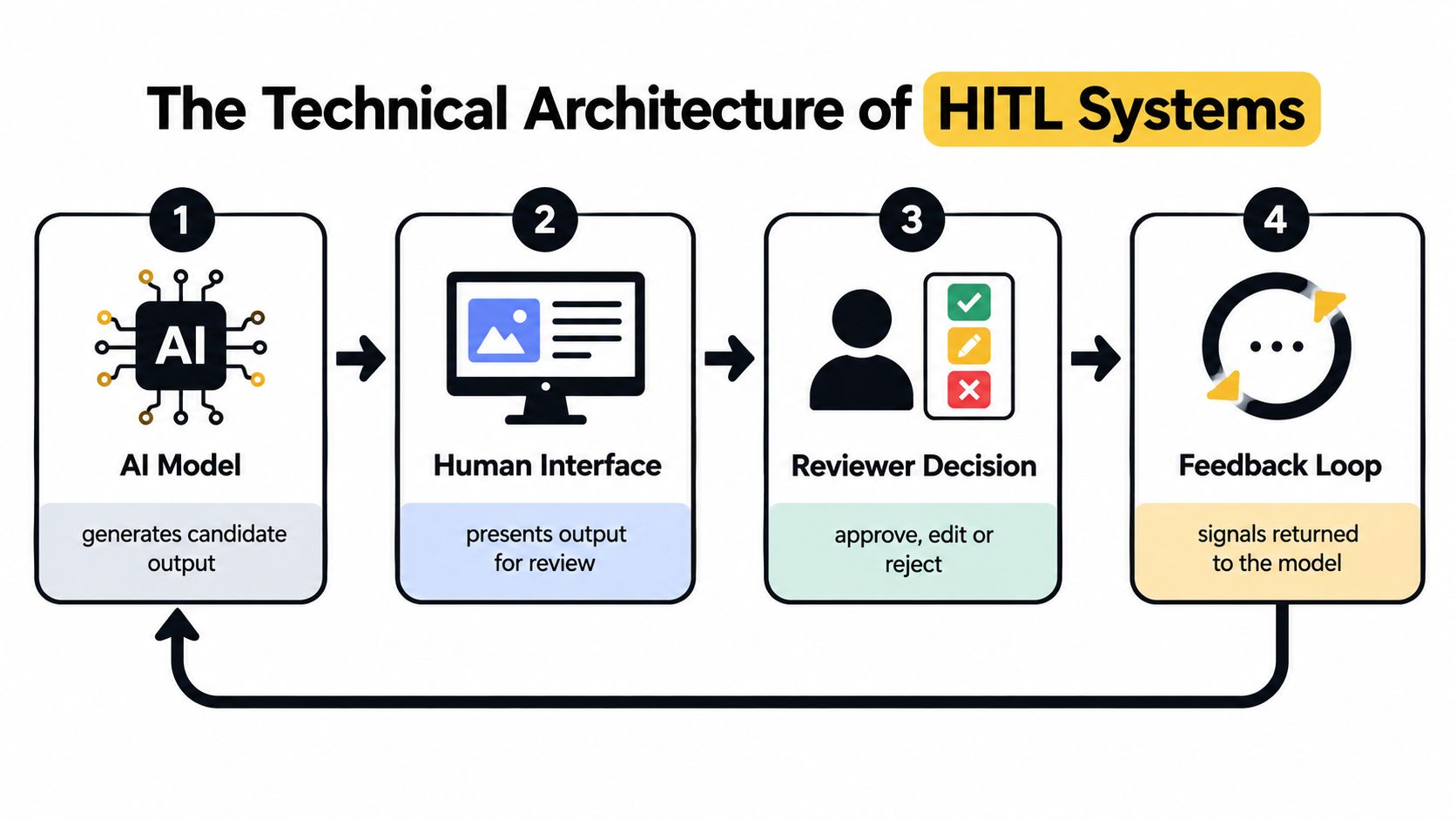
A useful HITL setup has four moving parts, and if one of them is weak, the whole system starts to wobble. The model generates an output, the interface presents it, the decision logic decides whether it needs review, and the feedback loop captures what happened so the system can improve.
The four parts that matter
AI model. This is the generator. It produces candidate outputs, recommendations, or actions.
Human interface. That is where the reviewer sees the output with enough context to judge it quickly. If the interface is cluttered or incomplete, oversight becomes ceremonial.
Decision logic. This is the gate. Teams use confidence thresholds, risk rules, or governance policies to decide what gets auto-approved and what gets escalated.
Feedback loop. Human corrections return to the system here. That feedback can shape prompts, rules, training data, or workflow logic.
HiL-Bench makes this measurable by operationalizing human-in-the-loop capability as selective escalation and scoring help-seeking behavior with Ask-F1, which is the harmonic mean of question precision and blocker recall. The benchmark includes 300 tasks and 1,131 total blockers, averaging 3.8 blockers per task (HiL-Bench). That's useful because it shows the core challenge isn't just producing an answer. It's knowing when to ask for help without spamming the reviewer.
Context packaging is the hidden make-or-break
A reviewer needs the right context, not just the output. That means the decision history, source material, confidence signals, policy rules, and the likely consequence of approval should all travel with the task. When teams forget that, they create the “human in the dark” problem, where people are technically in the loop but practically forced to guess.
If the reviewer has to reconstruct the situation from scratch, the system is already too expensive to trust.
The best architectures make intervention fast, informed, and auditable. That's what separates operational HITL from a decorative approval step.
Human in the Loop vs Fully Automated Approaches
Fully automated systems shine when the work is repetitive, low-risk, and reversible. HITL wins when the cost of a bad decision is high, the context is messy, or the output needs judgment that a model can't reliably supply.
| Factor | Fully Automated | Human in the Loop |
|---|---|---|
| Speed | Faster at high volume | Slower, but controlled |
| Accuracy on edge cases | More fragile | Stronger when review is informed |
| Risk handling | Depends on model confidence | Explicit human escalation |
| Brand safety | Can drift without notice | Human can catch tone and context issues |
| Compliance | Harder to prove accountability | Better auditability and approval trails |
| Cost | Lower direct labor cost | Higher review cost, lower failure risk |
The trade-off isn't abstract. In content moderation, a fully automated system can over-block legitimate speech or miss subtle abuse. In financial or healthcare workflows, that kind of error can cause real harm. HITL is slower, but it's often the only defensible choice when the system's output affects people, money, access, or reputation.
Where automation still makes sense
Automation makes sense when mistakes are cheap, easy to rollback, or limited to internal workflows. It also makes sense when the AI can safely draft and a human only needs to sample or spot-check. The problem starts when teams assume every workflow should be autonomous just because it can be automated.
Where HITL is the safer default
- Content moderation: reviewers catch sarcasm, nuance, and policy exceptions.
- Compliance-heavy operations: humans approve sensitive actions before they trigger downstream impact.
- Brand-facing generation: humans protect tone, accuracy, and message control.
- Safety-critical environments: human approval adds an essential stop point.
The best operating model is rarely one extreme or the other. High-volume systems often need automation at the front and human judgment at the boundary. That boundary is where the risk lives.
How Exerta Can Help
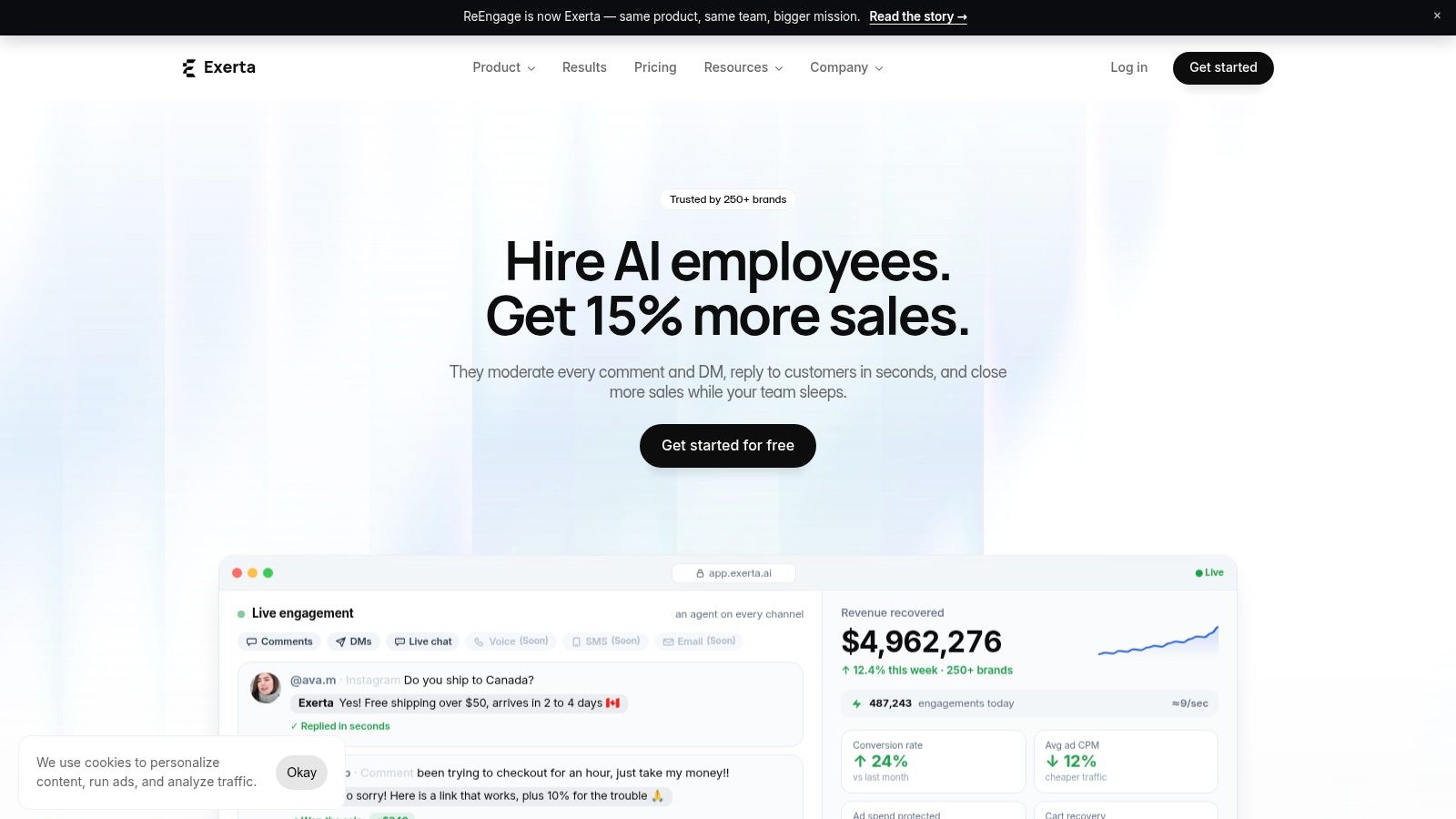
For teams managing comments, DMs, and web chat at scale, Exerta is one practical example of HITL done with operational guardrails. It deploys AI agents to manage customer engagement, moderate harmful content, and recover revenue across social and web channels, with actions logged and attributed. It works today with Facebook, Instagram, TikTok, and website chat, and it includes no-code setup, brand training controls, and escalation workflows.
Where that matters in practice
This kind of system is useful when the work is too public to let bots improvise. If you're handling ad comments, sales DMs, or inbound website chat, you need fast replies, but you also need moderation rules, brand consistency, and a clear approval path for sensitive cases. Exerta's setup is built for that mix, which makes it relevant for DTC brands, ecommerce teams, telehealth, lead gen, coaches, and agencies that rely on social conversations for revenue.
The link between workflow and oversight is the central point. If you're comparing different implementations of human in the loop AI, look for systems that don't just automate responses, but also log actions, support escalation, and let a human stay authoritative when the context gets tricky.
Why this is still a human-in-the-loop decision
A good fit here is not “replace the team.” It's “reduce manual load without losing control.” That's especially important when comment moderation, buyer-intent detection, and reply quality all affect spend efficiency and conversion. Exerta is one option in that category, and it's most useful when you want machine speed, but you're unwilling to give up review, attribution, or brand safety.
Benefits and Limitations of HITL AI
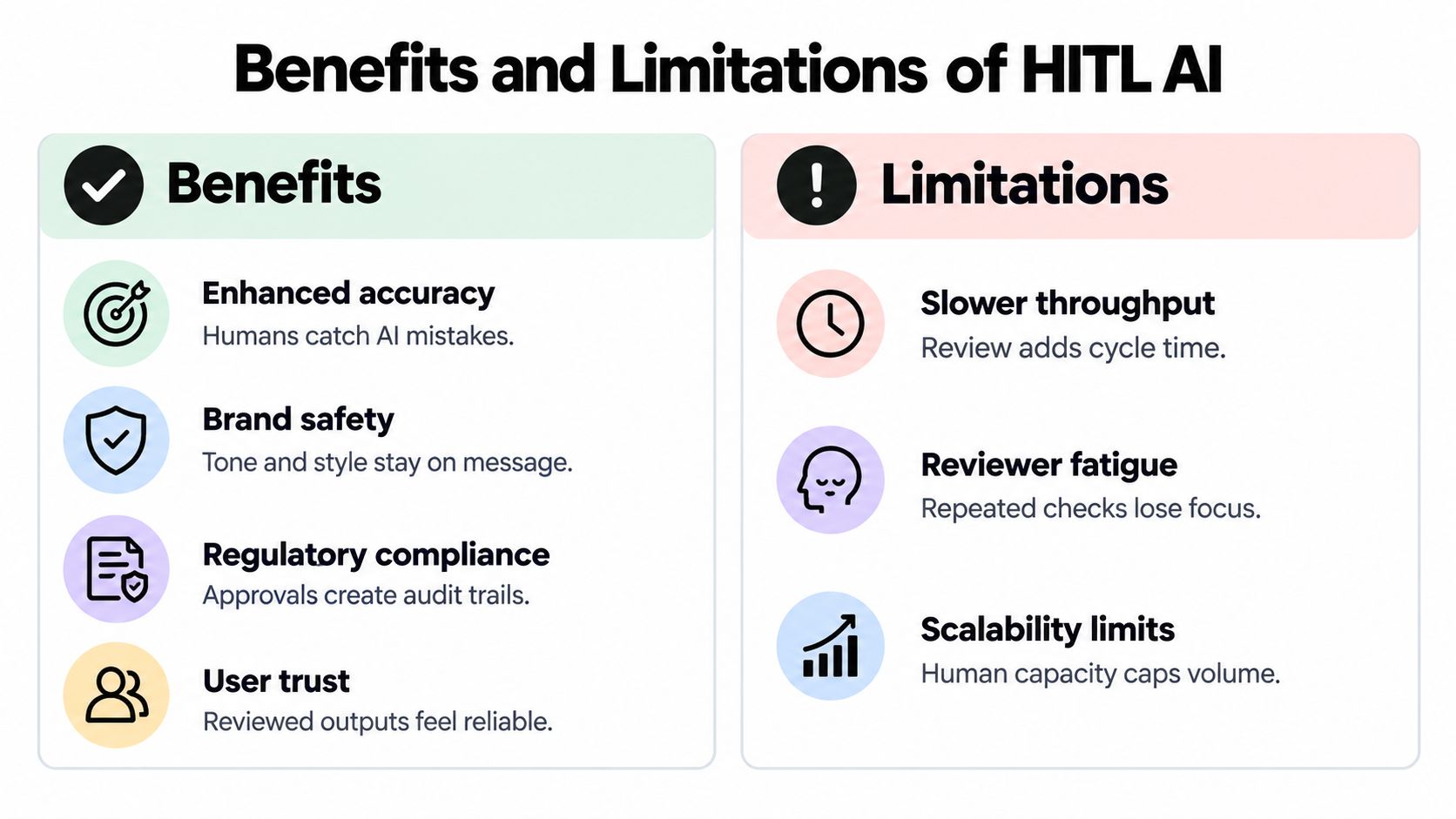
The strongest HITL systems improve output quality because humans catch what models miss. They also create cleaner audit trails, which matters when someone needs to explain why an action was approved. In regulated or customer-facing work, that's not a nice-to-have. It's the difference between a controllable workflow and a liability.
What works
- Enhanced accuracy: humans catch subtle errors, missing context, and awkward phrasing.
- Brand safety: people can protect tone, style, and commercial intent.
- Regulatory compliance: approvals and logs make decisions easier to review later.
- User trust: reviewed outputs feel less brittle to customers and stakeholders.
What breaks in real teams
- Slower throughput: review adds cycle time, especially when volume spikes.
- Reviewer fatigue: repeated approval work dulls attention.
- Scalability limits: human capacity always caps the top end.
A common failure mode is the ceremony trap. The team adds a reviewer, but the reviewer gets too little context, too many alerts, or too much trust in the model. That's where automation bias appears. People start accepting AI suggestions because the system looks confident, not because the output is right.
Replymer is a useful contrast here because it puts human-written replies at the center of social engagement on Reddit, X, and LinkedIn. In that kind of workflow, the human isn't just rubber-stamping drafts, the person is doing the judgment work that keeps replies native to the conversation. That matters when authenticity is the product, not a cosmetic layer.
The hidden risk
The “human in the dark” problem is real. If reviewers don't see enough source material, policy detail, or conversation history, they're not supervising. They're guessing. That's why the interface and the escalation rules matter as much as the model itself.
HITL works when humans are informed, not merely present.
Practical Use Cases and Examples
The most reliable HITL systems are the ones that match the kind of judgment the task requires. Content moderation is a good example. AI can filter obvious abuse, but humans are still needed for borderline cases, new slang, sarcasm, and policy calls that depend on context.
Customer support is another straightforward case. The model handles routine questions, then escalates emotionally charged or ambiguous issues to a person. That keeps response times fast without letting the bot escalate a frustrated customer into a worse experience.
Where the loop adds value
Moderation. Human reviewers validate filters, tune edge cases, and keep policies aligned with real language.
Recommendations. Humans curate initial datasets and sanity-check the outputs before they shape what buyers see.
Support. AI handles volume, humans handle complexity.
Social selling. Human-written responses on Reddit, X, and LinkedIn can recommend products in a way that feels native to the thread instead of forced.
That last one is where many teams misread the problem. The issue isn't only reply speed. It's conversational fit. A reply that lands technically but feels off destroys trust fast. Human review keeps the response grounded in the tone, norms, and pacing of the community.
What to measure
Don't judge the workflow by sentiment alone. Track whether the system produces fewer bad interventions, clearer approvals, and stronger downstream outcomes. If a team spends less time on repetitive work and more time on high-value decisions, the loop is doing real work. If the reviewers are just approving everything automatically, the process has turned into theater.
A practical rollout usually starts with the most failure-prone moments, not the most common ones. That's where humans add the most value per review minute.
Implementation Guidance and Metrics to Track
The cleanest way to deploy HITL is to define the decision boundaries first, then design the interface around them. Decide what must always be human-approved, what can be auto-approved under policy, and what should be escalated only when confidence drops or context becomes unclear. If you skip that step, the system will default to inconsistency.
Build the workflow around actual risk
Start with three questions. What can the model do alone? What must be reviewed? What should never execute without a person? That framework helps teams avoid both over-control and reckless automation.
A few implementation habits usually separate useful systems from frustrating ones:
- Clear escalation criteria: define the exact conditions that trigger review.
- Useful context packaging: include the source inputs, confidence signal, policy, and expected consequence.
- Simple reviewer UI: the faster a human can understand the case, the more reliable the decision.
- Audit logging: record who approved what and why.
- Feedback capture: store corrections so the workflow improves over time.
Track the right metrics
The metric set should reflect both quality and reviewer load.
A good HITL system gets better without making people slower and more cynical.
Useful metrics include human review time, escalation rate, correction rate, and downstream satisfaction from the people who receive the output. If review time keeps rising while quality stays flat, the loop is too heavy. If correction rate is near zero but the team still sees mistakes in production, the reviewers aren't getting enough context or authority.
Governance matters too. The 2026 EY-based report noted that roughly half of organizations had not updated AI governance for agentic AI, four in ten lacked visibility into all AI tools on their networks, and about one-quarter could not detect unauthorized AI agents internally (EY-based report). That's a reminder that operational oversight and policy oversight have to move together.
The point isn't to make humans the bottleneck. It's to make them the control surface where judgment still matters.
Conclusion - Balancing Speed and Judgment
Human-in-the-loop AI works because it accepts a hard truth many teams resist. Machine speed helps, but human judgment still decides whether the output is trustworthy. That is why HITL has stayed relevant for decades, from early feedback-control thinking to production AI systems, as defined earlier.
The mistake is treating HITL as an accuracy-only feature. It also has to handle accountability, context, and the failures that happen when the model is wrong. Strong systems do not place humans everywhere. They place humans where the decision changes outcomes, and they give those reviewers enough context to act well.
The next stage of AI adoption will be selectively supervised. High-risk actions need tighter governance, while low-risk steps can run with lighter review when errors are easy to correct.
That is the practical middle ground teams handling brand-facing or revenue-facing automation need. If the loop hides context, it creates automation bias and a human-in-the-dark problem, where review becomes a checkbox instead of a control.
If you are building or buying AI workflows now, ask where judgment still matters, where context is missing, and where a fast but wrong answer would cause real damage. Then design the loop around those points, not around the hype. Review escalation rules, tighten reviewer context, and choose tools that keep human authority where it counts.


