Demand generation marketing is all about creating awareness and, more importantly, desire for what you sell. Think of it less like putting up a "for sale" sign and more like being the trusted local expert everyone turns to for advice. It’s the art of making people want your solution before they even realize they need it.
You're not just waiting for the rain to start so you can sell umbrellas; you're becoming the go-to meteorologist everyone trusts, so when the first drop falls, they already know who to call.
So, What Is Demand Generation Marketing, Really?

At its heart, demand generation is about making your brand the obvious choice. It's a long-term play, focused on building an impeccable reputation and becoming the authority in your niche.
Think about the difference between a food truck that serves a quick, transactional meal and a Michelin-star restaurant. The restaurant meticulously crafts an experience, building a name that draws people in from all over. That’s the demand generation mindset—it's about creating an experience and a brand that people actively seek out.
Creating Desire, Not Just Capturing It
To really get it, you have to understand the distinction between demand generation and lead generation. They are often confused, but they play very different roles.
Lead generation is focused on capturing the contact information of people who are already interested. It’s the "sign up now" form, the "download our guide" gate. Demand generation is the hard work you do before that, creating the initial awareness and interest that makes someone want to fill out that form in the first place.
Demand Generation vs Lead Generation At a Glance
This table breaks down the core differences between the two concepts, highlighting their separate goals and methods.
| Aspect | Demand Generation | Lead Generation |
|---|---|---|
| Primary Goal | Create awareness, interest, and desire for your solution. | Capture contact info from people who are ready to engage. |
| Focus | Top-of-funnel (educating the market). | Mid-to-bottom-of-funnel (converting interest into leads). |
| Key Tactics | Ungated content, podcasts, social media, community. | Gated content (eBooks, webinars), contact forms, demos. |
| Measurement | Brand awareness, website traffic, social engagement. | Cost per lead (CPL), conversion rates, MQLs. |
| Analogy | Planting seeds and nurturing the soil. | Harvesting the crops that have grown. |
Ultimately, demand generation is about building a relationship, not just getting a name for your CRM.
This entire approach is built on the idea of long-term relationship building, guiding potential customers with valuable insights from the very first time they hear about you.
The whole point is to make sure that when a prospect finally has a problem your product can solve, your brand is the first—and only—one that comes to mind. You achieve this by consistently adding value.
- Educational Content: This means freely sharing expertise through helpful blog posts, insightful webinars, and practical guides without demanding an email address upfront.
- Community Engagement: It's about creating and participating in spaces where your audience can connect, learn, and see your brand as a helpful peer, not just a vendor.
- Brand Storytelling: This is about crafting a narrative that truly connects with your ideal customer’s problems, goals, and ambitions.
The Core Pillars of a Powerful Demand Generation Strategy
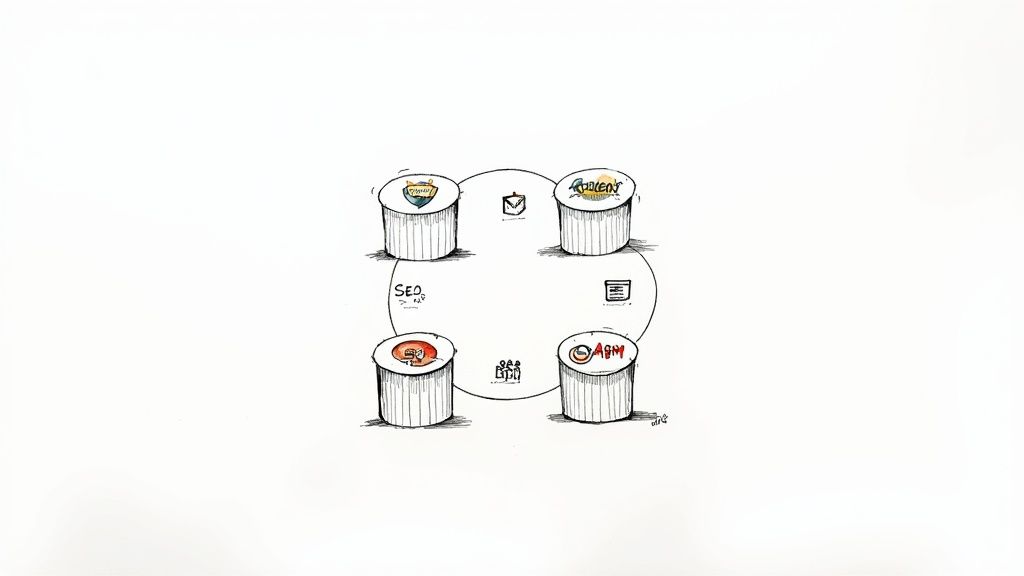
A great demand generation program isn't about throwing one tactic at the wall and hoping it sticks. It’s an engine, a system where all the parts work together to build momentum. Each pillar holds up the others, creating a machine that naturally pulls in your ideal audience without ever feeling like a hard sell.
Think of it like building a house. You can't just put up a roof. You need a solid foundation, sturdy walls, and then the roof to protect it all. In demand gen, these core strategies are the structural elements that give your program its strength.
Value-Driven Content and SEO
Content is the absolute bedrock of modern demand generation. We're talking about high-quality, genuinely helpful content that solves your audience's problems, answers their burning questions, and provides real value—usually for free. This is how you stop being just another vendor and start becoming a trusted expert.
But the best content in the world is useless if nobody ever sees it. That’s where Search Engine Optimization (SEO) comes in. By optimizing your content, you make sure it shows up on Google right when potential customers are actively searching for the solutions you provide.
This one-two punch is incredibly effective. It attracts an audience that already knows they have a problem, which makes them far more open to what you have to say. It's no surprise that content marketing is the most effective strategy for 83% of marketers, with organic SEO following close behind at 67%.
Community Building and Social Engagement
At its heart, demand generation is all about relationships. Building a community around your brand gives customers and prospects a place to connect, talk shop, and feel like they belong. This is where you find your most passionate brand advocates and get unfiltered feedback.
Engaging on social media is a huge part of this. The trick is to stop broadcasting marketing messages and start participating in real conversations. Offer advice, share insights, and show the human side of your brand.
The goal is to be a valued member of the conversation, not an interruption. When you consistently add value, you build the kind of authentic relationships that advertising can't buy.
Strong community engagement is a direct line to understanding how to build brand trust and create real loyalty.
Account-Based Marketing (ABM)
While a lot of demand gen involves casting a wide net to attract an audience, Account-Based Marketing (ABM) is the complete opposite. It’s a precision tool. Instead of marketing to a broad industry, ABM treats individual high-value companies as their own unique markets.
With this strategy, you create deeply personalized campaigns and content designed specifically for the key players at your target accounts. It’s a strategic move for landing bigger, more complex deals where a generic message would just get ignored.
These pillars form the foundation of a healthy demand ecosystem. Let's break down how they contribute:
- Content Creation: Develops blogs, webinars, and podcasts that educate and solve real-world problems.
- Search Engine Optimization (SEO): Makes sure your valuable content gets found by the right people when they need it most.
- Community Building: Creates a loyal following and turns customers into advocates through genuine interaction.
- Account-Based Marketing (ABM): Concentrates your efforts on high-value accounts with personalized outreach that resonates.
By weaving these core pillars together, you create a system that feeds itself. To get these right, it helps to explore the different ways to execute them, as covered in these top demand generation strategies.
How to Build Your Demand Generation Framework
So, you get the concept of demand generation. But how do you actually build a program that works? It’s all about having a clear, repeatable process. Think of it as your blueprint—the guide that informs every decision, from who you’re talking to, to the actual campaigns you run. Without a solid framework, you’re just creating noise, and your efforts will feel scattered, making it nearly impossible to measure what’s actually working.
Building this framework all comes down to one simple question: Who are you trying to help? Everything else flows from that answer.
Start with Your Ideal Customer Profile
Before you even think about writing a blog post or launching an ad, you need to get crystal clear on your Ideal Customer Profile (ICP). This isn't just a vague list of job titles and company sizes. It’s a vivid picture of the exact companies that get the most out of your product and, in turn, are the most valuable to your business.
The best way to define your ICP is to look at your happiest, most successful customers right now. What do they have in common?
- Firmographics: What industry do they operate in? How big are their companies (employee count or revenue)? Where are they located?
- Pain Points: What specific, nagging problems does your product actually solve for them? What are the challenges that keep them up at night?
- Goals: What are they ultimately trying to accomplish? What does a huge win look like for their business?
Nailing down your ICP ensures that your entire strategy is laser-focused on the right people. It makes every other step that follows way more effective.
Map the Customer Journey
Once you know who you're talking to, you need to understand how they think and buy. The customer journey map is your tool for this. It outlines every single touchpoint a potential customer might have with your brand, from the moment they realize they have a problem to the day they sign on the dotted line. It's never a straight line; it's a winding road.
Put yourself in their shoes and think about the questions your ICP is asking at each phase:
- Awareness Stage: The prospect feels the pain of a problem but can't quite put a name to it. They're searching for educational content to better understand what’s going on.
- Consideration Stage: They’ve now defined their problem and are actively researching all the possible solutions. This is where they start comparing different vendors and approaches.
- Decision Stage: The prospect has whittled down their options and is ready to make a choice. They’re looking for social proof—case studies, demos, and reviews—to validate their decision.
Mapping out this journey tells you exactly what content and messaging will hit the mark at each stage. It stops you from pushing a product demo on someone who is still just trying to figure out what their problem is.
Develop a Content and Distribution Strategy
With your ICP and journey map complete, you can finally build a content strategy that actually helps people. The goal here is to create genuinely valuable resources that directly answer the questions and address the pain points you've already identified for each stage. You’re essentially making sure you have the right answer ready at the exact moment they need it.
But creating great content is only half the battle. Your distribution plan is just as critical. You have to meet your audience where they already hang out. This could be LinkedIn, niche industry forums, specific subreddits, or simply through organic search. For a much deeper look into effective execution, you should explore these demand generation best practices to really sharpen your approach.
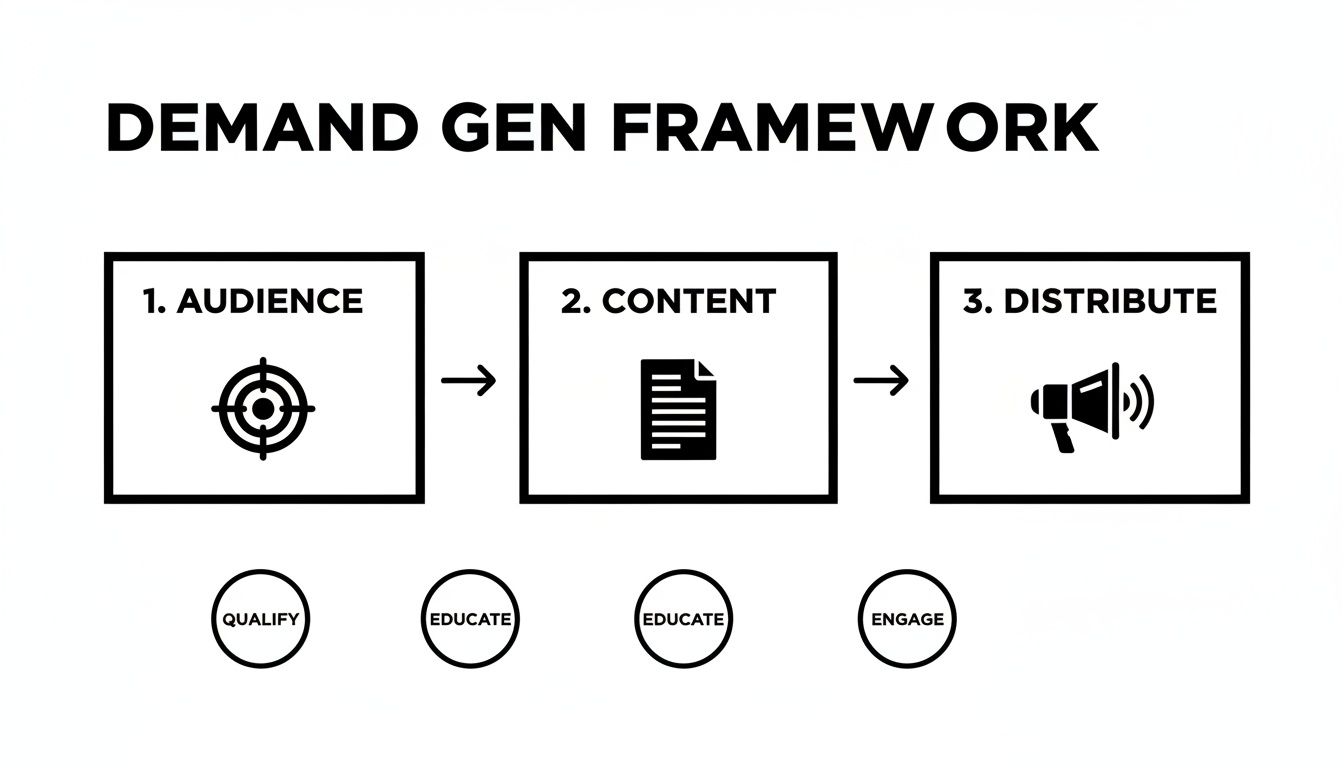
When you align your content with your audience's journey and get it in front of them on the right channels, you create a powerful, cohesive system. This framework is what systematically builds awareness, educates prospects, and ultimately turns genuine interest into real business growth.
Measuring Success Beyond Vanity Metrics
Let's get one thing straight: real demand generation isn't measured in likes, shares, or impressions. It's measured in revenue. Period.
While those top-of-funnel numbers like website traffic and social media engagement can be useful signals, they don't pay the bills. To prove your strategy is actually working, you have to draw a clear line from your marketing activities straight to business growth.
This means you need to stop talking about vanity metrics and start focusing on the numbers that matter to your leadership team. It’s about shifting the conversation from "how many clicks did we get?" to "how much pipeline did we generate?"
Key Performance Indicators That Matter
A healthy demand gen program is tracked with a dashboard that focuses on tangible outcomes, not just busywork. These are the KPIs that show the true business impact of your efforts.
Here are the big ones to watch:
- Pipeline Velocity: How fast are deals moving from first touch to closed-won? A quickening velocity is a great sign that your marketing is bringing in well-educated prospects who are genuinely ready to talk business.
- Customer Acquisition Cost (CAC): What’s the total bill for marketing and sales to land one new customer? A successful demand gen engine should drive this cost down over time by creating a more efficient, predictable path to purchase.
- Sales Cycle Length: How long does it take, on average, to close a deal? When you see this number shrinking, it’s a powerful indicator that your content is doing its job building trust and educating buyers long before they ever talk to sales.
This framework breaks down the essential flow: it all starts with your audience, which dictates the content you create and the channels you use to get it in front of them.
The Challenge of Attribution
One of the trickiest parts of measurement is attribution—figuring out which touchpoints actually influenced a deal. A future customer might read a blog post, catch a podcast interview, and then attend a webinar over several months before they finally raise their hand for a demo.
It's a mistake to give 100% of the credit to the last touchpoint, like a demo request. A holistic view is essential. You must recognize that top-of-funnel activities, like creating ungated content, are crucial for building the initial awareness and trust that lead to that final conversion.
Instead of getting bogged down trying to find the "perfect" attribution model, it’s often more productive to focus on the overall trends. Is your content leading to more qualified opportunities for the sales team? Is your average deal size on the rise? These are the questions that truly reveal the health of your program.
For a deeper dive into this, check out our complete guide on how to measure marketing effectiveness and build a dashboard that tells a powerful ROI story.
Putting Demand Generation into Practice with Real Examples
Theory is great, but let's be honest—it's seeing how these ideas work in the real world that makes everything click. The best way to grasp the power of demand generation is to look at how actual companies blend different tactics to create a groundswell of interest, making them the go-to solution for their ideal customers.
Let's walk through a couple of scenarios that show how these principles turn into real business results.
The SaaS Company That Became an Authority
Picture a B2B SaaS startup trying to break into the crowded project management software market. Their budget is tight, so instead of blowing it on "Buy Now!" ads, they decide to become the most helpful, trusted resource for project managers out there.
Their whole strategy is built on giving away value, no strings attached:
- Weekly Webinars: They start hosting free sessions on advanced topics that project managers actually care about, like "Agile Methodologies for Remote Teams" or "Resource Allocation for Hybrid Work." They bring in industry experts to co-host, adding even more credibility.
- Deep-Dive Guides: They create incredibly thorough, SEO-friendly guides that tackle the biggest headaches for their audience, like risk management and team productivity. Soon enough, they start ranking on the first page of Google for these topics.
- A Thriving Community: They launch a Slack community where project managers can connect, swap stories, and ask for advice. The company’s team hangs out in there too, but they act as helpful moderators, not pushy salespeople.
What happens? Over six months, they cultivate a loyal following. When someone in that community hits a wall with their current tools, this company is the first one they think of. The result is a steady stream of high-quality, inbound demo requests from people who already see the brand as an expert.
This completely flips the script. The sales team isn't making cold calls; they're having warm conversations with educated buyers who are already convinced of the company's value.
The Fintech Firm’s Precision ABM Play
Now, let's switch gears. Imagine an established fintech company that has its sights set on landing five massive enterprise banking clients. A broad, spray-and-pray approach is doomed to fail. They need a scalpel, not a sledgehammer. So, they turn to Account-Based Marketing (ABM).
First, their marketing and sales teams huddle up to pinpoint the key decision-makers at each target bank. From there, they build a multi-channel campaign designed to speak directly to the unique pains of each organization.
- Personalized Content: They create a custom whitepaper that details exactly how their platform solves specific compliance headaches common in large financial institutions.
- Targeted Outreach: Key executives at the target banks get personalized LinkedIn messages and emails referencing the whitepaper, but it doesn't stop there. The call-to-action is an invitation to an exclusive, closed-door roundtable discussion with other banking leaders.
This hyper-focused approach shows they’ve done their homework and genuinely understand the prospect's world. It builds massive credibility long before a sales pitch is ever made. These real-world examples prove that successful what is demand generation marketing isn't about one magic tactic; it's about orchestrating a smart strategy that builds trust and creates authentic demand.
Frequently Asked Questions About Demand Generation
Alright, let's tackle some of the common questions that pop up when you start moving from theory to actually doing demand generation.
How Long Until We See Results?
This is the big one, isn't it? The honest answer is: demand generation is a long game. Think of it like planting a tree, not flipping a switch. You're building brand authority and a sustainable pipeline for the future.
While you might see early signals like more website traffic or better social media engagement within 3-6 months, the real, bottom-line impact takes time. Generally, you can expect to see a noticeable lift in your sales pipeline and revenue after about 6-12 months of consistent, quality work. The key is patience. You're building momentum that pays off for years, not just next quarter.
What's the Single Biggest Mistake to Avoid?
Easy. The most common mistake is thinking demand generation is just a fancier name for lead generation and slapping a form on every piece of content you create. True demand generation is about creating genuine value first—through truly helpful content, building a community, and sharing your expertise—without immediately asking for an email in return.
When you skip this foundational work, you're only capturing the demand that already exists. You aren't creating new demand. The goal isn't just to build an email list; it's to build an audience that knows, likes, and trusts you.
Can Small Businesses Actually Pull This Off?
Absolutely. In fact, small businesses and startups can have an advantage. You might not have a massive budget, but you can be laser-focused on a specific niche. This is where high-impact, low-cost strategies really shine.
You can create a ton of demand by:
- Owning a Niche with SEO: Write the single best, most helpful article on the internet for a very specific problem your audience faces.
- Building a Passionate Community: Find your people on platforms like LinkedIn or Reddit and become a valuable, contributing member.
- Joining Real Conversations: Instead of just broadcasting, jump into discussions to offer help and build awareness organically, one person at a time.
Ready to turn online conversations into qualified inbound leads without all the manual effort? Replymer uses human-written replies on Reddit, X (Twitter), and LinkedIn to get your product recommended in the right discussions, building authentic demand on autopilot. See how Replymer works.