Building brand trust isn't about running a one-off campaign or just having a great product. It's the daily practice of earning confidence and proving your reliability through everything you do—every customer email, every social media post, and every product update.
It’s an ongoing commitment to being who you say you are. This is what transforms a curious first-time user into a loyal, long-term advocate for your brand.
What Does Brand Trust Really Mean Today
It used to be that a slick logo and a solid product were enough to get by. Not anymore. Today, trust is the engine of growth, and it goes far beyond basic customer satisfaction.
People don't just care about what you sell; they care deeply about how you operate. They're looking for authenticity, ethical practices, and a real human connection. This shift means trust is no longer a "nice-to-have"—it's a critical asset you have to earn and protect every single day.
The stakes are high. The Edelman Trust Barometer found that trust is now a dealbreaker for 71% of consumers worldwide. They'll either buy from you or boycott you based on it. This proves that your ethics and transparency aren't just feel-good concepts; they directly hit your bottom line. While business is seen as the most trusted institution right now, that trust is fragile. It’s built on genuine communication, not flashy ads. If you're interested in digging deeper, you can explore more about these brand trust trends and their impact on purchasing behavior.
The Core Pillars of Brand Trust
To build a brand that people rely on, you need a solid foundation. Everything boils down to three core pillars that work in tandem to shape how customers see you and whether they'll stick around.
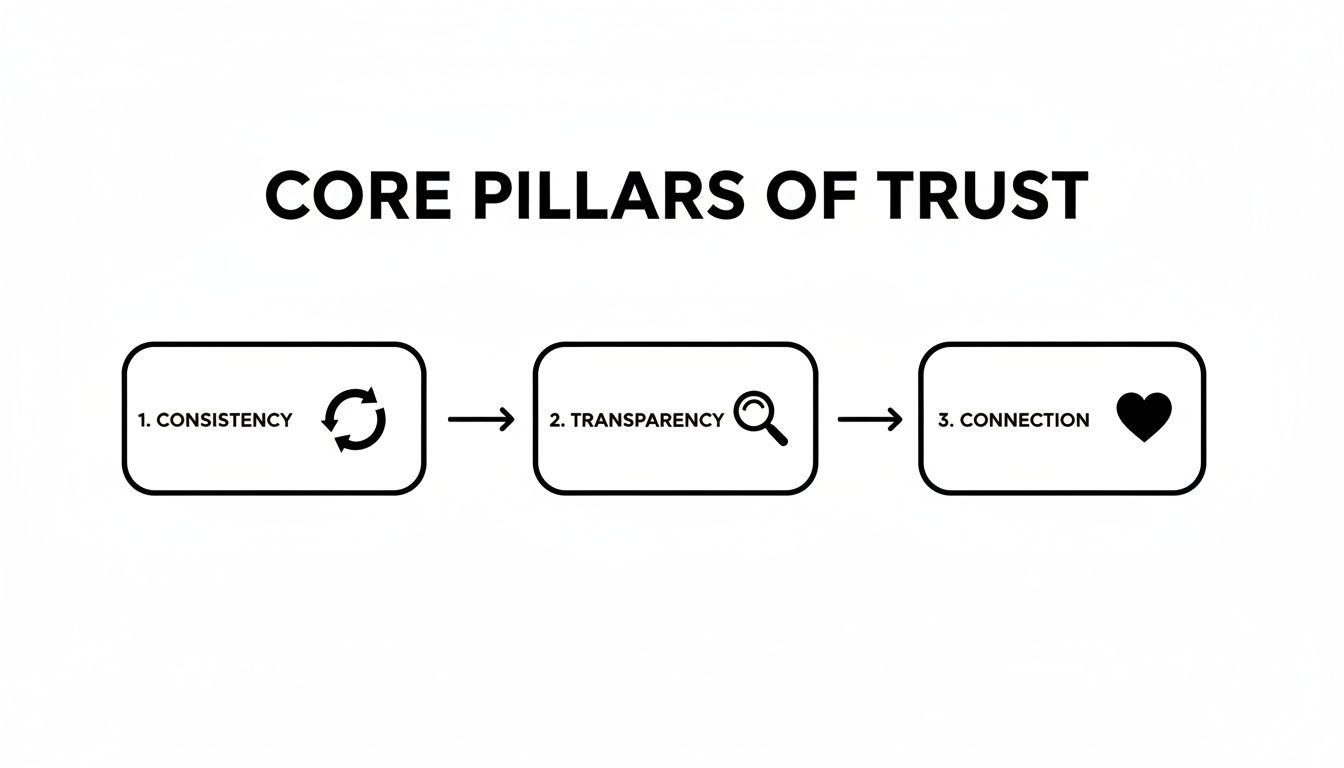
As you can see, these elements aren't siloed—they reinforce each other to create a strong, trustworthy brand identity. Getting these right provides the blueprint for every single tactic you'll use from here on out.
To make this crystal clear, here’s a quick breakdown of what each pillar means in practice.
Core Pillars of Brand Trust
| Pillar | Description | Example in Action |
|---|---|---|
| Consistency | This is all about reliability and predictability. Your messaging, design, and user experience should feel familiar and dependable across every channel, every single time. It removes guesswork for the customer. | A SaaS company like Slack maintains the same friendly, slightly quirky brand voice in its app, on Twitter, and in support documentation. Users always know what to expect. |
| Transparency | This is being open, honest, and accountable. It's about clear pricing, admitting when you've made a mistake, and being upfront about how you handle customer data. It shows you have nothing to hide. | When Buffer had a security breach, they didn't hide it. They immediately and openly communicated what happened, what they were doing to fix it, and how they would prevent it in the future. |
| Connection | This is the emotional bond you create. It comes from understanding your customers' pain points, listening to their feedback, and engaging in genuine, two-way conversations, not just broadcasting marketing messages. | The team at SparkToro regularly engages with their audience through webinars, social media Q&As, and by sharing personal insights, making their brand feel accessible and human. |
Mastering these three pillars isn't just a marketing exercise; it's a fundamental business strategy that lays the groundwork for sustainable growth and customer loyalty.
Go Radically Transparent with Your Business
"Transparency" gets thrown around a lot, but few companies truly live it. It’s not just a buzzword—it’s a powerful strategy that tells your customers, "We have nothing to hide." Going radically transparent means being wide open, honest, and accountable in everything you do. It’s about turning your everyday operations into brand trust-building moments.
This mindset really proves its worth when things go wrong. Owning a mistake immediately is one of the most powerful things you can do. Trying to cover it up or pass the buck just destroys confidence. A fast, honest admission followed by a clear plan to fix it? That can actually make customers more loyal.
Think about something every SaaS founder dreads: raising prices. The fear of backlash is completely understandable. But handling it with transparency can soften the blow. Don't just spring a price hike on people. Announce it well in advance and explain why it's happening. Maybe you need to fund a critical new feature or beef up your infrastructure. Frame it around the value they'll get in return, and you turn a negative into a conversation about shared growth.
Put Your Plans on Public Display
One of the best ways to show you're serious about transparency is to publish your product roadmap. Use a tool like Trello or just a dedicated page on your site to show everyone what you’re building, what’s up next, and even ideas you’re kicking around.
This does two amazing things for building trust:
- It pulls customers into your story. They stop being passive users and start feeling like insiders who are part of the journey.
- It sets clear expectations. People can see what you're prioritizing, which cuts down on the frustration of wondering if their feedback ever went anywhere.
Of course, a public roadmap makes you publicly accountable. If a deadline slips, you need to be ready to explain why. That's not a sign of weakness. It's just another chance for honest communication that shows you respect your customers enough to keep them in the loop.
Get Crystal Clear on Data Privacy
Nowhere is transparency more vital than with customer data. We live in an age of constant data breaches and privacy anxiety, so being clear about your data practices isn't optional—it's essential. Vague, jargon-filled policies just make people suspicious.
"Transparency isn't just about being honest; it's about being understandable. If your customers can't easily figure out how you use their data, you haven't been transparent enough."
Your privacy policy should be written for a human, not a lawyer. Use simple language, bullet points, and clean headings. Spell out exactly what data you collect, why you collect it, and how you keep it safe. This is your chance to turn a legal chore into a trust-building masterpiece.
This is more critical now than ever. There’s a huge gap between what people expect and what businesses are doing. A recent global survey found that for 44% of consumers, a brand’s transparency about data usage is the single most important factor in their trust. Yet, a shocking 77% of consumers say they don’t really get how companies are collecting or using their personal information. That disconnect is a massive risk, but it's also a golden opportunity for brands willing to be upfront. You can dig into the full report on how data privacy shapes digital trust.
The report cover itself really drives the point home.
This visual says it all: trust isn’t a nice-to-have, it’s the very foundation of the modern customer relationship. By being proactive and clear about your data policies, you’re not just checking a box—you’re showing customers you’re a brand they can count on.
Creating a Consistent and Authentic Brand Experience
If transparency is about making promises, consistency is about keeping them. Every single time. This is where your bold marketing messages have to line up with the day-to-day reality of your product, your support team, and your social media feed. When it all clicks, you create a seamless journey for customers that builds real, lasting trust.
Think about it like this: your brand is a person. If that person acts completely differently depending on who they're with, you quickly learn not to rely on them. It's the same for your business. A slick, professional website paired with sloppy, impersonal support emails creates a jarring disconnect that just kills confidence.
This alignment is everything. A customer who reads a friendly, helpful blog post should get that exact same vibe when they're troubleshooting an issue with your support team. That feeling of familiarity and reliability is the foundation of trust.

Unifying Your Brand Voice Across Channels
Your brand voice isn't just the words you pick; it's the personality that comes through in every single interaction. To get that consistent experience, your voice has to be the same everywhere—from the copy on your homepage to the tiniest bit of microcopy in your app.
First, you need to actually define what your brand sounds like. Are you witty and informal? Authoritative and direct? Get it down on paper in a simple style guide the whole team can reference.
This guide should be practical, covering things like:
- Tone of Voice: Settle on 3-5 adjectives that capture your personality (e.g., "Helpful, confident, and a little quirky").
- Vocabulary: Create a simple list of preferred words (like using "team" instead of "staff") and words to banish (no more corporate jargon like "synergy").
- Formatting Rules: Nail down the small stuff. How do you use emojis, capitalization, and contractions? It all adds up to a uniform feel.
Once that guide exists, you have to actually use it. A marketing email and a reply on X (formerly Twitter) should feel like they came from the same brain. That predictability is what makes your brand feel stable and dependable.
Aligning Marketing Promises with Product Reality
There's no faster way to destroy trust than to overpromise and under-deliver. Your marketing team can spin a fantastic story about how your SaaS will change lives, but if a new user logs in and finds a buggy, confusing interface, that trust vanishes. Poof.
This is where cross-functional alignment becomes a trust-building superpower. Your marketing, product, and support teams can’t be locked away in their own little worlds. They need to talk—constantly—to make sure the story you're telling matches the experience you’re actually delivering.
A classic pitfall for SaaS startups is hyping up a "game-changing" feature before it's fully baked. The intent is to build excitement, but it almost always backfires, leading to frustrated users who feel misled. Being honest about your product's current capabilities builds far more trust than hype ever will.
For instance, if your ads are screaming "effortless onboarding," your product team better be obsessed with making that true. They should work directly with marketing to understand the specific pain points being targeted in campaigns and then design a user flow that solves them. That's how you create a cohesive journey where the promise is immediately fulfilled, solidifying the user's belief in you from minute one.
When all these pieces work together, every interaction feels reliable and true to who you are. Your brand stops being just a tool and starts becoming a trusted partner—the kind that customers stick with for the long haul.
Fostering Trust Through Genuine Community Engagement

You can't just tell people to trust you; it doesn't work that way. Trust is earned, not announced. It’s forged in the back-and-forth of real conversations, by showing up, listening, and actually participating where your customers are. The whole game changes when you shift your mindset from simply selling a product to truly serving a community.
This means getting away from the endless cycle of one-way announcements and pre-scheduled content. Instead, you need to actively create and nurture spaces where people feel heard, valued, and connected—not just to your brand, but to each other.
Master the Art of the Social Reply
Think of social media as your digital storefront. Every comment, question, and complaint is a customer walking in. How you respond—or if you respond—says everything about your company's character. Simply deleting or ignoring negative feedback is the fastest way to signal that you don’t care.
When a customer leaves a glowing comment, go deeper than a generic "Thanks!" Acknowledge a specific detail they mentioned; it shows a real human is on the other side of the screen.
And when someone complains? See it as an opportunity. Your public response is your chance to show everyone watching how you handle problems.
Here’s a simple, effective way to handle it:
- Acknowledge and Empathize: Kick things off by validating their feelings. A simple "I'm so sorry you're running into this issue" can completely change the tone.
- Move to a Private Channel: Keep the resolution focused and protect their privacy. Try something like, "Could you DM us your account email so our team can dig into this for you?"
- Follow Up Publicly: Once it's all sorted out, pop back to the original comment. "Just wanted to confirm we got this sorted out for you!" shows you follow through.
This transparent process turns a public complaint into a live testimonial for your customer service. You’re not just solving one person’s problem; you’re building trust with every single person who sees that thread.
Create a Dedicated Space for Connection
While social media is perfect for quick, public interactions, a dedicated community hub is where you can build much deeper relationships. This gives your most dedicated users a place to connect directly with your team and, crucially, with each other.
This could be a Slack channel, a Discord server, or even a private user group on a platform like LinkedIn. The goal is to create a space where users feel comfortable sharing best practices, asking nuanced questions, and giving you unfiltered feedback.
By creating a central hub for your power users, you're not just offering support—you're building a volunteer army of advocates. These are the people who will answer questions for new users, share creative use cases, and provide the unvarnished feedback you need to improve.
This is the heart of community marketing, an approach that prioritizes building genuine relationships over just acquiring leads. If you’re curious to learn more, our guide on https://replymer.com/blog/what-is-community-marketing offers a complete playbook for getting started.
The trick is being an active participant. Your team has to be in there, answering questions and even asking for input on new features. This is how you transform from a faceless company into a team of real, accessible people who are genuinely invested in their customers' success. For more ideas on turning users into advocates, check out these powerful community engagement strategies.
When you consistently show up in these spaces, you prove that you’re more than just another vendor—you’re a partner they can count on.
Turning Social Proof into Your Greatest Asset
Let’s be honest: what other people say about your brand carries far more weight than anything you could ever say about yourself. That's social proof in a nutshell, and it's one of the most powerful tools in your arsenal for building rock-solid brand trust. Think of it as the digital version of a friend raving about a new restaurant—the recommendation lands differently because it’s coming from a real person, not a paid ad.
But harnessing this power isn't about just slapping a few testimonials on your homepage and calling it a day. It’s about building a system to find your happiest customers, making it easy for them to share their stories, and then placing that authentic praise right where it’ll make the biggest splash.
When you get this right, you prove that the best marketing isn't really marketing at all. It's the genuine voice of your customers.
Systematize Your Search for Advocates
You can't just sit back and hope positive feedback finds its way to you. You need to build a machine that actively seeks out and empowers your biggest fans.
Start by looking for customers who are already showing signs of advocacy. These are the folks consistently liking your social posts, giving you high NPS scores, or shooting over unsolicited praise to your support team. They're your low-hanging fruit.
Once you’ve spotted these potential advocates, reach out personally. A simple, non-automated email can work wonders:
"Hey [Name], we saw your kind words about [Feature] and it absolutely made our day. We’d be honored if you'd be willing to share your experience in a brief review on [Platform]. It would mean the world to our team."
That personal touch shows you’re actually paying attention and that their opinion matters. It makes them far more likely to go from a happy customer to a vocal supporter.
Encourage and Showcase User-Generated Content
User-generated content (UGC) is the gold standard of social proof. Why? Because it’s raw and unfiltered. In fact, a staggering 92% of people trust recommendations from other people—even complete strangers—over content that comes directly from a brand.
The key is to make it easy and rewarding for users to share how they use your product. You can get the ball rolling by:
- Running a contest that asks users to share their best results using your software.
- Creating a unique hashtag for customers to use when they post about their wins.
- Featuring customer content on your own social channels (with their permission, of course).
Imagine a project management SaaS featuring a user's beautifully organized dashboard on its Instagram Stories. This doesn't just provide incredible social proof; it also gives other users great ideas for getting more out of the product. This creates a powerful feedback loop that fuels even more authentic endorsements. For a deeper dive, our guide on word-of-mouth marketing strategies has more ideas you can steal.
Place Your Proof Strategically
Finally, where you put your social proof is just as crucial as collecting it in the first place. Different types of proof resonate at different stages of the buyer’s journey. Someone landing on your homepage for the first time needs a different kind of validation than someone on your pricing page, ready to pull the trigger.
Here’s a quick look at how you can match different kinds of social proof to the right moments in the customer journey.
Types of Social Proof and Their Impact
| Type of Social Proof | Best Use Case | Implementation Tip |
|---|---|---|
| Customer Testimonials | Homepage & Landing Pages | Use high-quality headshots and include the customer's full name, title, and company. The more real they seem, the more credible the quote. |
| Case Studies | Sales Decks & Feature Pages | Dive deep into the "before and after" story. Use hard numbers and metrics to show the tangible ROI your product delivered. |
| Third-Party Reviews | Pricing Page & Comparison Pages | Embed widgets from sites like G2 or Capterra right on the page. This tackles last-minute doubts and builds confidence at the critical point of purchase. |
By being smart about where you deploy each type of proof, you can anticipate and answer a potential customer's specific questions at every step. This makes the decision to trust you feel not just logical, but completely safe.
Measuring the Tangible ROI of Your Trust-Building Efforts
Trust can feel like a "soft" concept, one of those fuzzy things that's hard to pin down on a spreadsheet. But its impact on your bottom line is very real and very measurable. You can't put a dollar sign on a customer's confidence, but you can absolutely track its ripple effects on hard business numbers.
The trick is to stop thinking about trust-building as an expense. It’s an investment in your company’s long-term health. Proving its value is what gets everyone on board and justifies putting more resources behind it.
Key Performance Indicators for Trust
To show the financial return of your work, you need to zero in on a few powerful KPIs. These numbers tell a clear story about how customer trust is shaping behavior and driving real growth.
Get started by keeping a close eye on these metrics:
- Customer Lifetime Value (CLV): This is the holy grail of trust metrics. When CLV goes up, it means customers are sticking with you longer and spending more—a direct result of the confidence you’ve built.
- Churn Rate: Think of this as your anti-trust metric. High churn is a massive red flag that you’re not meeting expectations. As trust grows, this number should steadily drop.
- Net Promoter Score (NPS): NPS is a direct pulse check on loyalty. It asks the simple question: "How likely are you to recommend us?" Your Promoters are your most trusted advocates, and their word-of-mouth marketing is invaluable.
Trust doesn't just keep customers around; it actively unlocks new revenue. When people trust you, they're far more willing to invest in you—with both their loyalty and their wallets.
The financial upside here is huge. Research on consumer behavior has found that 87% of customers are willing to pay a premium for brands they trust. Yet, get this—only about one-third of consumers actually trust most of the brands they use. This gap is a massive opportunity. Dig into some more of these powerful branding statistics to see the full picture.
Tying Trust to Acquisition Costs
Beyond keeping the customers you have, brand trust directly impacts how much you spend to get new ones. When people trust your brand, you gain an organic growth engine powered by your own users.
Think about it: every word-of-mouth referral and glowing online review makes your paid marketing work harder. Each advocate you create through great service and transparency effectively lowers your Customer Acquisition Cost (CAC).
For SaaS founders who need to connect these dots for their team or investors, a great next step is learning how to calculate marketing ROI to build that clear financial case.
By tracking metrics like referral rates and conversions from organic search, you can draw a straight line from your trust-building activities to a more efficient, profitable way to grow.
Answering Your Top Questions About Brand Trust
Even with the best game plan, building brand trust brings up a ton of questions. Let's dig into some of the most common ones I hear from SaaS founders and growth teams who are in the trenches doing this work.
How Long Does It Take to Build Brand Trust?
Honestly? It's a marathon, not a sprint. There's no finish line you cross where you can say, "Okay, we've built all the trust!" It's a continuous, ongoing effort.
You might start seeing positive signs—more social shout-outs, better reviews—within a few months of putting in consistent work. But that deep, unshakable trust? That can take years to really solidify.
Think of it like an investment account. Every positive interaction, whether it's a helpful support ticket or a transparent email, is a small deposit. Over time, these consistent actions compound into a massive asset that fuels loyalty and helps you weather any storms that come your way. The key is consistency, not just short-term intensity.
Can a Single Mistake Destroy All Our Brand Trust?
A single misstep can definitely sting, but it doesn't have to be a knockout punch. The real test isn't making the mistake—it's how you handle the fallout. Brands that try to sweep problems under the rug or point fingers are the ones that see their trust completely evaporate.
On the flip side, companies that face a crisis with honesty and radical transparency can actually come out of it with even stronger customer relationships. It's counterintuitive, but it's true.
Your recovery playbook should look something like this:
- Take Ownership, Fast: Acknowledge the mistake immediately. No excuses.
- Communicate Clearly: Explain what happened, who it affects, and exactly what you're doing to make it right.
- Show Your Work: Lay out the concrete steps you’re taking to prevent the same issue from ever happening again.
This approach shows you respect your customers and proves your commitment is real, even when things get messy.
"A brand's response to a crisis is the ultimate trust-building opportunity. Hiding a mistake erodes trust instantly, while owning it with transparency and a clear plan for resolution can actually strengthen customer loyalty."
What Is the Best First Step for a New Company?
If you're just starting out, the single most important thing you can do is deliver a fantastic, reliable product. Full stop. No amount of slick marketing or friendly community management can make up for a service that's buggy or just doesn't do what you promised it would.
Right alongside that, build a culture of transparent communication from day one. That means having simple, clear pricing, sharing a public roadmap (even a basic one!), and being totally upfront about your product’s current limitations.
Nailing these fundamentals creates the bedrock for everything else. For a deeper dive into turning that trust into lasting relationships, you can learn more about how to retain customers and build real loyalty.
Ready to build trust by joining real conversations? Replymer uses human-written social replies to recommend your product in the right discussions on Reddit, X, and LinkedIn, turning authentic engagement into compounding demand. Learn more at https://replymer.com.