Think of social media community engagement as less of a monologue and more of a conversation. It’s the art of building genuine, two-way relationships with your audience, moving beyond just shouting your message into the digital ether. The goal is to create a space where people feel seen, valued, and connected—not just to your brand, but to each other.
Why Engagement Is More Than Just Likes and Shares
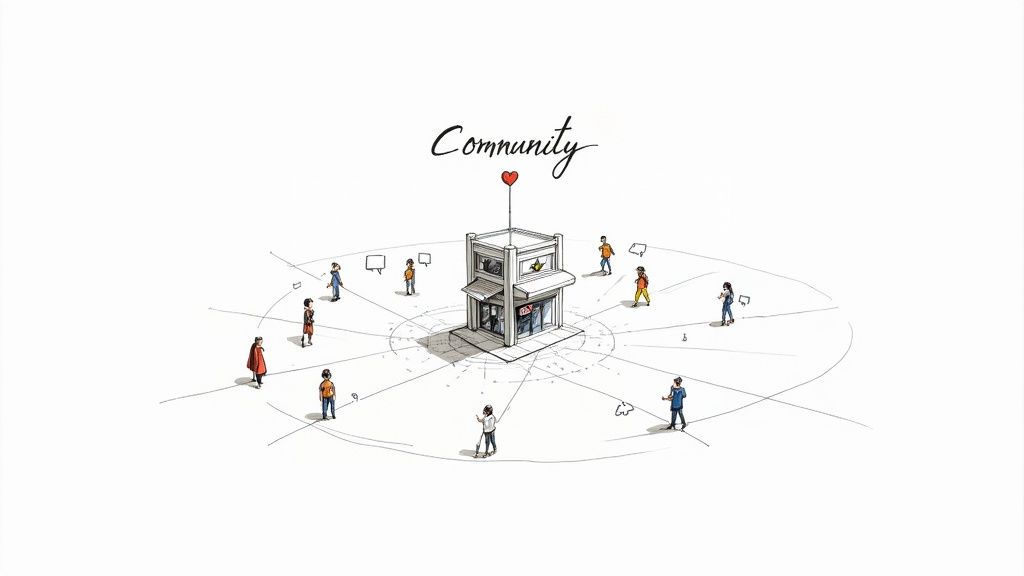
For a long time, the standard social media playbook was pretty simple: treat your channels like a digital megaphone. Brands would blast out promotions and then count likes and followers as a win. True community engagement turns that old model completely upside down. It’s the difference between hosting a lively dinner party and just handing out flyers on a street corner.
One creates real connection; the other is just adding to the noise. In a world with 5.24 billion social media users—that’s 64% of everyone on the planet—just being loud isn't enough. With the average person juggling 6.8 different platforms a month, cutting through the clutter requires a genuine human touch.
A thriving community doesn't just consume your content—it co-creates your brand's story. It's your most powerful source of feedback, advocacy, and long-term loyalty.
This shift changes the questions you ask. Instead of "How many people saw our post?" the focus becomes, "How many meaningful conversations did we start?" This is the very heart of community marketing, a strategy built around nurturing a dedicated group of brand advocates. Dig deeper into what that means here: https://replymer.com/blog/what-is-community-marketing.
The Shift From Broadcasting to Community Building
The evolution from shouting at an audience to building a community with them is a fundamental change in mindset and tactics. Here’s a quick breakdown of what that looks like in practice.
| Aspect | Traditional Broadcasting | Community Engagement Model |
|---|---|---|
| Primary Goal | Maximize reach and impressions. | Build trust and relationships. |
| Communication Flow | One-way: Brand to Audience. | Two-way and multi-way conversations. |
| Key Metrics | Likes, followers, shares. | Comments, sentiment, user-generated content. |
| Audience Role | Passive consumers of content. | Active participants and co-creators. |
| Brand Voice | Corporate and polished. | Authentic, human, and conversational. |
| Desired Outcome | Short-term sales and brand awareness. | Long-term loyalty and customer advocacy. |
Ultimately, this shift is about seeing the people behind the profiles and investing in relationships that grow over time.
The Business Case for Real Connection
Putting real effort into engagement isn't just a nice-to-have; it’s a smart business move that pays off in very real ways. When you cultivate a strong community, you start to see tangible benefits that go straight to your bottom line.
- Boosted Brand Loyalty: People who feel like they belong are far more likely to stick around. They become the repeat customers who trust what you have to say.
- Priceless Customer Insights: A truly engaged community is your best focus group. They’ll tell you exactly what they love, what isn’t working, and what they wish you’d create next.
- Authentic Word-of-Mouth: A happy community member is the most credible salesperson you’ll ever have. Their genuine recommendations are more powerful than any ad you could run.
- Increased Brand Visibility: When people in your community actively share and talk about your content, their networks take notice. This amplifies your reach and builds powerful social proof without you spending a dime.
If you're interested in going further into the discipline of building and nurturing these online spaces, you might find value in exploring the principles of mastering social media community management.
At the end of the day, social media community engagement is about treating your followers like people, not just numbers on a dashboard. It’s a long-term investment in relationships that create lasting trust, loyalty, and sustainable growth for your brand.
The Four Pillars of an Unbeatable Engagement Strategy
A great social media community doesn't happen by accident. It's built, piece by piece, on a solid strategic foundation. When you get down to it, building genuine social media community engagement isn't about chasing viral trends or using clever hacks. It’s about having a repeatable framework that works.
This framework stands on four key pillars: Listening, Responding, Creating, and Empowering.
Think of it like hosting a great dinner party. Listening is like asking about dietary restrictions before you plan the menu. Responding is greeting guests at the door and making them feel welcome. Creating is cooking a meal everyone will be talking about for weeks. And Empowering? That's when your guests feel so at home they start helping clear the table and share stories with each other.
Pillar 1: Listen Actively to the Conversation
Before you can add anything meaningful to a conversation, you have to know what people are actually talking about. This seems obvious, but it’s the most overlooked part of any engagement strategy. Active listening is so much more than just keeping an eye on your @mentions.
To really listen, you need to tune into three different frequencies:
- Brand Conversations: This is your home base—keeping track of direct mentions of your company, your products, and even your key team members. It’s the bare minimum.
- Industry Chatter: This is where you zoom out. What are the hot topics, keywords, and frustrations in your entire industry? You need to know what problems people are trying to solve, even if they've never heard of your brand.
- Audience Sentiment: This is about reading the room. What’s the emotional tone of the conversation? Are people excited? Frustrated? Confused? This emotional subtext is where you'll find the best opportunities to connect.
Skipping this step is like walking into a room and just shouting your sales pitch. You won't make any friends, and you certainly won't build a community.
Pillar 2: Respond Authentically and Quickly
Once you're tuned in, it's time to join the conversation. But how you respond matters just as much as if you respond. The speed and quality of your replies are what separate real engagement from a corporate box-ticking exercise. A slow or robotic answer can often be worse than no answer at all.
This is your chance to show there are real people behind the logo. It’s about making someone feel seen and heard. This is exactly where brands that prioritize authentic dialogue—like those that use a service like Replymer—really pull ahead, because they’re all about human-crafted replies, not soulless, automated messages.
A timely, empathetic response can turn a frustrated user into a lifelong advocate. It shows you're not just a brand shouting into the void; you're a partner who's invested in your customers' success.
Pillar 3: Create Content That Sparks Discussion
Now that you have a deep understanding of what your community needs and you're committed to genuine interaction, you can start creating content that actually hits home. The goal isn't just to post updates; it's to start conversations.
Great community-focused content usually does one of three things:
- Educates: Solves a specific problem or teaches a skill your audience actually wants.
- Entertains: Gives people a moment of joy, humor, or inspiration in their feed.
- Engages: Directly asks for opinions, feedback, or personal stories.
This pillar is all about adding value, not just noise. Every single post should be a potential conversation starter. So instead of just announcing a new product feature, ask your community how they’d use it to tackle a real-world problem.
Pillar 4: Empower Your Community to Lead
This last pillar is where the magic really kicks in. It’s the shift from a brand-led audience to a member-led community. Empowering your audience means giving them the tools, recognition, and platform to become advocates and co-creators.
This is how you go from counting followers to building real influence and loyalty. You can empower your community by turning passive followers into active champions with a few key moves.
- Promote User-Generated Content (UGC): Actively search for and celebrate the content your members are already creating. Make them the hero.
- Build Ambassador Programs: Formally recognize and reward your most passionate fans. Give them a special status and inside access.
- Create Exclusive Spaces: Set up dedicated forums, Slack channels, or Facebook Groups where your best members can connect with each other and your team.
When you truly empower your community, you create a self-sustaining ecosystem. Members start supporting each other, advocating for your brand on their own, and driving the conversation forward. That’s the ultimate goal: building a brand that people don't just buy from, but feel like they belong to.
How to Measure Engagement That Actually Matters
Counting likes and followers is a classic rookie mistake. It's like judging a restaurant by how many people walk past the window—it tells you nothing about who actually came in, loved the food, and plans to come back. To get a real read on your social media community engagement, you have to look past those surface-level vanity metrics and dig into the numbers that signal genuine connection.
Effective measurement isn’t about drowning in data. It’s about being selective and focusing on the Key Performance Indicators (KPIs) that actually line up with your business goals. Think of these KPIs as your compass; they tell you if your strategy is on track and give you the hard evidence you need to prove its value.
We can break these metrics down into a simple hierarchy that shows how engagement deepens over time. It all starts with listening.
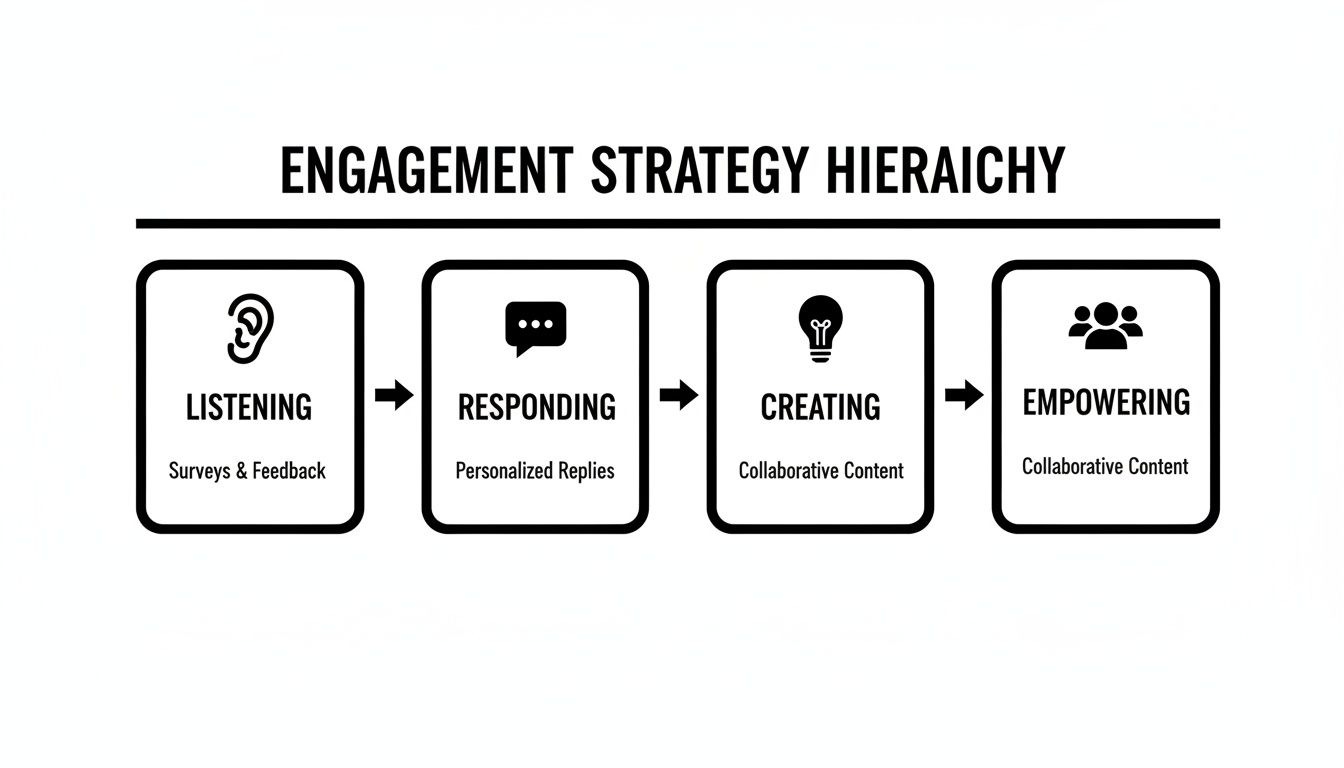
This pyramid makes it clear: a rock-solid engagement strategy is built on a foundation of listening. What you hear informs how you respond, what you create, and, eventually, how you empower your community to advocate for you.
Essential Social Media Community Engagement KPIs
So, what should you actually be tracking? The KPIs below offer a clear picture of your community's health, from initial awareness to deep-seated loyalty. This table breaks down the most critical metrics, what they measure, and why they're so important for understanding your performance.
| Metric | What It Measures | Why It's Important |
|---|---|---|
| Reach | The total number of unique people who see your content. | It shows the potential size of your audience and the effectiveness of your content distribution. |
| Impressions | The total number of times your content is displayed on screen. | This helps you understand content visibility, though it doesn't confirm it was actually viewed. |
| Engagement Rate | The percentage of your audience that interacts (likes, comments, shares) with a post. | This is the gold standard for measuring how well your content resonates with your audience. |
| Amplification Rate | The rate at which your followers share your content with their own networks. | It proves your content is valuable enough for people to stake their own reputation on it. |
| Sentiment Score | The emotional tone (positive, negative, neutral) of comments and brand mentions. | A high positive score is a powerful indicator of brand health and customer satisfaction. |
| UGC Volume | The amount of content created by users that features your brand. | This is the ultimate sign of advocacy, showing that your community has become your storyteller. |
By tracking these specific KPIs, you move beyond just counting likes and start measuring the real, tangible impact of your community-building efforts.
Awareness Metrics: Are People Seeing You?
At the very top of the funnel, awareness metrics tell you how many eyeballs are on your content and how far your message is spreading. While they don't signal deep connection, they're the essential first step. You can't engage an audience that doesn't know you exist.
- Reach: This is your unique audience. Think of it as the number of individual people your post landed in front of.
- Impressions: This is the total number of times your content was shown. One person could see the same post multiple times, counting for multiple impressions.
Big reach and impression numbers are great—it means the platform's algorithm is working in your favor. But it's just the start of the story.
Consideration Metrics: Are They Paying Attention?
This is where the real magic begins. Consideration metrics track how many people are actually interacting with your content. They’ve gone from passively scrolling to actively participating.
The king of all KPIs here is the Engagement Rate. It’s the clearest signal that your content hit the mark. The basic formula is:
(Total Likes + Comments + Shares) / Total Followers x 100 = Engagement Rate
A strong engagement rate proves your content was compelling enough to stop the scroll and earn a click. What’s considered "good" really depends on the platform—averages hover around 0.5% on Instagram and can jump to 2.5% on TikTok. To get a precise read on your own performance, you can use an Instagram engagement calculator to see how you stack up.
Another powerful metric is the Amplification Rate, which tracks how often your followers share your content. This is huge. It means people found your post so valuable, they were willing to share it with their own friends and family.
Loyalty Metrics: Have You Built True Fans?
Loyalty metrics are the ultimate proof that you’ve built a thriving community, not just a following. These numbers show you’ve created a genuine bond, turning casual followers into passionate brand advocates.
- Sentiment Score: This goes beyond numbers to analyze the feeling behind the comments and mentions. Is the conversation about your brand positive, negative, or just neutral? A consistently high positive sentiment is a massive win.
- User-Generated Content (UGC) Volume: This tracks how many people are creating their own posts that feature your brand. When your community members start telling your story for you, you’ve reached the pinnacle of trust.
By focusing on this tiered approach to measurement, you can build a dashboard that ties social media activity directly to real business outcomes. For a deeper dive, check out our complete guide on https://replymer.com/blog/how-to-measure-social-media-engagement. This method helps you make smarter decisions and finally prove the undeniable ROI of building a strong, engaged community.
Winning Engagement Tactics for Every Major Platform
Great social media engagement is never a one-size-fits-all game. Every platform has its own unwritten rules, its own culture, and its own algorithm quirks. A generic strategy is like trying to speak the same language in five different countries—you might be understood, but you'll never truly connect.
To build real relationships, you have to speak the native language of each network. That means tailoring your approach to fit the environment, making sure every interaction feels natural and valuable. A brand that gets it knows that what crushes it on LinkedIn will almost certainly fall flat on TikTok.
Mastering Instagram for Visual Connection
Instagram is all about visuals and quick, interactive engagement. The secret is to lean into the features that invite people to participate with a simple tap.
- Spark Conversations with Stories: Don't just post, interact. Use stickers like Polls, Quizzes, and Question boxes in your Stories. They're super low-effort for your followers but give you a direct line to their thoughts and ideas.
- Encourage User-Generated Content (UGC): Create a brand hashtag people actually want to use. When they post about your product, feature the best content on your feed or in your Stories. It’s a powerful way to make your community feel seen and celebrated.
- Go Live for Real-Time Interaction: Hosting an Instagram Live for a Q&A session or a behind-the-scenes look creates an "in the moment" vibe that's hard to replicate. It's unscripted, direct, and builds powerful connections with your audience.
Building Niche Communities with Facebook Groups
The main Facebook feed is noisy, but Facebook Groups are where you can build a truly dedicated community. This is the place your biggest fans can gather to connect with each other and with your team directly.
Think of your Facebook Group as your brand’s exclusive clubhouse. It’s a space for deeper conversations and stronger relationships than you can build on a public page.
Inside your group, you can drop exclusive content, run member-only polls, and ask for honest feedback on new products. Since people actively chose to be there, they're far more invested and ready to participate in meaningful discussions.
Establishing Authority on LinkedIn
LinkedIn is the go-to platform for B2B, and the name of the game is thought leadership and professional credibility. Forget viral trends; here, it’s all about providing genuine, industry-specific value.
Your focus should be on contributing to conversations, not just starting them. This means dropping insightful, well-thought-out comments on posts from others in your field. Seriously, one great comment that adds real value to a discussion can often be more powerful than your own post.
Share in-depth articles, interesting case studies, and sharp analysis of industry news. The goal is to become a resource, not just another promoter.
Driving Real-Time Dialogue on X (Twitter)
X (what we all still call Twitter) thrives on speed and wit. It’s the digital water cooler where news breaks and conversations happen in real time. Winning on X is all about being present, being quick, and having a personality.
To get ahead, you have to be part of the conversation. That means monitoring keywords and hashtags in your niche and jumping into discussions where you can offer a helpful tip or a unique perspective. Don’t just tweet into the void—reply, engage, and become part of the dialogue.
Participating Authentically on TikTok and Reddit
Platforms like TikTok and Reddit are powered by user trends, very specific subcultures, and a sharp radar for anything that feels inauthentic. A hard-sell approach here is a recipe for disaster.
- TikTok: Success on TikTok isn't about running ads; it’s about participating in the culture. Use features like Duets and Stitches to react to or build on what other creators are doing. It shows you "get" the platform and you're there to be part of the fun.
- Reddit: This platform is a massive collection of niche communities, or subreddits, each with its own strict rules and etiquette. The only way in is to provide value first, full stop. For a deep dive on doing this right, our Reddit marketing strategy guide is a complete playbook for building trust and getting results.
By tweaking your tactics for the unique culture of each platform, you’ll build a far more effective engagement strategy—one that creates real brand loyalty that lasts.
Common Engagement Mistakes and How to Dodge Them

Even with the best of intentions, it's easy to trip up on social media. Building a real community is a delicate dance, and a few common missteps can undo all your hard work, leaving your audience feeling unheard or, even worse, just another lead in your sales funnel.
Knowing what not to do is just as important as knowing what to do. If you can learn to sidestep these common pitfalls, you’ll protect the trust you’ve earned and create a space where genuine connections can actually happen.
Mistake 1: The Generic Robot Reply
Nothing kills a conversation faster than a canned, soulless response. A customer takes the time to write a thoughtful comment, and all they get back is a "Thanks for your feedback!" It basically screams, "We're not really listening." This approach turns engagement into a chore—a box to be checked off a list instead of a relationship to build.
These robotic replies have zero personality and completely ignore the specific point the person was trying to make. It’s a huge missed opportunity to make someone feel seen and valued.
A human-crafted reply acknowledges the individual, references their specific comment, and adds to the conversation. It’s the difference between a form letter and a personal note—one gets tossed, the other builds a relationship.
This is exactly why a service like Replymer exists. It’s built on the idea that every interaction should be handled by a real person who gets the nuances of the conversation, turning a simple comment into a powerful moment of connection.
Mistake 2: Ignoring or Deleting Negative Feedback
Look, nobody likes criticism. The knee-jerk reaction is often to sweep negative comments under the rug, but deleting bad feedback or ignoring unhappy customers is a massive mistake. Not only does it infuriate the person who left the comment, but it also signals to everyone else watching that you can't handle honest dialogue. Hiding from problems doesn't solve them; it just puts them under a microscope.
Instead of running from negativity, see it as a gift. A complaint is your chance to show off incredible customer service, prove you’re listening, and maybe even turn a disappointed customer into a loyal fan. After all, 86% of social media managers agree that building community is vital, and handling tough feedback with grace is a huge part of that.
- What Not to Do: Deleting a comment that says, "Your new feature is confusing and broke my workflow."
- What to Do Instead: Replying publicly with something like, "So sorry to hear you're running into trouble, and we really appreciate you letting us know. Can you shoot us a DM with the details? Our team wants to get this sorted out for you."
This simple act validates their frustration and takes the nitty-gritty of troubleshooting offline, all while showing the public that you take feedback to heart.
Mistake 3: Being Overly Promotional
Your social media page isn't just a digital billboard. If every single post is a hard sell, you’re not building a community—you're running a 24/7 infomercial. People are on social media to connect and learn, not to be pitched to constantly. This kind of relentless self-promotion leads to tune-out, fatigue, and a steady stream of unfollows.
Great community engagement is all about the "give, give, give, ask" philosophy. You have to provide value—whether it's through helpful tips, entertaining content, or behind-the-scenes stories—way more often than you ask for a sale. This builds up trust and goodwill, so when you do have something to promote, your audience is actually receptive. Think of it as making deposits in a relationship bank before you ever try to make a withdrawal.
Frequently Asked Questions About Community Engagement
Even with a solid plan, questions always pop up once you get into the trenches of social media community engagement. Building real relationships is more art than science, and every brand's path is a little different. This section tackles the common hurdles and questions we hear all the time from teams just like yours.
Think of this as your field guide for the day-to-day realities of building a community that actually cares.
How Long Does It Take to See Real Results?
This is the big one, isn't it? The honest answer requires a bit of a mindset shift. You're not flipping a switch; you're growing a garden. It takes time, consistency, and a whole lot of patience.
You'll probably see some encouraging signs early on—maybe a better response rate to your comments or a warmer tone in conversations within a few weeks. But the real, measurable business impact? That takes longer. We're talking about things like a tangible lift in brand loyalty or a higher customer lifetime value, which usually start to show up after 3-6 months of consistent, quality effort.
The trick is to focus on the small wins. Every single positive interaction builds on the last, creating the momentum that leads to lasting brand advocacy and growth.
Social Media Management vs. Community Engagement
It’s so easy to lump these two together, but they’re fundamentally different roles with very different goals. Getting this right is key to setting your team up for success.
I love using an event analogy to explain it:
A social media manager is the event planner. They book the venue, design the invitations, and make sure the whole thing runs on schedule. The community engagement specialist is the host who works the room—making introductions, sparking conversations, and ensuring every single guest feels seen and valued.
So, social media management is about the broad logistics of your presence: planning content, scheduling posts, and analyzing performance. Community engagement is the deep work of building human-to-human relationships and fostering a true sense of belonging.
How Can a Small Business Manage Engagement Effectively?
If you're a small business owner or a one-person marketing team, the thought of managing engagement can feel completely overwhelming. But here's the good news: you don't have to be everywhere. In fact, trying to be is a fast track to burnout.
Your superpower here is focus. Use these tips to make a real impact, even with limited resources:
- Pick Your Platforms Wisely: Don't stretch yourself thin. Find the one or two channels where your ideal customers actually hang out and pour your energy into those.
- Time-Block Your Engagement: You don't have to be glued to your phone 24/7. Set aside dedicated time blocks each day—even just 20-30 minutes—where your only job is to interact with your community.
- Prioritize Quality Over Quantity: One thoughtful, personalized reply is worth a hundred generic "Thanks!" comments. Aim for a few truly meaningful conversations a day.
By being strategic and intentional, even the smallest brands can build incredibly powerful communities that drive their business forward.
Should I Use AI or a Human for Comment Replies?
This AI vs. human debate is everywhere right now, but it's the wrong way to look at it. The best strategy isn't an either/or choice; it's a smart partnership where each plays to its strengths. Think of it as a human-AI collaboration.
Here’s how you can strike the right balance:
- Let AI Handle the Simple Stuff: Use AI-powered tools as your first line of defense. They can filter mentions, answer repetitive FAQ-style questions, and flag high-priority comments that need a human touch, fast.
- Deploy Humans for the High-Touch Moments: Save your team’s brainpower for the interactions that really count. This means handling nuanced customer problems, jumping into complex industry chats, and injecting real personality into your conversations.
AI gives you the scale to make sure nothing slips through the cracks. But it’s the human touch—the empathy, the wit, the genuine understanding—that actually builds the relationship. That's the entire philosophy behind services that use real people for social replies; they know that while tech can assist, only a human can truly connect.
Ready to turn social conversations into customers without sacrificing authenticity? Replymer uses real, human writers to monitor keywords on Reddit, X, and LinkedIn, find high-quality opportunities, and craft authentic replies that build trust and drive demand. Set it up once and grow on autopilot at https://replymer.com.


