Trying to find the right social media monitoring tool can feel overwhelming. A quick look shows that the best choice really boils down to what you're trying to accomplish. If you need a single platform for everything from publishing to deep-dive analytics, a comprehensive suite like Sprout Social or Meltwater makes sense. But if your main goal is just to catch brand mentions and find new leads, a more focused tool like Brand24 or Awario is probably a better fit. It all depends on whether you're looking for a tool for daily engagement or something to power bigger strategic decisions.
Why Social Media Monitoring Is Essential for Brand Growth
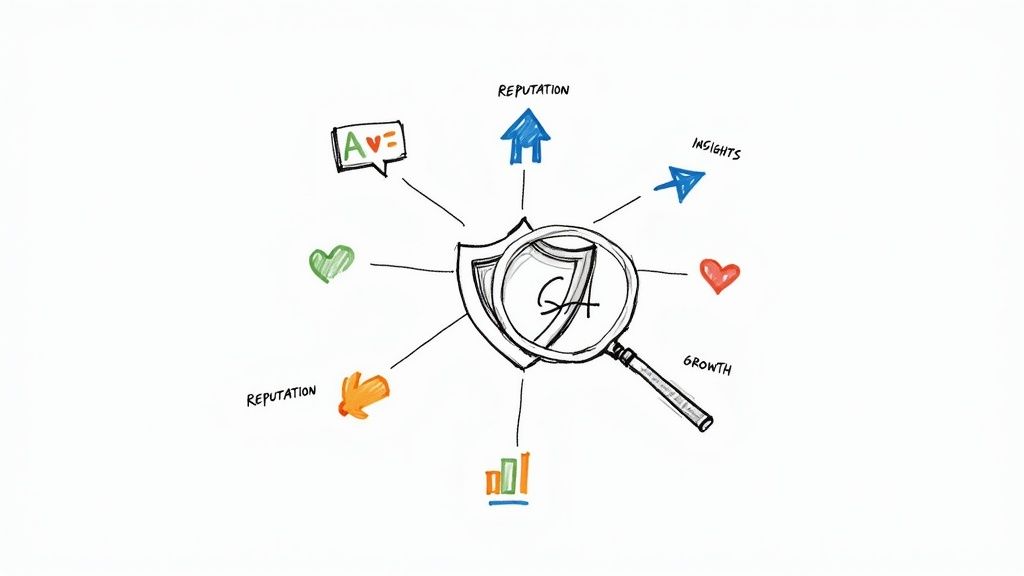
With millions of conversations happening online every second, knowing what people are saying about your brand isn't just a nice-to-have anymore. It’s fundamental to staying relevant and growing your business. Social media monitoring goes way beyond just checking your notifications; it’s about sifting through all that public chatter and finding the data that gives you a real competitive edge. Think of it as both a shield and a sword for your brand.
It's a shield because it helps you catch negative comments or spot a potential crisis before it spirals out of control, protecting your hard-earned reputation. It’s a sword because it lets you proactively see what your competitors are up to, spot sales opportunities in real-time, and get an honest read on what your customers actually want. Trying to do this without a dedicated tool is like walking into a maze blindfolded.
The Shift from Optional to Indispensable
The market growth for these tools tells the whole story. Valued at roughly USD 5.7 billion in 2025, the global media monitoring market is expected to explode to an estimated USD 13.8 billion by 2034. This isn’t just a trend; it's a direct response to the urgent need for brands to manage their presence across an ever-growing number of platforms.
This rapid expansion points to one simple fact: manually tracking mentions is no longer feasible. You need specialized software to process the sheer volume of conversations and pull out the patterns that matter. For a closer look at the benefits, check out our guide on the advantages of social media monitoring.
The real power of monitoring lies in its ability to transform unstructured social chatter into structured business intelligence. It’s the difference between hearing noise and understanding a conversation.
Core Benefits of a Dedicated Monitoring Strategy
Putting a proper tool in place opens up several key functions that are nearly impossible to manage by hand. These benefits are the bedrock of any modern, responsive brand. To get the most out of them, it helps to understand the broader principles of effective social media marketing strategies.
- Real-Time Reputation Management: Instantly spot and respond to customer complaints or negative feedback before they gain traction, protecting brand trust.
- Competitor Intelligence: Get a clear, unbiased picture of your competitors' campaigns, customer sentiment, and market positioning.
- Customer Insight Discovery: Uncover what your audience truly thinks about your products, services, and marketing—straight from the source.
How to Define Your Monitoring Goals Before Choosing a Tool
Jumping into a social media monitoring tool comparison without a clear strategy is a recipe for disaster. The best software isn't about having the most features; it’s about having the right features that actually solve your problems. Before you even think about looking at a pricing page, you need to map out what success looks like for your business.
Taking the time for this self-assessment gives you a focused checklist. It’s the difference between picking a tool that fits your unique needs and overpaying for a bunch of capabilities you’ll never touch. Without clear goals, you’re just guessing.
Identify Your Primary Objective
First things first: what is the single most important outcome you need from this tool? Your answer here will immediately shrink the overwhelming list of options down to a manageable few. While most tools wear many hats, they almost always have one thing they do exceptionally well.
Start by picking your main driver:
- Brand Reputation & Crisis Management: Is your top priority catching negative comments and potential PR fires before they spread? If so, you need a tool with lightning-fast, real-time alerts and highly accurate sentiment analysis.
- Lead Generation & Social Selling: Are you hunting for buying signals, questions about your industry, or complaints about competitors? This requires powerful keyword and Boolean search functions that can sift through the noise.
- Competitive Analysis: Maybe your main goal is to keep tabs on your rivals' campaigns, share of voice, and customer feedback. You'll want a platform built for strong competitor benchmarking and reporting.
- Customer Service: Do you need to find and respond to customer questions and support issues across a dozen different channels? A tool with a unified social inbox is non-negotiable.
Choosing a primary goal doesn't mean you can't have secondary ones. It simply forces you to prioritize what's mission-critical, ensuring the tool you pick is a perfect match for your most important job.
Determine Your Data Depth and Reporting Needs
Once you know why you're monitoring, you need to figure out how you'll use the data. Are you looking for instant notifications or deep-dive monthly insights? The answer will dictate the complexity—and the cost—of the tool you should be looking at. This step is crucial for building a useful social media analytics dashboard.
This decision is more important than ever. The social media monitoring market in North America alone was valued at USD 1.94 billion in 2024 and it's still climbing. Businesses are pouring money into these platforms to sharpen their marketing and get closer to their customers, as highlighted in this North American market trends report.
Think about who on your team needs what. A community manager might need live alerts pinging them all day to handle customer issues on the fly. A marketing director, on the other hand, might just need a high-level report on brand sentiment once a month. Matching the tool’s reporting capabilities to your team’s actual workflow is key to avoiding data overload.
A Real-World Comparison of the Top Monitoring Platforms
Picking the right social media monitoring tool isn't about finding the "best" one on the market. It's about finding the one whose strengths match exactly what you need to do. A lot of these tools look similar on the surface, but the small differences in where they pull data from, how smart their analysis is, and how they send alerts can make or break your team's success.
This isn't just another feature list. We're going to dig into the real differences between the enterprise-level powerhouses and the more nimble, focused platforms. You'll see the trade-offs in data coverage, sentiment accuracy, and reporting, so you can make a call that fits your workflow.
H3: Data Coverage and Source Depth
A tool is only as good as the data it sees. The breadth and depth of its sources determine whether you’re getting the full picture or just a tiny, skewed snapshot. This is where you see the biggest split between the major players.
For All-Encompassing, Enterprise-Level Reach:
Platforms like Brandwatch and Talkwalker are built to find everything. They go way beyond the main social networks, pulling from a massive index of sources:
- Global News: Millions of articles from major outlets and niche publications.
- Forums & Message Boards: Deep dives into communities like Reddit, Quora, and thousands of industry-specific forums.
- Blogs & Review Sites: Commentary from individual creators and consumer review platforms.
- Broadcast Media: Transcripts from TV and radio, giving you a complete media picture.
Sprinklr also offers massive coverage, but its secret weapon is how it mixes in your own first-party customer data. It lets you overlay social chatter with direct feedback from surveys, support tickets, and other internal channels to create one unified view of the customer.
For Focused, Mainstream Monitoring:
On the other hand, a tool like Mention focuses on the channels that matter most to the majority of businesses—the big social networks, major blogs, and key news sites. It might not crawl the deepest corners of the web, but its focused approach gives you highly relevant data for day-to-day brand tracking without the overwhelming complexity of an enterprise platform.
For Buyer-Intent Lead Capture: A newer class of tool skips broad brand tracking entirely and optimizes for pipeline. HotMention monitors Reddit, X, LinkedIn, Threads, Quora and YouTube and scores every mention from 0 to 100 for buyer intent, so instead of a firehose you get a ranked short list of people close to buying — each with a Reply, Careful or Skip verdict and an AI draft in your brand voice. Alerts hit email, Slack or Telegram in real time, and it starts free. For founders hunting leads rather than tracking sentiment, it is often the fastest path from mention to customer.
The right tool often comes down to your primary goal, whether that's managing a crisis or hunting for new leads.
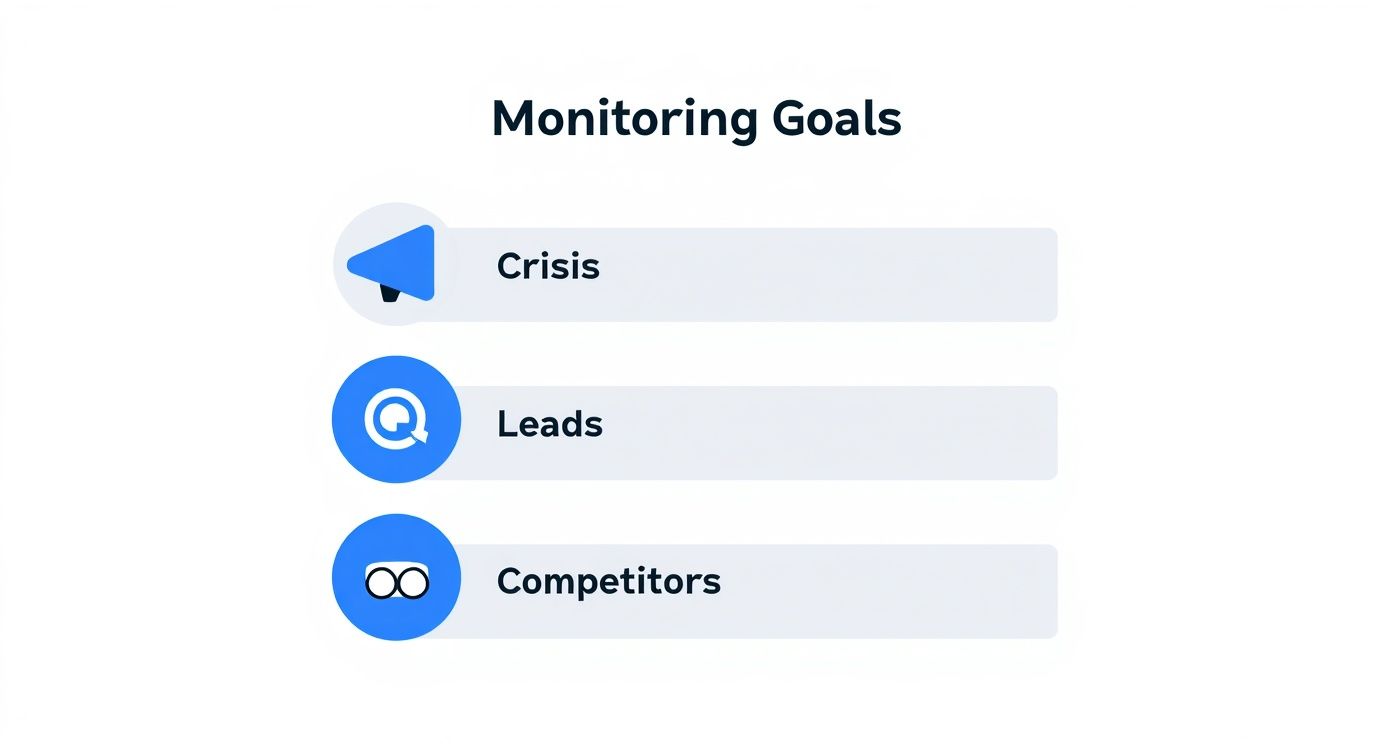
As you can see, the speed needed for crisis detection requires very different capabilities than the strategic patience of competitor research.
H3: Feature Comparison Across Top Social Media Monitoring Tools
To make sense of the key differences, here's a side-by-side breakdown. This table helps you quickly see which platforms excel in the areas most important to your business, from data sources to how they handle alerts.
| Feature | Brandwatch | Mention | Sprinklr | Talkwalker |
|---|---|---|---|---|
| Primary Use Case | Deep consumer intelligence, market research, brand health. | Real-time brand monitoring, competitor tracking for SMBs/agencies. | Unified customer experience management (CXM), enterprise-level social care. | PR, crisis management, deep conversation analysis. |
| Data Sources | Exhaustive: Social, news, blogs, forums, reviews, broadcast, image/video. | Focused: Major social networks, key news sites, blogs, forums. | Extensive: Social, news, blogs, plus first-party data (surveys, support). | Exhaustive: Social, news, blogs, forums, broadcast, print, image/video. |
| Sentiment Analysis | Highly accurate, customizable AI models. | Solid out-of-the-box accuracy, good for general brand health. | Powerful AI contextualized with customer journey data. | Industry-leading accuracy with predictive analytics and customizable rules. |
| Alerting System | "Spike Alerts" for sudden increases in mention volume. | Near-instant alerts for keyword mentions, great for community management. | Integrated with case management and workflow automation. | Predictive alerts to identify trends before they peak. |
| Reporting & Dashboards | Vizia platform for stunning, C-suite-ready data visualizations. | Clean, simple, and fast PDF reports for quick updates. | Vast library of role-specific dashboards, reports on the full customer journey. | Highly flexible and customizable for deep data analysis. |
| Ideal for... | Global brands, market research teams, large enterprises. | SMBs, marketing agencies, community managers. | Large corporations with complex customer service and marketing operations. | PR agencies, communications teams, large enterprises focused on reputation. |
This comparison highlights a clear divide: enterprise tools like Brandwatch, Sprinklr, and Talkwalker offer immense depth and customization, while a tool like Mention provides speed and simplicity for more focused, day-to-day monitoring tasks.
H3: Accuracy of AI-Driven Sentiment Analysis
It's one thing to flag a mention as positive or negative. It's another thing entirely for an AI to understand sarcasm, irony, or industry-specific slang. A tool that gets sentiment wrong can send you running in completely the wrong direction.
Talkwalker and Brandwatch pour a ton of resources into their proprietary AI, and it shows. They deliver some of the most reliable sentiment analysis you can get. Crucially, they let you create custom rules to teach the AI the unique language of your industry, which dramatically cuts down on errors. A gaming company, for instance, could teach its model that "insane" or "sick" are high praise, not negative comments.
The ability to customize sentiment models is what separates the big leagues from the rest. You move from generic analysis to insights that actually reflect how your specific audience talks.
Sprinklr's AI has a huge advantage because it learns from a massive dataset of actual customer interactions. This gives it powerful context for understanding the emotion behind support tickets and product feedback.
Mention gives you solid, ready-to-go sentiment analysis that’s accurate enough for most everyday conversations. It doesn't have the deep customization of the enterprise giants, but it’s more than enough for teams that just need a reliable pulse on general brand health. It's a great choice if you need more power than basic tools but want to avoid enterprise-level complexity. For a deeper look at your options, check out our guide to powerful alternatives to Google Alerts.
H3: Real-Time Alerting and Customization
When a crisis is brewing, every second counts. A five-minute delay versus an hour-long one can be the difference between a minor issue and a full-blown PR disaster. This is where alerting systems really show their value.
Brandwatch has a feature called "Spike Alerts," which is brilliant. It doesn't just ping you when a keyword is mentioned; it alerts you when the volume of mentions suddenly explodes. This is exactly what you need to spot viral content or an emerging crisis before it hits the evening news.
Talkwalker is all about proactive alerts. Its system is designed to notify you of potential trends before they peak, helping you get ahead of the conversation instead of just reacting to it.
Mention is built for speed and simplicity. It delivers highly reliable, near-instant alerts for your keywords, making it perfect for community managers who need to jump on individual customer comments right away.
Sprinklr’s alerts are woven directly into its workflow tools. An alert can automatically create a support ticket, assign it to the right person, and escalate it based on rules you set. It's an ideal setup for large-scale customer service teams.
H3: Reporting Dashboards and Flexibility
Data is just noise until you can visualize it and share it with people who can act on it. A great reporting dashboard needs to be both powerful and easy to use, letting you build custom reports that answer specific business questions.
Brandwatch’s Vizia platform is a market leader for a reason. It lets you create stunning, shareable dashboards that look great on big screens in an office. It’s built for presenting insights to executives in a way that’s clear and compelling.
Talkwalker also has incredibly robust and customizable dashboards. It’s a data analyst's dream, perfect for slicing and dicing information for deep market research or complex competitive analysis.
Sprinklr comes with a huge library of pre-built dashboards for specific roles, from social media managers to product marketers. Its real strength is reporting on metrics across the entire customer journey, not just social media. To see more tools with strong monitoring capabilities, take a look at these top online reputation management software tools.
Mention offers clean, easy-to-read reports that are perfect for sharing key metrics like mention volume, reach, and sentiment. You can spin up a professional-looking PDF report in minutes, which is a lifesaver for agencies and marketers who need to provide regular updates without spending hours on it. The market is definitely growing; by 2030, global spending on media monitoring tools is expected to top USD 12 billion. With social media monitoring already making up 28% of that in 2024, these reporting features are only going to become more important.
Matching the Right Tool to Your Business Scenario
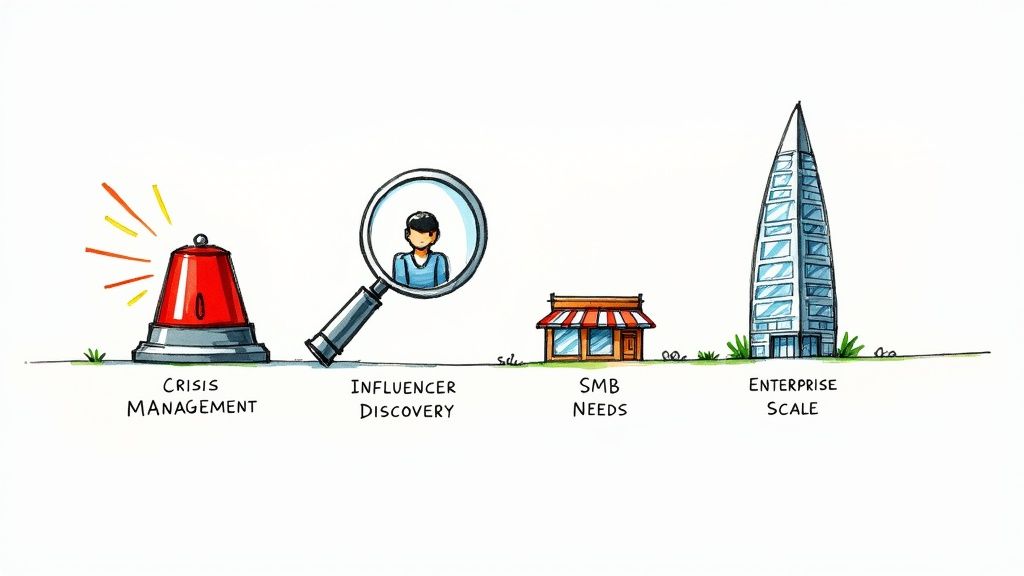
Breaking down features is one thing, but the real test is how a tool performs when you actually need it. The best platform for a global enterprise putting out a PR fire is almost never the right choice for a small business just trying to see what locals are saying about them. The key to this social media monitoring tools comparison is matching a tool’s core strengths to your specific, day-to-day needs.
Let's move past the theory and look at how these platforms would fit into your workflow. Here are a few common business situations and my take on which tools are best equipped for the job.
Scenario 1: Crisis Management and Reputation Defense
When a negative story starts catching fire or customer complaints suddenly flood your feed, you need a tool built for one thing: immediate action. The most critical feature here isn't a pretty dashboard; it's an alert system that can spot trouble long before it becomes a full-blown crisis.
For this job, platforms like Talkwalker and Brandwatch are in a league of their own. Their alerting systems are smart enough to go beyond simple keyword flags. They’re designed to identify sudden spikes in conversation volume and sharp turns toward negative sentiment. Talkwalker's predictive alerts can even give you a heads-up on a trend before it peaks, buying your team precious time to get ahead of the story.
In crisis management, the goal isn't just to see the fire; it's to see the smoke. An enterprise-level tool with "spike alerts" gives you the early warning system needed to respond effectively, not just reactively.
These tools also provide the depth you need to understand what's really happening. You can quickly see who is driving the conversation, where it's spreading, and what the emotional tone is. That’s the kind of intelligence you need to craft a response that actually works.
Scenario 2: Identifying and Engaging Micro-Influencers
Finding the right influencers means digging much deeper than follower counts. You're looking for real advocates who have an authentic connection with their audience and are already talking about things that matter to your brand. This requires some serious audience analytics and conversation tracking.
While plenty of tools can find big accounts, a platform like Brandwatch really shines here because of its deep audience intelligence. It lets you:
- Analyze audience demographics: Get a clear picture of an influencer’s followers—their age, location, and interests—to make sure they line up with your target customer.
- Track conversational history: See if an influencer has organically mentioned your industry or competitors before. This is a huge indicator of genuine interest.
- Identify passion topics: Pinpoint the subjects where an influencer is a true authority, not just a paid mouthpiece.
This level of detail helps you find those perfect micro-influencers whose endorsement will feel natural and credible. It’s about finding the right voice, not just the loudest one. The result is almost always higher engagement than you’d get from a generic post by a mega-influencer.
Scenario 3: Small Business Brand Tracking
If you run a small or medium-sized business (SMB) and are just dipping your toes into brand monitoring, your needs are totally different. You don’t need a tool that can process a billion data points; you need something intuitive and affordable that gives you clear, actionable insights without a six-week training course.
In this case, tools like Mention or Brand24 are fantastic choices. They do a solid job of monitoring the channels that matter most—major social networks, blogs, and news sites—for a fraction of the cost. Their dashboards are clean and simple to use, making it easy to track your mentions, see how people are feeling, and spot your most vocal supporters.
These platforms are built for efficiency. You can have alerts up and running in minutes and pull simple reports that give you a quick health check on your brand. For an SMB, this focused approach delivers 80% of the value for 20% of the cost and complexity. It’s the perfect starting point for building a monitoring strategy while still having time to actually run your business.
When Does Automation Miss the Mark?
Automated monitoring tools are fantastic for casting a wide net and pulling in massive amounts of data. Their ability to track keywords and gauge sentiment across the web is unmatched. But that incredible scale is also their biggest blind spot. Software is great at collecting, but it often fails to connect the dots.
The real money isn't just in finding a mention; it's in understanding the human context behind it. Even the smartest AI stumbles here. It might see a tweet like, "Ugh, is there a better alternative to X for project management?" and flag it as a simple question.
A person, on the other hand, immediately recognizes this for what it is: a frustrated user actively looking to switch products. That’s a hot lead. This is where automation falls short—it’s programmed to see keywords, not intent.
The gap widens when your goal is to actually join these conversations. Software can't replicate the empathy, wit, or personal touch of a real person. Trying to automate genuine engagement often does more harm than good.
When a Human Touch is Non-Negotiable
Some business goals just can't be outsourced to an algorithm. If you're more focused on building relationships and driving sales than just collecting data, it might be time to think beyond software. This is especially true when the quality of your interactions matters more than the quantity.
Think about these situations where a human approach is the only one that works:
- Finding High-Intent Leads: You need someone who can read between the lines. Spotting a potential customer who's fed up with a competitor or asking for recommendations requires a level of nuance that algorithms simply don't have.
- Engaging in Niche Communities: Jumping into a specific subreddit or a technical LinkedIn group has rules, both written and unwritten. A person knows how to offer helpful advice without coming off as a pushy salesperson, building credibility first. An automated message just feels like spam.
- Building Real Relationships: Turning casual followers into loyal brand advocates happens one genuine interaction at a time. Automated, generic replies feel cold and can completely undermine the trust you’re working so hard to build.
Automated tools find mentions; human experts find opportunities. The real value isn't in knowing someone mentioned your keyword, but in understanding why and knowing the perfect way to respond.
Bridging the Gap: From Monitoring to Engaging
This is exactly where a service like Replymer fits in. It’s not a replacement for traditional monitoring tools, but a powerful layer on top of them. While a tool gives you the "what," a human-driven service provides the "so what" and "now what."
Instead of just getting an alert that someone mentioned a competitor, a real person crafts a thoughtful, context-aware reply and posts it from a credible account. It turns passive monitoring into an active growth strategy.
For example, a SaaS company could use this to find developers complaining about a rival's clunky API. A human expert can then jump into that conversation, offer a genuinely helpful tip, and subtly introduce a better solution. That's how you generate real demand.
Ultimately, this isn't an "either/or" choice. For pure data analysis at scale, a tool is your best bet. But when your goal is to build high-quality human connections that actually drive sales, a done-for-you service is a far more strategic move.
Your Top Social Media Monitoring Questions, Answered
Picking the right platform is a big decision, but it’s normal for more questions to pop up the closer you get. It's crucial to get clear on the details—like implementation, budget, and what the tool can actually do—before you commit. Let’s tackle the most common questions brands ask before they sign on the dotted line.
Think of this as the final check-in to make sure you move forward with confidence, knowing there won't be any surprises after you've invested in a tool.
What's the Real Difference Between Social Media Monitoring and Social Listening?
I see these terms get mixed up all the time, but they’re two sides of the same coin. Getting the distinction right is what separates a reactive strategy from a proactive one. It's basically the difference between hearing someone talk and truly understanding what they mean.
Social media monitoring is the "in the trenches" work. It’s about catching brand mentions, competitor names, and important keywords in real-time. This is fundamentally a reactive job—you're responding to what’s happening right now, whether it's answering a customer's question on Twitter or thanking someone for a great review.
Monitoring is about the trees—seeing and responding to individual conversations. Social listening is about the forest—analyzing the patterns in those conversations to understand the bigger picture.
Social listening, on the other hand, is the proactive, big-picture analysis. You step back and look at all the data you've gathered to spot trends, track brand sentiment over time, and pull out strategic insights. For example, monitoring tells you ten people complained about a feature this week. Listening tells you complaints about that feature have been climbing by 20% month-over-month and are often mentioned alongside a specific competitor. A solid strategy needs both.
How Much Should I Actually Budget for a Monitoring Tool?
This is a tough one because the prices are all over the map. What you'll pay usually comes down to three things: how many mentions you need to track (mention volume), how many people on your team need access (user seats), and whether you need fancy extras like AI-driven analytics.
Here’s a rough guide to what you can expect to spend:
- Entry-Level (Under $200/month): Perfect for small businesses or solo entrepreneurs. These plans typically give you a few keywords and a cap on mentions, maybe 5,000 to 20,000 a month. The focus is on basic monitoring across the major social networks.
- Mid-Tier ($200 - $1,000/month): Built for growing marketing teams and agencies. You'll get higher mention limits, more user seats, and much better reporting. This is where you start to see features like API access for integrations and deeper analytics.
- Enterprise (Custom Pricing, often $1,000+/month): This is the big league, for large organizations with complex needs. We're talking unlimited mentions, advanced AI and consumer intelligence features, access to historical data, and a dedicated support team.
My advice? Always run a trial to get a real sense of your monthly mention volume. It’s a classic mistake to underestimate this, and it can lead to surprise overage fees or needing to upgrade your plan way sooner than you expected.
Can These Tools Track Private Groups or Direct Messages?
This question comes up a lot, and the answer is a hard no—for very good reasons. Any legitimate social media monitoring tool will not and cannot access private content. This includes:
- Private Facebook Groups
- Direct Messages (DMs) on any platform
- Posts from private or "friends-only" profiles
- Content from ephemeral formats like Instagram Stories (unless your brand is specifically tagged)
This isn’t a flaw in the tools; it's a critical feature. They are built to comply with the platforms' API rules and global privacy laws like GDPR. Any service claiming it can scrape private data is likely breaking terms of service and putting your brand's reputation at serious risk. Knowing this helps you set realistic expectations for what you can monitor and ensures your strategy respects user privacy.
How Quickly Will I See Value from a New Tool?
You can get basic keyword tracking set up in less than an hour, but seeing a real return on your investment will take a bit longer. The initial setup is just step one. The true value starts to show up after you’ve spent the first few weeks really dialing things in.
A realistic timeline means setting aside time for your team to get comfortable with the platform’s more powerful features. This could be learning how to build complex Boolean queries to filter out irrelevant noise or customizing the sentiment analysis to better fit your industry’s slang. Expect a learning curve as you tweak your searches to capture the right conversations. After all, value isn't just about collecting data—it's about collecting the right data and knowing exactly what to do with it.
If your goal is to turn conversations into customers without the headache of managing another piece of software, Replymer offers a different approach. We're a done-for-you service where real people find high-intent conversations online and post genuine, helpful replies that recommend your product. Stop just monitoring and start engaging with Replymer.