
Google Alerts was once the go-to free tool for tracking your brand, keywords, and competitors online. But for modern teams, its limitations have become glaring. Missed mentions, delayed notifications, and a significant lack of social media coverage can leave your brand vulnerable and unaware of critical conversations. If you're tired of discovering important discussions days late, or not at all, it's time for an upgrade.
This guide breaks down the 13 best Google Alerts alternatives for 2025, each designed for a specific business need. We will move beyond simple keyword tracking and explore powerful platforms for real-time social listening, deep media intelligence, and even done-for-you services that turn monitoring into measurable growth. Moving beyond basic alerts requires a deeper understanding of audience interactions, which is why a comprehensive view of social media engagement is essential for any modern brand.
Inside, you'll find a detailed comparison of tools like Talkwalker Alerts, Brand24, Mention, and Replymer. Each review includes screenshots, direct links, core features, pricing, and the ideal use case. Our goal is to help you confidently choose the right tool to protect your reputation, track competitors, and uncover new sales opportunities without the noise and blind spots of outdated systems. Let's find the perfect fit for your team.
1. Replymer
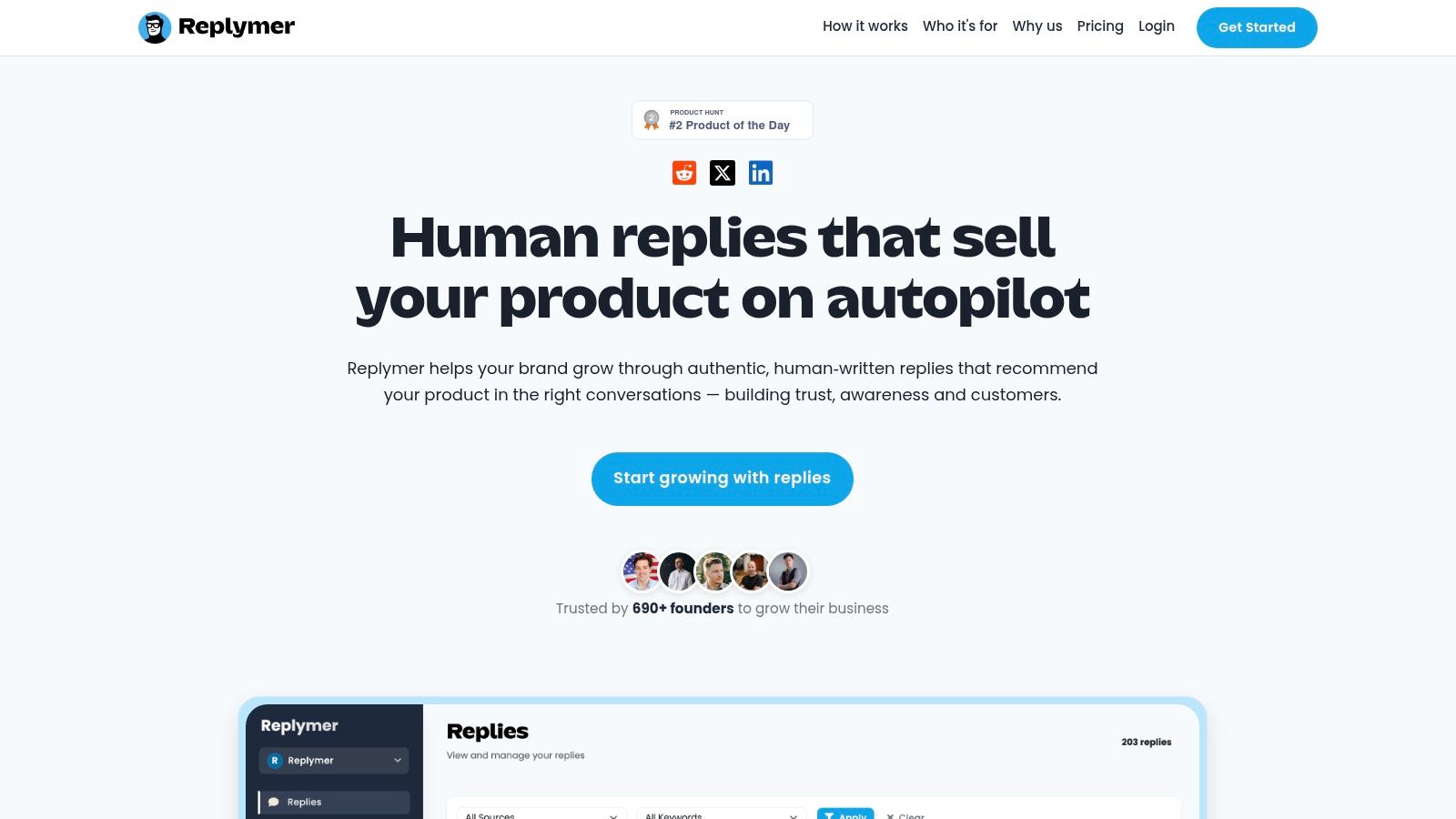
Replymer stands out as a powerful, human-centric Google Alerts alternative designed not just for monitoring, but for actively driving growth. It transforms passive brand mentions and keyword tracking into a proactive lead generation engine by deploying a team of real writers to engage in relevant conversations on your behalf. This "done-for-you" service monitors Reddit, X (Twitter), and LinkedIn 24/7 for high-intent discussions, then crafts authentic, brand-voiced replies.
The core premise is to build trust by helping first and recommending second, a strategy that resonates deeply with audiences tired of automated, spammy outreach. This approach makes Replymer an exceptional choice for SaaS startups, founders, and B2B marketing teams who prioritize genuine engagement over sheer volume.
Core Features & Functionality
Unlike tools that simply deliver a feed of mentions, Replymer handles the entire workflow from discovery to engagement. After a quick 5-10 minute onboarding, its team manages everything, publishing from established, credible social accounts to ensure recommendations feel organic. The user dashboard provides transparent reporting on mentions found, replies published, and performance by keyword and platform, making it easy to track ROI.
- Human-Powered Outreach: Every reply is researched and written by a human, ensuring it is context-aware, helpful, and adheres to platform-specific etiquette.
- Managed Publishing: Replies are posted from established, high-credibility accounts, avoiding the "brand account crashing the conversation" problem.
-Performance Dashboard: Provides clear metrics to measure the impact of the service, including mentions identified, replies sent, and reply rates. - Frictionless Onboarding: Setup is remarkably fast, with the first replies often going live within 24 hours.
Who is Replymer Best For?
Replymer is engineered for teams that understand the value of authentic, one-to-one engagement but lack the time and resources to execute it at scale. It's an ideal solution for:
- SaaS startups and founders aiming to generate organic demand and build community.
- Growth and marketing teams looking for a scalable, ROI-positive alternative to paid ads.
- Agencies needing to generate high-quality inbound leads for their clients.
- B2B brands focused on building trust and authority through helpful social interactions.
Pricing
Replymer offers a free trial and month-to-month plans, making it accessible without long-term commitments.
- Starter: Begins at 30 replies per month.
- Growth & Scale Plans: Offer higher volumes, from 300 to over 1500 replies per month for larger teams and enterprises.
| Pros | Cons |
|---|---|
| 100% human-written replies ensure authentic, context-aware engagement. | Cost is higher than DIY or bot-based tools, reflecting the premium for human quality. |
| Fast, low-friction setup gets you started in minutes, with replies live within a day. | Platform support is limited to Reddit, X (Twitter), and LinkedIn. |
| Fully managed publishing from credible accounts removes the burden from your team. | |
| Clear ROI tracking via a dedicated performance dashboard. | |
| Scalable, month-to-month plans with a free trial offer flexibility. |
2. HotMention — Best for Buyer-Intent Monitoring
HotMention turns keyword alerts into qualified leads. Instead of emailing you every match, it scores each mention from 0 to 100 for buyer intent across five dimensions, so the alerts you act on are the ones where someone is actually looking to buy. It covers six platforms — Reddit, X, LinkedIn, Threads, Quora and YouTube — from a single inbox.
Every mention comes with a Reply, Careful or Skip verdict, the reasoning behind it, and an AI draft reply in your brand voice that you post yourself. Alerts land in email, Slack or Telegram in real time, and HotMention flags when a competitor is named so you can respond first.
- Six platforms in one inbox: Reddit, X, LinkedIn, Threads, Quora, YouTube
- 0-100 buyer-intent scoring instead of raw keyword matching
- Reply / Careful / Skip verdicts with reasoning on every mention
- AI draft replies in your brand voice, ready to send
- Real-time delivery to email, Slack and Telegram, plus competitor detection
Pricing: Free tier (Reddit and X, 10 leads/month), then $29-$199/month as you add platforms and volume.
Best for: founders and agencies who want monitoring that ranks alerts by who is ready to buy, across six platforms. Try HotMention free →
3. Talkwalker Alerts
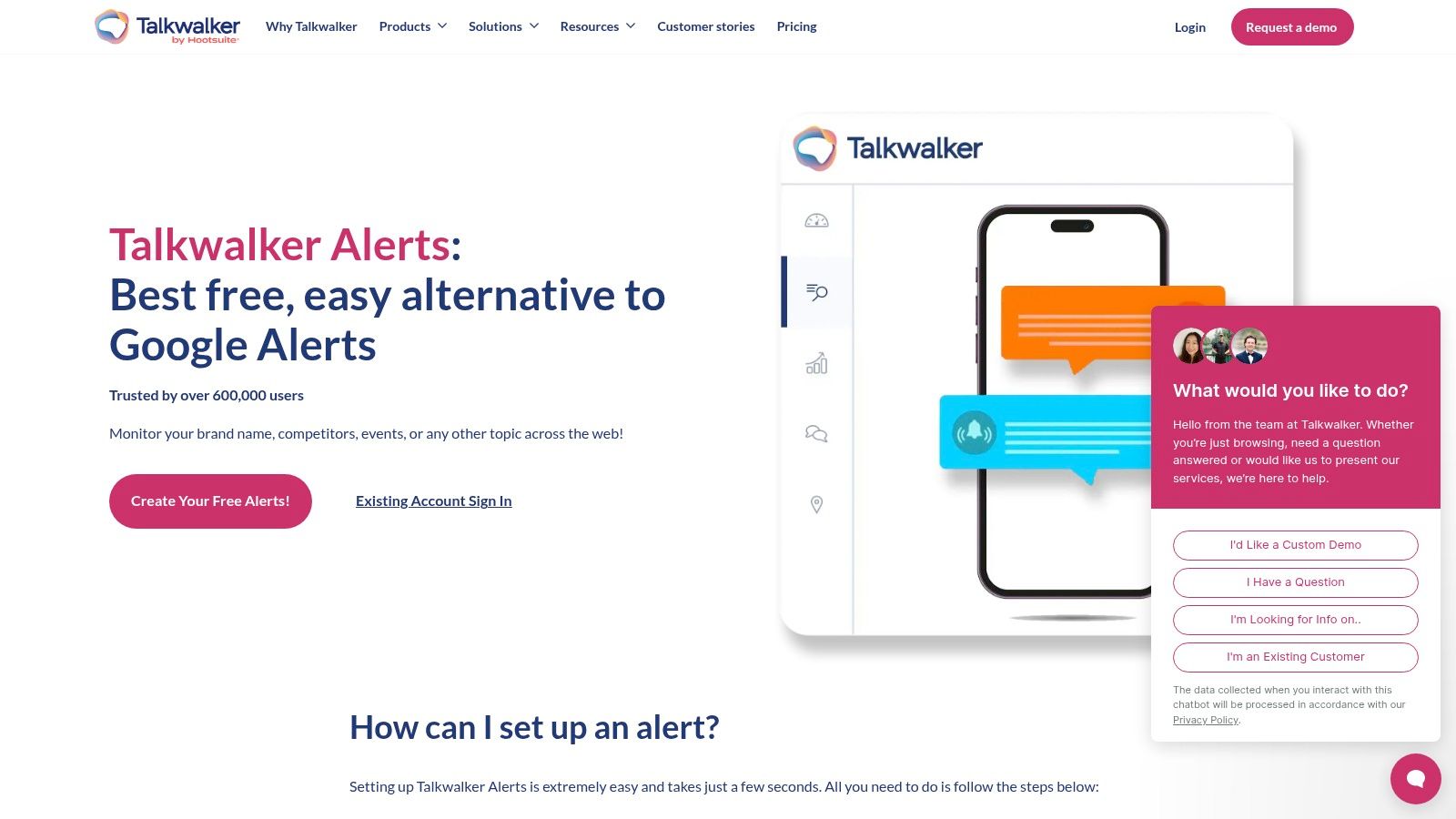
Talkwalker Alerts is often considered the most direct, like-for-like replacement for Google Alerts, offering a simple, free, and effective way to monitor online mentions. Its primary advantage is its simplicity and speed; you can set up email-based alerts for keywords, brand names, or topics in seconds without needing a Google account. The platform monitors news sites, blogs, forums, and notably, X/Twitter, a source Google Alerts often misses.
This makes it one of the best google alerts alternatives for individuals, solopreneurs, or small teams who need a straightforward, no-cost solution for basic media monitoring. The setup process is refreshingly minimal, and the email-only delivery keeps the workflow uncluttered.
Core Features and Use Cases
- Source Coverage: Monitors news, blogs, forums, and X/Twitter.
- Delivery Control: Choose alert frequency from "as it happens" to daily or weekly digests.
- Noise Reduction: A useful "Only the best" filter helps prioritize significant mentions over general chatter.
- Language Support: Covers 22 different languages, making it suitable for global brand monitoring.
Best For: Individuals or small marketing teams needing a free, reliable alert system that includes social media mentions without the complexity of a full-fledged social listening tool.
Pros and Cons
- Pros:
- Completely free and incredibly easy to set up.
- Includes X/Twitter mentions, a key weakness of Google Alerts.
- No Google account required, works with any email address.
- Cons:
- Lacks advanced analytics, reporting dashboards, and sentiment analysis.
- No team collaboration features; alerts are sent to individual inboxes.
Website: https://www.talkwalker.com/alerts
4. Mention
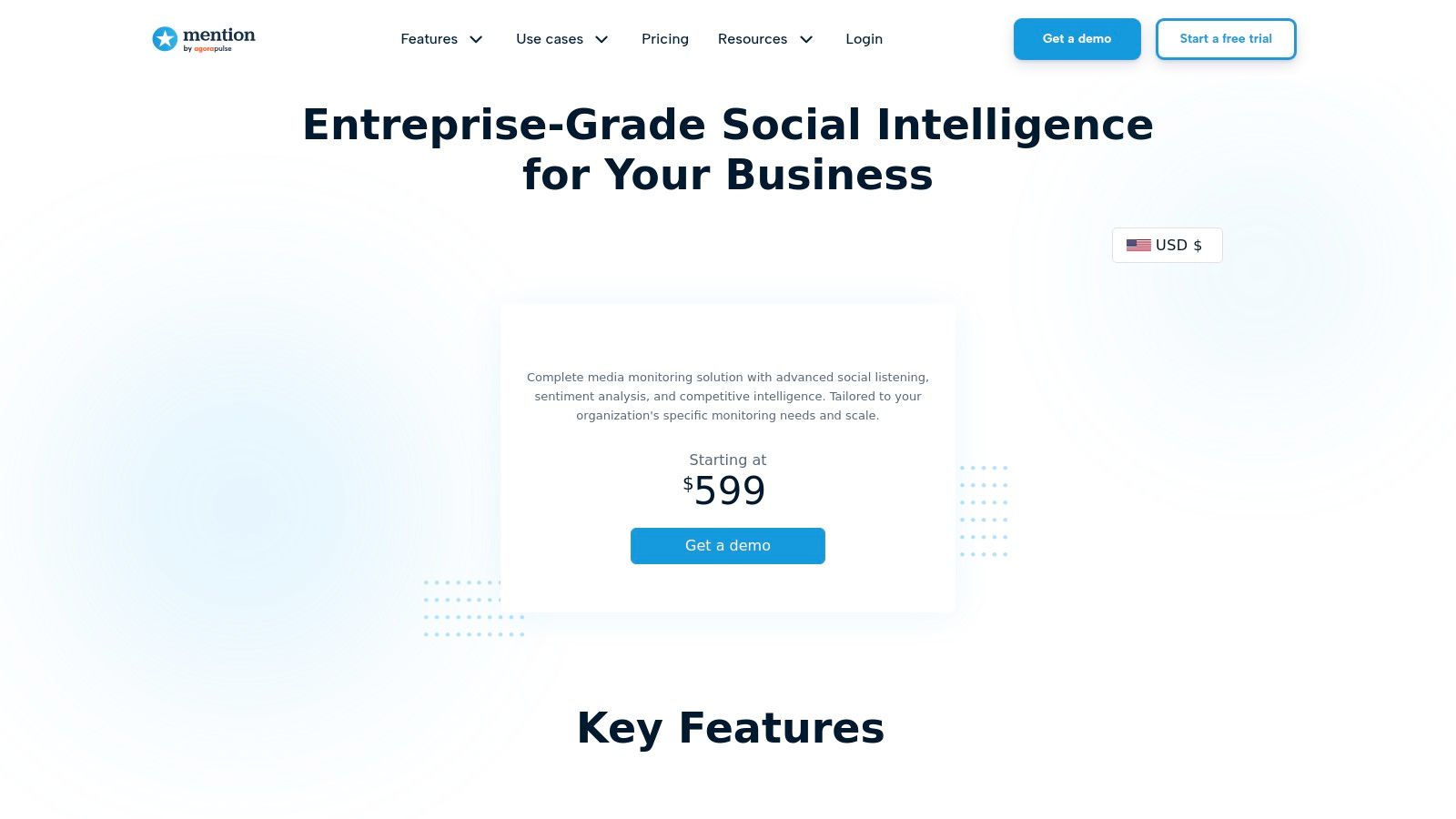
Mention is a comprehensive media monitoring and social listening platform that goes far beyond simple email notifications. It’s designed for users who have outgrown the basic functionality of Google Alerts and require a more robust suite of tools for real-time tracking, reporting, and team collaboration. The platform excels at pulling in mentions from a vast array of sources, including major social networks, news sites, blogs, forums, and even review sites.
As one of the more powerful google alerts alternatives, Mention is ideal for brands that need to actively manage their online reputation, track competitors, and identify industry trends. Its user-friendly interface makes setting up complex queries straightforward, and the platform delivers insights through an intuitive dashboard rather than just email.
Core Features and Use Cases
- Source Coverage: Real-time tracking across social media (Facebook, Instagram, Reddit, TikTok, YouTube, X), the web, and review sites like Google, Amazon, and Trustpilot.
- Advanced Analytics: Features sentiment analysis, competitive tracking, and trend detection to turn data into actionable insights.
- Team Collaboration: Includes dashboards, custom reports, and user roles, allowing marketing teams to work together on monitoring campaigns. For an in-depth guide, you can learn more about social media mention monitoring.
- Review Management: Directly monitors and aggregates customer reviews from key platforms, helping manage brand reputation.
Best For: Marketing teams and growing businesses that need a unified dashboard for social listening, competitive analysis, and reputation management with advanced reporting capabilities.
Pros and Cons
- Pros:
- Excellent source coverage, combining web and social media in one platform.
- User-friendly UI with a smooth and quick alert setup process.
- Strong documentation and onboarding resources for new teams.
- Cons:
- Pricing plans are now more focused on enterprise clients.
- Lower-tier plans have significant limitations compared to professional suites.
Website: https://mention.com/en/pricing/
5. Brand24
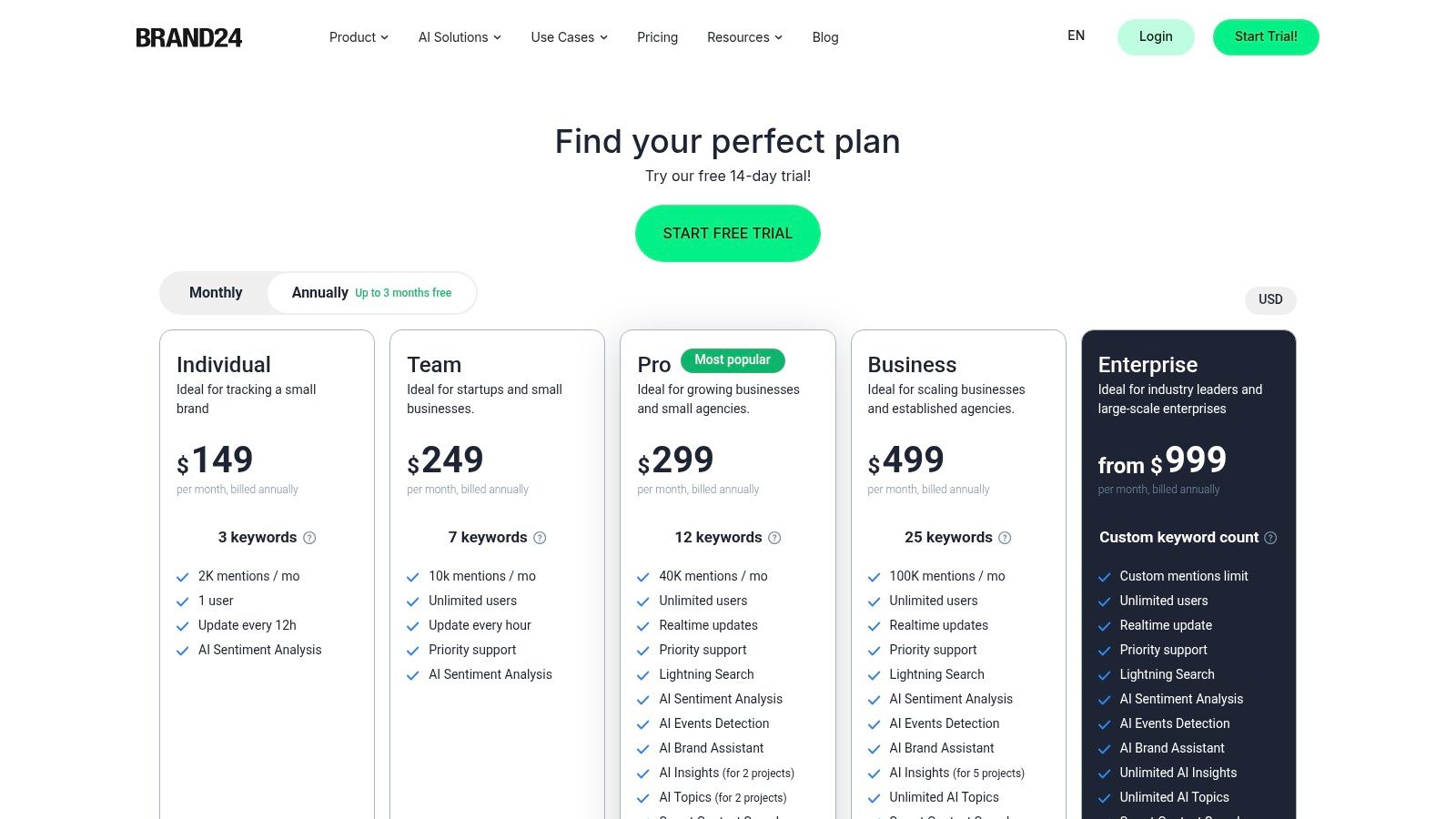
Brand24 is a comprehensive, all-in-one media monitoring solution particularly popular with small and mid-sized businesses. It moves beyond simple alerts to offer a robust platform with analytics, sentiment analysis, and extensive source coverage, including news, blogs, forums, podcasts, and major social media channels like TikTok and Reddit. Its user-friendly interface and transparent pricing make it an accessible yet powerful step up from basic free tools.
This platform stands out as one of the best google alerts alternatives for businesses ready to invest in a dedicated tool for brand health and competitive analysis. The inclusion of AI-powered insights and shareable reports provides tangible value for marketing teams, justifying the move to a paid service. The benefits of using a dedicated tool like this are significant, and you can learn more about the advantages of social media monitoring to see how it can impact your strategy.
Core Features and Use Cases
- Web and Social Coverage: Monitors a wide range of sources, including TikTok, Reddit, LinkedIn, and YouTube.
- Real-time Updates: Delivers instant notifications and "storm alerts" to flag sudden spikes in mention volume.
- AI Analytics: Provides AI-driven sentiment analysis and insights, which are presented in easily shareable reports.
- Integrations: Connects with tools like Slack and Microsoft Teams for seamless workflow integration, alongside custom email alerts.
Best For: SMBs and marketing teams that need a user-friendly, value-driven media monitoring platform with strong analytics, reporting, and broad social media coverage.
Pros and Cons
- Pros:
- Transparent pricing plans and a generous 14-day free trial.
- Very easy to set up and manage keyword monitoring projects.
- Real-time monitoring is available on higher-tier plans.
- Cons:
- Entry-level plans have keyword and mention limits that may necessitate upgrades.
- Advanced AI features are gated behind more expensive tiers.
Website: https://brand24.com/prices/
6. BuzzSumo
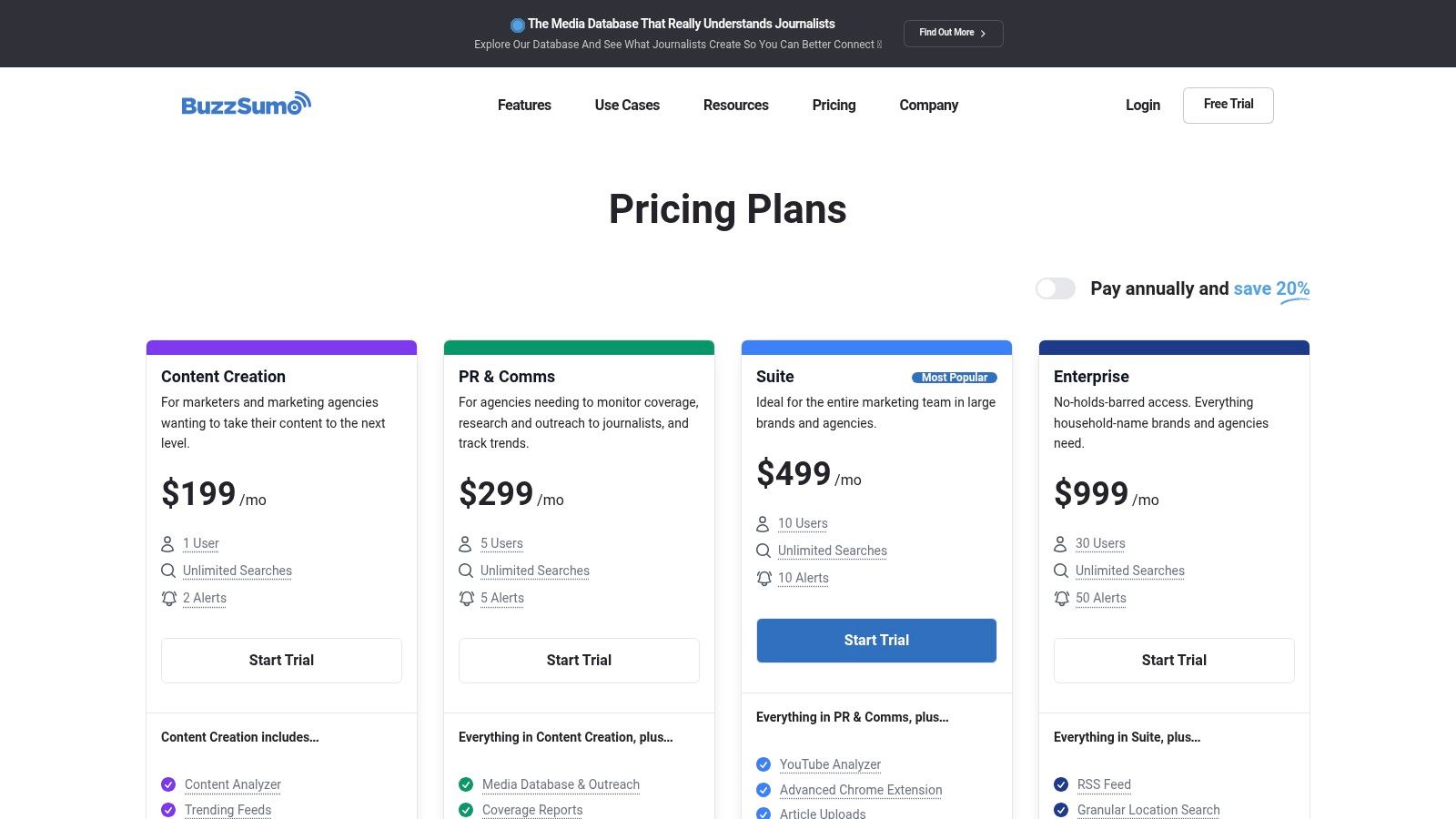
BuzzSumo is a powerful content intelligence platform that goes far beyond simple notifications. While it offers robust alerts, its real strength lies in connecting those mentions to broader content marketing performance, PR outreach, and competitor analysis. It’s an ideal choice when you need alerts to be the starting point for a deeper strategic action, like analyzing what content gets links or finding journalists to pitch.
This platform stands out as one of the best google alerts alternatives for teams who need to integrate their monitoring with their content creation and public relations workflows. Instead of just knowing that you were mentioned, BuzzSumo helps you understand why and what to do next, thanks to its extensive content database and outreach tools.
Core Features and Use Cases
- Comprehensive Alerts: Set up alerts for brand mentions, keywords, competitors, and even new backlinks to your or a competitor's domain.
- Content Intelligence: Use its massive content index to research trending topics, analyze top-performing articles, and identify key influencers.
- PR and Outreach Tools: Higher-tier plans include a journalist database and PR coverage reports, allowing you to turn a mention into an outreach opportunity.
- Team Integration: Alerts can be easily integrated into Slack channels, keeping your entire team informed in real-time.
Best For: Content marketing and PR teams who need alerts bundled with powerful research, trend-spotting, and media outreach capabilities.
Pros and Cons
- Pros:
- Combines alerts with a comprehensive suite of content and PR tools.
- Excellent for tying brand mentions directly to content performance and outreach.
- Seamless Slack integration for piping alerts directly to team channels.
- Cons:
- Alert quotas on the entry-level plan are relatively low.
- The best pricing is typically available with annual billing commitments.
Website: https://buzzsumo.com/pricing/
7. Ahrefs Alerts
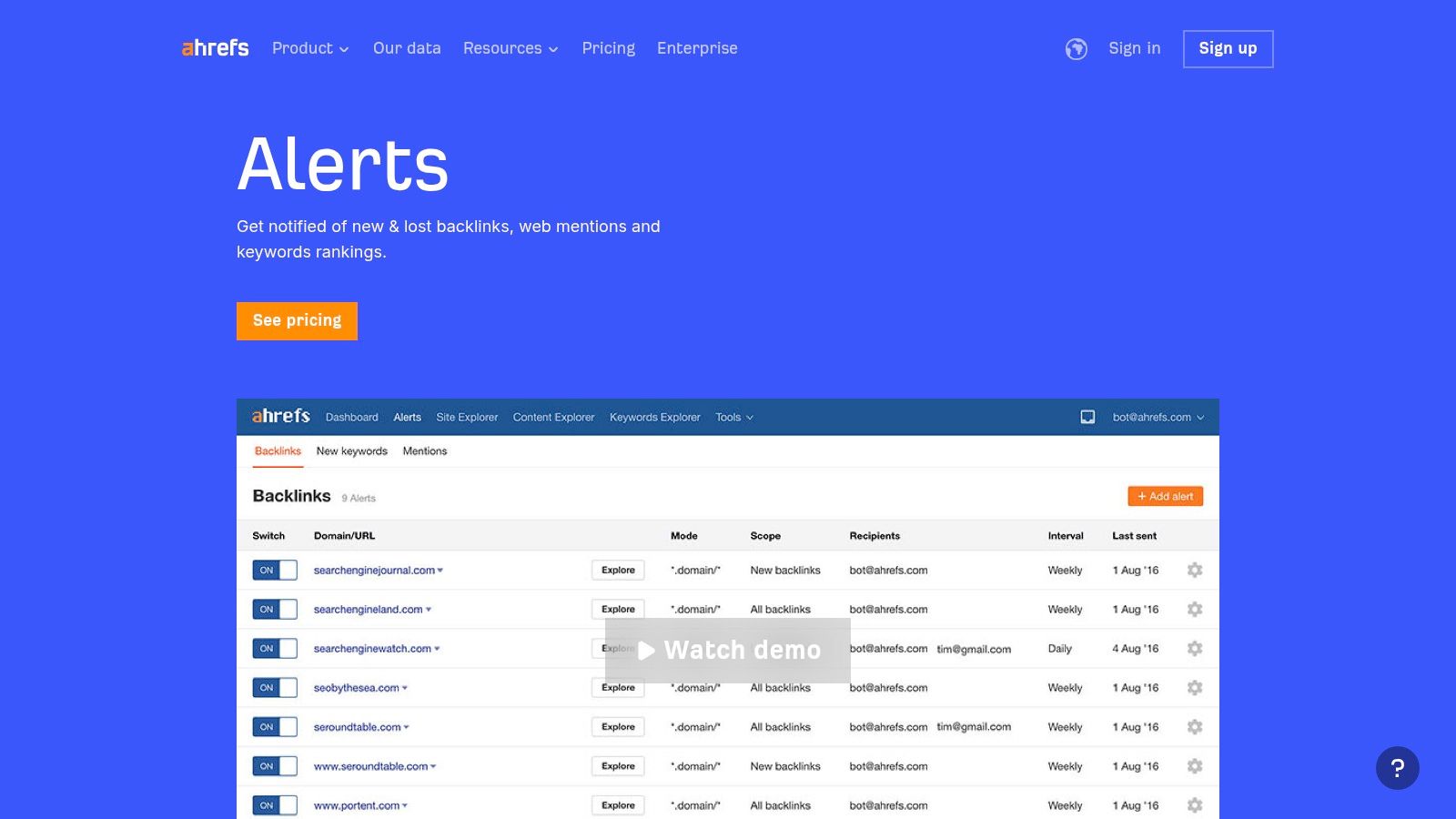
For those already invested in the SEO ecosystem, Ahrefs Alerts offers a powerful, integrated solution that extends beyond simple brand mentions. It leverages Ahrefs’ massive web index to monitor new and lost backlinks, keyword ranking changes, and web mentions, consolidating critical SEO and PR notifications into a single workflow. This makes it a highly efficient tool for marketing teams focused on link building and search engine performance.
Instead of just tracking conversations, Ahrefs Alerts is designed for action, particularly for identifying "unlinked mention" outreach opportunities. It’s one of the best google alerts alternatives for users who want to connect their media monitoring directly to their SEO strategy, turning brand mentions into valuable backlinks. Access requires a paid Ahrefs subscription, positioning it as a professional-grade tool rather than a free, standalone service.
Core Features and Use Cases
- Web Mentions: Get notified when your brand, product, or keywords are mentioned on the web, perfect for PR and reputation management.
- New & Lost Backlinks: Track your backlink profile in real-time to capitalize on new links or address lost ones immediately.
- Keyword Ranking Alerts: Monitor your most important keywords and receive updates on significant position changes in search results.
- Advanced Filtering: Use operators and blocked domains to refine alert criteria and reduce irrelevant notifications.
Best For: SEO professionals and marketing teams who already use Ahrefs and want to combine backlink monitoring, rank tracking, and web mention alerts within one platform.
Pros and Cons
- Pros:
- Powered by Ahrefs’ industry-leading web crawler and link index.
- Excellent for finding unlinked brand mentions for link-building outreach.
- Combines PR, SEO, and reputation monitoring into a unified workflow.
- Cons:
- Requires a paid Ahrefs subscription; no free or standalone option.
- Not a comprehensive social listening tool; focus is on web and search.
Website: https://ahrefs.com/alerts
8. Semrush – Brand Monitoring (App Center)
For teams already embedded in the Semrush ecosystem for SEO and content marketing, the Brand Monitoring app is a powerful and convenient addition. It transforms Semrush from a pure SEO tool into a more holistic digital marketing platform by adding a dedicated module for tracking brand, competitor, and keyword mentions across the web. Its key advantage is this seamless integration, allowing you to connect brand reputation signals directly with your SEO and PR campaigns.
This makes it one of the most practical google alerts alternatives for digital marketers who want to consolidate their tool stack. Instead of managing a separate monitoring service, you can track your brand's share of voice, identify backlinks as they happen, and monitor industry trends all within the same interface you use for keyword research and site audits. You can find more details in this social listening tools comparison.
Core Features and Use Cases
- Integrated Workflow: Combines brand monitoring with Semrush’s existing SEO, content, and PR toolkits for a unified strategy.
- Share of Voice: Compare your mention volume against key competitors to benchmark brand presence and track campaign impact.
- Mention Tracking: Monitors news sites, blogs, and forums for your brand, product, or keywords with trend data.
- Flexible Queries: Easily set up and refine tracking queries with options to expand mention and query limits via affordable add-ons.
Best For: Marketing teams and agencies already using Semrush who need an integrated brand monitoring solution to complement their SEO and digital PR efforts without adding another standalone subscription.
Pros and Cons
- Pros:
- Seamless integration with the broader Semrush toolkit.
- Affordable as an add-on compared to enterprise-level suites.
- Excellent for identifying untagged brand mentions for link-building opportunities.
- Cons:
- Base app limits on queries and mentions may require purchasing add-ons for heavy use.
- Lacks the deep social media and broadcast monitoring of specialized listening tools.
Website: https://www.semrush.com/kb/1266-brand-monitoring-app
9. Meltwater
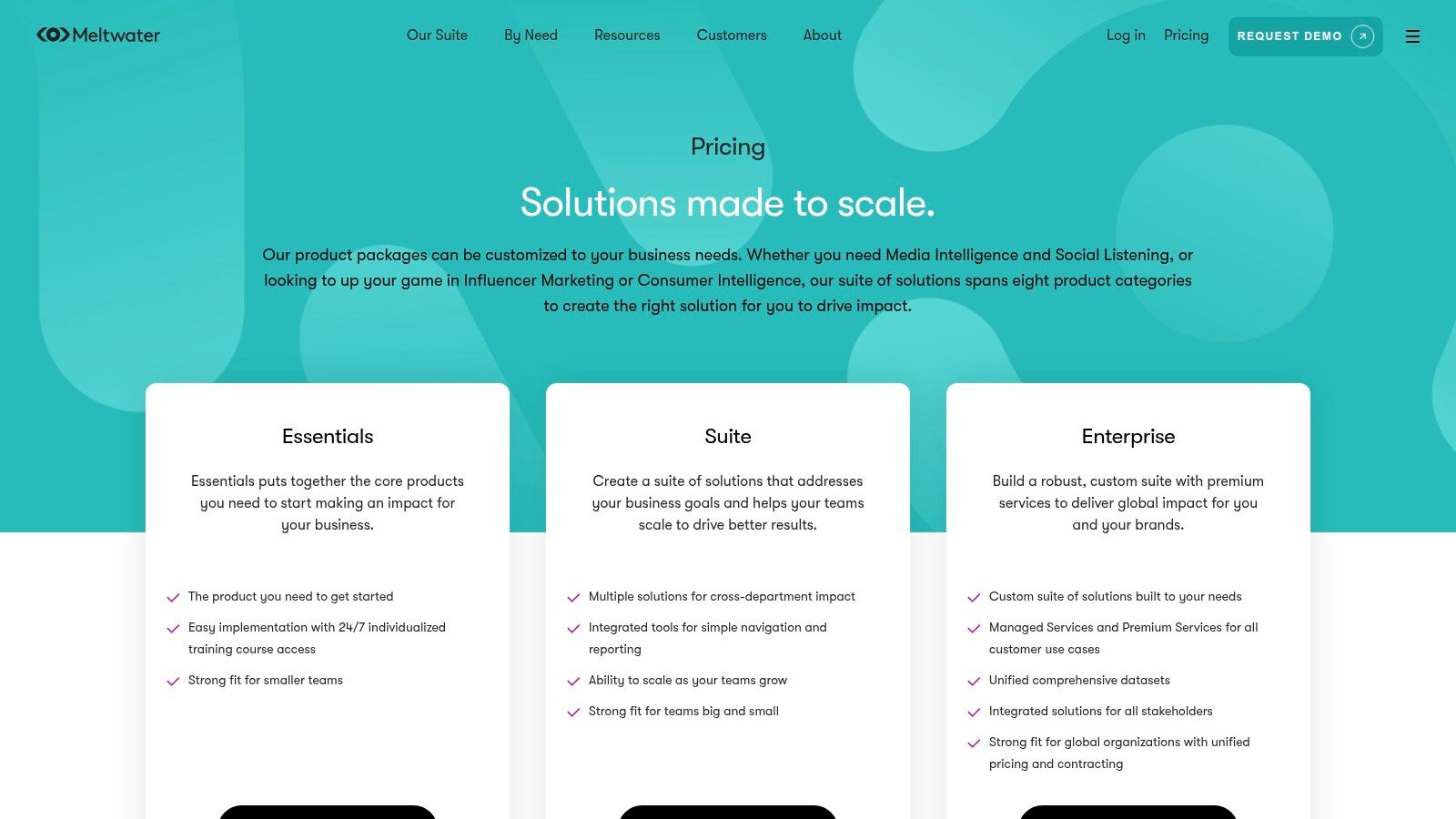
Meltwater is an enterprise-grade media intelligence suite designed for large organizations and agencies that require comprehensive monitoring beyond what simple tools can offer. It provides an all-in-one solution for tracking mentions across online news, print, broadcast media, podcasts, and social media channels. Its strength lies in its ability to consolidate vast amounts of data into custom dashboards and actionable reports, complete with AI-powered summaries and insights.
As a premium platform, Meltwater is one of the more powerful google alerts alternatives for enterprises that need broad media coverage, service-level agreements (SLAs), and advanced analytics for brand management, competitive intelligence, and crisis communication. The service is tailored to each client, including dedicated support and onboarding.
Core Features and Use Cases
- Source Coverage: Real-time monitoring across earned media (online news, print, broadcast, podcasts) and social media.
- Advanced Reporting: Custom dashboards and reports featuring AI-driven analysis and trend identification.
- Enterprise Support: Includes dedicated Customer Success managers and provides 24/7 support for critical needs.
- Global Reach: Offers scalable, multi-region coverage suitable for international brands and campaigns.
Best For: Large enterprises, PR firms, and marketing agencies needing a holistic media intelligence platform with deep analytics, extensive source coverage, and dedicated account management.
Pros and Cons
- Pros:
- Extremely broad channel coverage and significant data depth.
- Enterprise-grade onboarding, support, and professional services.
- Flexible, modular packaging to build a custom solution.
- Cons:
- Pricing is available only by custom quote and represents a significant investment.
- Higher total cost of ownership compared to SMB-focused tools.
- No self-serve free trial; access requires a sales demo and negotiation.
Website: https://www.meltwater.com/en/pricing
10. CisionOne
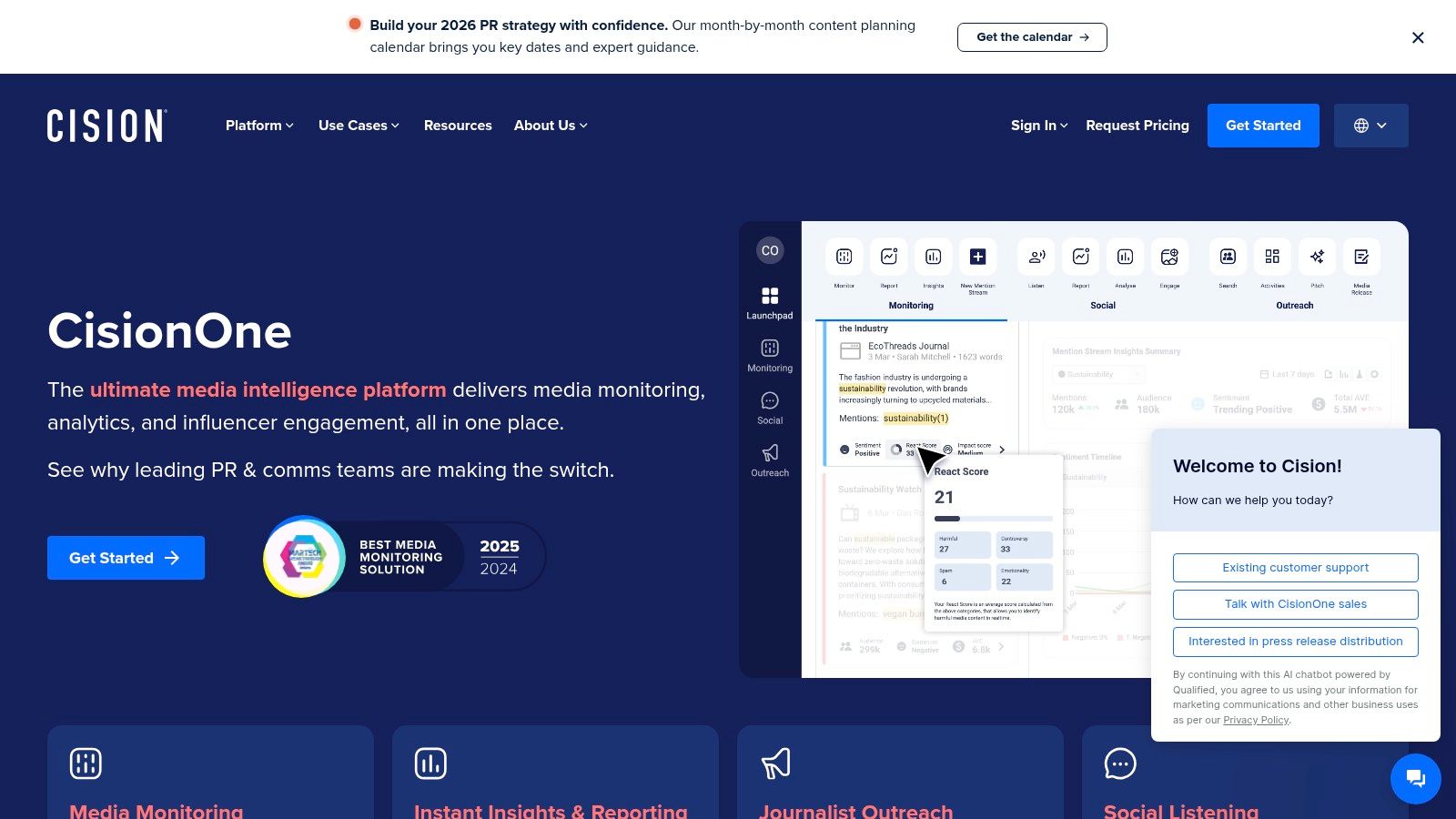
CisionOne is a comprehensive public relations and communications suite that goes far beyond simple monitoring. It combines omnichannel media tracking with a massive journalist database, outreach tools, and sophisticated PR measurement, making it a powerful platform for enterprise-level communications teams. It's less a direct alert tool and more of an integrated command center for managing brand reputation and media relations from start to finish.
This platform is one of the more robust google alerts alternatives for organizations that need to connect their monitoring efforts directly to their PR outreach and distribution strategies. The value lies in having a single source of truth for tracking mentions, identifying journalists, pitching stories, and reporting on campaign impact.
Core Features and Use Cases
- Omnichannel Monitoring: Real-time alerts across online news, print, broadcast, social media, and podcasts.
- Journalist Database: Access to an extensive, searchable database of media contacts for targeted outreach.
- AI Insights: Provides automated analysis and customizable dashboards for tracking share of voice, sentiment, and key trends.
- Distribution Add-ons: Seamlessly integrates with services like PR Newswire and PRWeb for press release distribution.
Best For: Large corporate communications and PR departments that require an all-in-one solution for media monitoring, outreach, and performance analytics, and have the budget for a premium enterprise tool.
Pros and Cons
- Pros:
- Integrates monitoring, outreach, and reporting in one platform.
- Widely adopted by large organizations, making it an industry standard.
- Produces strong, stakeholder-ready reporting and analytics outputs.
- Cons:
- Opaque pricing requires a custom quote, often involving annual contracts.
- Cost is significantly higher than most SMB-focused monitoring tools.
Website: https://www.cision.com
11. Feedly
Feedly transforms the classic RSS reader into a powerful monitoring engine, making it a highly customizable option among google alerts alternatives. Instead of just receiving emails, Feedly lets you create dedicated feeds for any keyword, topic, or brand, pulling in results from Google News, specific websites, blogs, and other sources into a unified, readable dashboard. This approach is ideal for users who prefer to review all their intelligence in one place rather than managing separate email alerts.
Its standout feature is an AI assistant named Leo, which can learn your priorities, filter out noise, summarize key articles, and identify emerging trends. This moves beyond simple notifications to active intelligence gathering, allowing you to consume vast amounts of information efficiently.
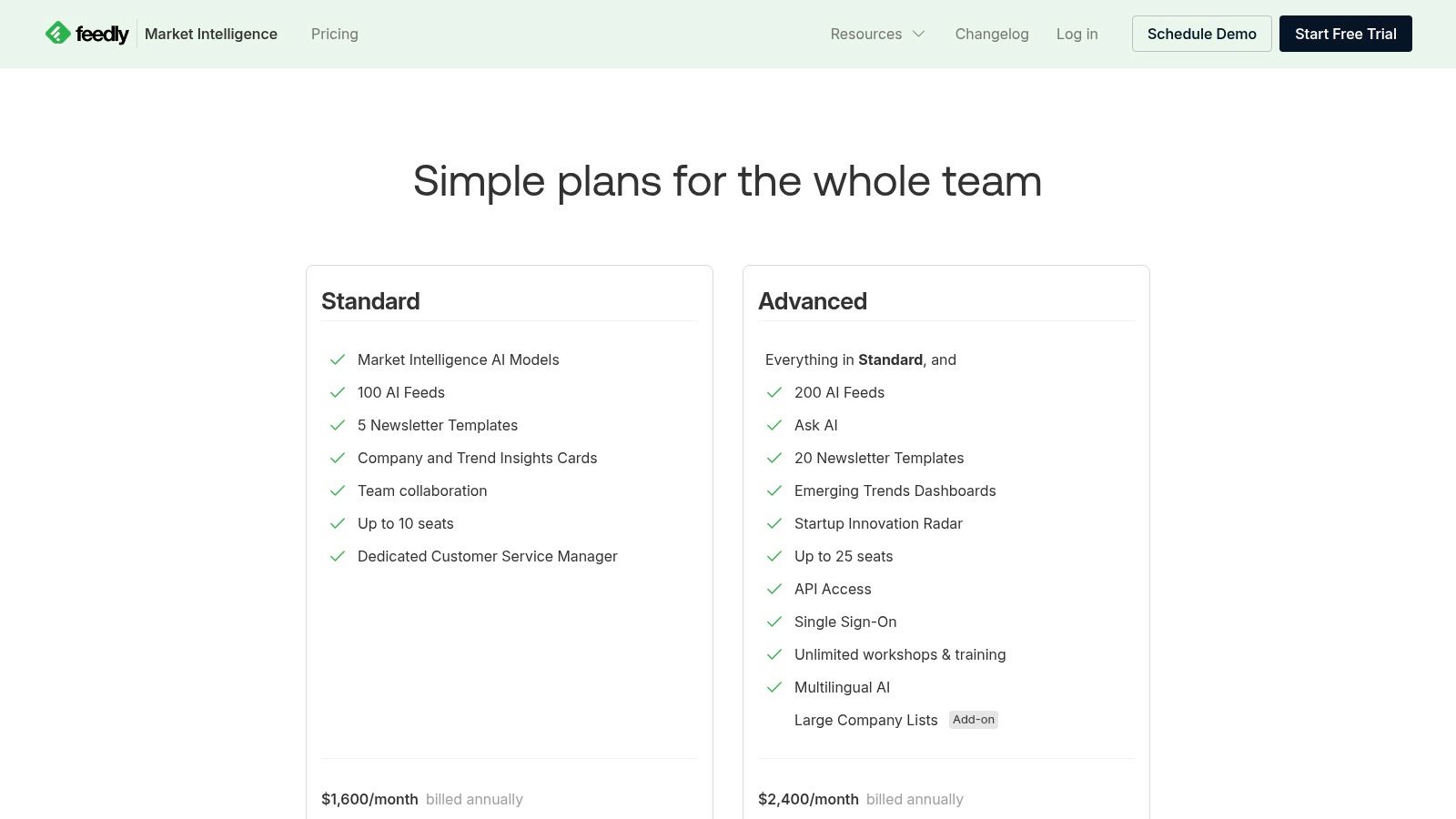
Core Features and Use Cases
- Keyword Alerts: Create monitoring feeds for keywords, pulling from Google News and other web sources.
- AI Assistant (Leo): Prioritizes important articles, removes duplicates, summarizes content, and flags critical information (available on Pro+ plans).
- Team Collaboration: Business and Market Intelligence plans include team feeds, newsletters, and integrations with Slack and Microsoft Teams.
- Centralized Dashboard: Consolidates all your monitored topics and news sources into a single, organized interface instead of scattered emails.
Best For: Professionals and teams who want to integrate brand monitoring and keyword alerts directly into their daily content consumption and market research workflow.
Pros and Cons
- Pros:
- Combines news reading and alerts into one seamless, powerful platform.
- Excellent for organizing and processing high volumes of information.
- Scales effectively from individual use (Pro plan) to enterprise-level market intelligence.
- Cons:
- The core AI-powered filtering and summarization features are locked behind higher-tier paid plans.
- Market Intelligence pricing is premium and targeted at larger teams.
Website: https://feedly.com/market-intelligence/pricing
12. Inoreader
Inoreader is a powerful RSS reader that has evolved into a highly customizable monitoring tool for power users. Instead of a traditional media monitoring dashboard, it allows you to build your own sophisticated alerting system using "monitoring feeds" that track keywords across the web, including on sites without native RSS support. This DIY approach gives you unparalleled control over your information flow.
This platform is one of the best google alerts alternatives for tech-savvy individuals or small teams who prefer building a bespoke monitoring setup over paying for an enterprise suite. Its strength lies in its rules, filters, and de-duplication features, which let you meticulously refine your feeds to eliminate noise and surface only the most relevant content.
Core Features and Use Cases
- Monitoring Feeds: Create feeds for keywords, Google News searches, or even specific websites that lack an RSS feed.
- Advanced Filtering: Use rules to automatically tag, filter, or highlight articles based on keywords, authors, or other criteria.
- De-duplication: Automatically hides duplicate articles from different sources, keeping your feeds clean.
- High Subscription Limits: The Pro plan supports up to 2,500 subscriptions, ideal for comprehensive monitoring.
- API Access: Integrate your monitoring feeds with other applications for custom workflows.
Best For: Technically inclined users, researchers, and content curators who want maximum control to build a low-cost, highly-filtered alerting system from the ground up.
Pros and Cons
- Pros:
- Extremely configurable with powerful rules and filters.
- Very affordable Pro plan with scalable add-ons.
- Active product development and robust API access.
- Cons:
- Requires a significant hands-on effort to configure properly.
- Lacks the enterprise-grade analytics, sentiment analysis, and reporting of dedicated media monitoring tools.
Website: https://www.inoreader.com/pricing/feature/filters
13. IFTTT
IFTTT (If This Then That) is not a direct media monitoring tool, but an automation platform that serves as a powerful, customizable alternative. It acts as the "glue" between different online services, allowing you to build your own bespoke alert workflows. For example, you can take a keyword mention from an RSS feed or a webhook and automatically trigger a notification via email, Slack, SMS, or even a push notification to your phone.
This makes it one of the most flexible and creative google alerts alternatives for tech-savvy users or teams looking to integrate alerts into existing systems. Instead of being a standalone monitoring tool, it empowers you to connect the dots between your favorite apps and create highly personalized alert recipes for virtually any trigger you can find online.
Core Features and Use Cases
- Service Connections: Connects over 900 services, including RSS, Webhooks, email, Slack, and social media platforms.
- Custom Workflows: Create "Applets" that trigger actions based on specific events (e.g., "If new article in RSS feed matches keyword, then send me a Slack message").
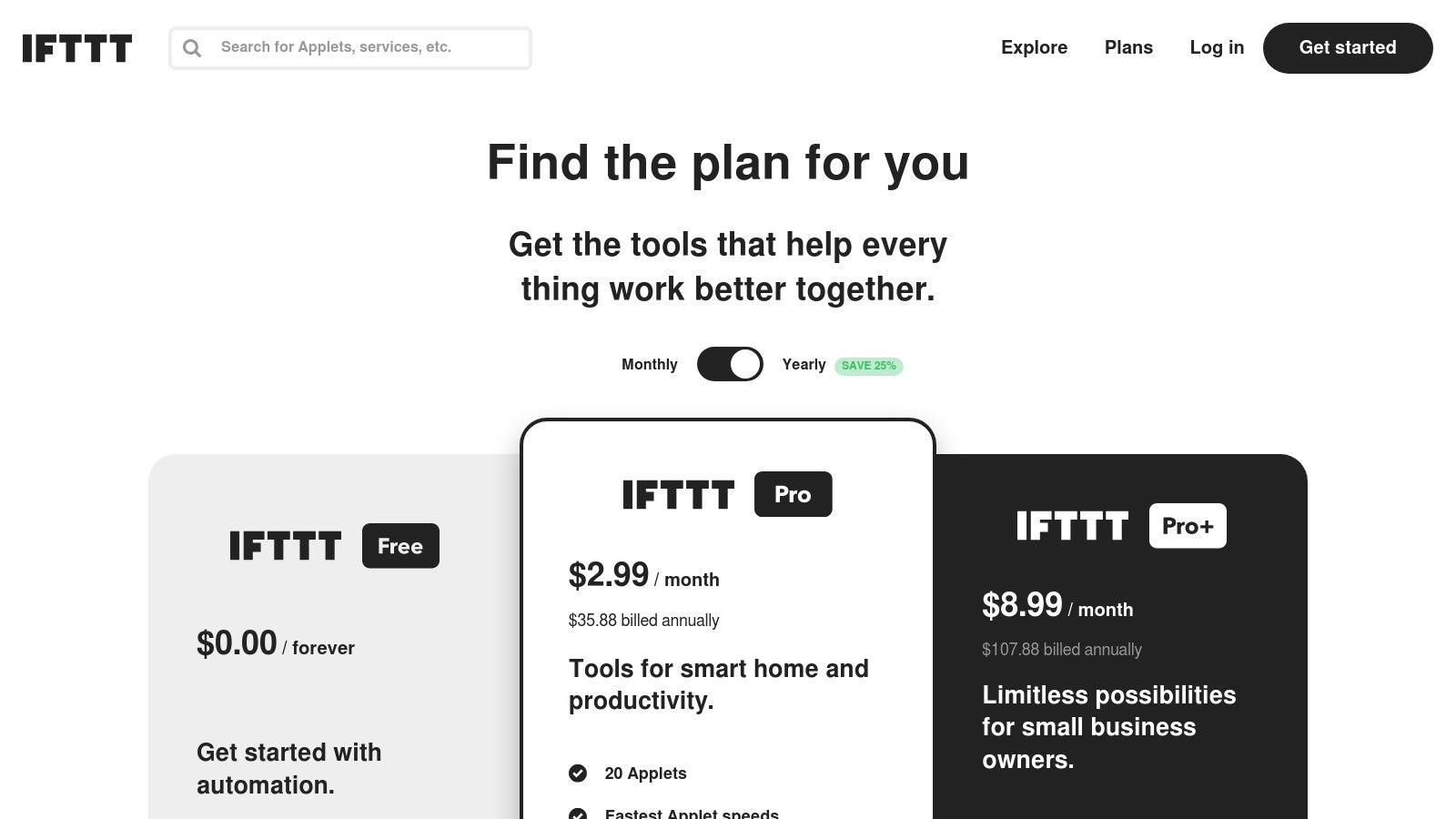
- Advanced Logic: Pro and Pro+ plans offer multi-action applets and conditional filters for more complex and targeted automations.
- Flexible Notifications: Deliver alerts via mobile push, email, SMS, or direct integrations with project management tools.
Best For: Technically inclined individuals or teams who want to build custom, low-cost alert systems that integrate with their existing tech stack, especially by leveraging RSS feeds from other tools.
Pros and Cons
- Pros:
- Extremely flexible and can be connected to hundreds of other tools.
- Very low cost, with a free tier for basic automations.
- Excellent for prototyping and testing different alert workflows quickly.
- Cons:
- Not a dedicated media monitoring suite; requires you to provide the data source (like an RSS feed).
- Reliability is dependent on the third-party services it connects to.
- Can have a steeper learning curve than simple alert tools.
Website: https://ifttt.com/plans
12 Google Alerts Alternatives — Feature Comparison
| Product | Core features ✨ | Quality ★ | Value / Price 💰 | Target 👥 |
|---|---|---|---|---|
| 🏆 Replymer | ✨ 100% human-written replies, 24/7 keyword monitoring, credible account publishing, performance dashboard | ★★★★★ | 💰 Tiered (Starter → Enterprise), month-to-month, free trial | 👥 SaaS founders, growth teams, agencies |
| Talkwalker Alerts | ✨ Free email alerts across news, blogs, forums & X, frequency options | ★★☆☆☆ | 💰 Free | 👥 Individuals, small teams wanting simple alerts |
| Mention | ✨ Real-time social + web tracking, sentiment, dashboards & team workflows | ★★★★☆ | 💰 Paid tiers (SMB → Enterprise) | 👥 Growing brands needing reporting & collaboration |
| Brand24 | ✨ Web + social monitoring, AI sentiment, real-time "storm" alerts, integrations | ★★★★☆ | 💰 Clear pricing, 14‑day trial | 👥 SMBs seeking value & ease of use |
| BuzzSumo | ✨ Content & PR alerts, large content index, journalist database (higher tiers) | ★★★★☆ | 💰 Tiered; best value annually | 👥 Content teams, PR/comm teams |
| Ahrefs Alerts | ✨ Web mentions, new/lost backlink alerts, keyword ranking changes | ★★★★☆ | 💰 Included with Ahrefs subscription | 👥 SEO & link-building teams |
| Semrush – Brand Monitoring | ✨ Brand/keyword mentions, share-of-voice, integrates with Semrush toolkit | ★★★★☆ | 💰 Affordable add-on within Semrush | 👥 Teams using Semrush for SEO/PR |
| Meltwater | ✨ Enterprise-grade media intelligence, custom dashboards, AI summaries | ★★★★★ | 💰 Custom enterprise pricing | 👥 Large enterprises & agencies |
| CisionOne | ✨ Omnichannel monitoring + journalist DB, PR outreach & measurement | ★★★★★ | 💰 Annual contracts, enterprise quotes | 👥 Large PR/communications teams |
| Feedly | ✨ Keyword RSS feeds, AI assistant "Leo", team features (Market Intelligence) | ★★★★☆ | 💰 Freemium → Pro/Market Intelligence (premium) | 👥 Researchers, content teams, solo users |
| Inoreader | ✨ Power-user RSS, rules/filters, change-tracking, API access | ★★★★☆ | 💰 Affordable Pro & add-ons | 👥 DIY monitorers, power users on a budget |
| IFTTT | ✨ 900+ integrations to route alerts to email/Slack/SMS, quick automations | ★★★☆☆ | 💰 Free tier; Pro paid plans | 👥 Builders prototyping alert workflows |
Making the Right Choice: Moving Beyond Basic Alerts
The digital landscape is a constant stream of conversations, mentions, and opportunities. While Google Alerts has served as a foundational tool for catching brand mentions, its limitations in reliability, scope, and speed have become increasingly apparent for businesses that depend on timely, actionable intelligence. As we've explored, the world of Google Alerts alternatives is vast and specialized, offering solutions tailored to every conceivable goal, from simple media monitoring to complex, revenue-driven engagement strategies.
Moving beyond basic alerts requires a clear understanding of your primary objective. The journey from passive listening to active engagement is a strategic one, and choosing the right tool is the critical first step.
From Simple Monitoring to Strategic Action
Your choice should directly reflect your team's needs and resources. A solo founder building in public has vastly different requirements than a multinational enterprise managing its corporate reputation.
- For Direct Replacements: If your only goal is to replace the core function of Google Alerts with a more reliable, free email notification service, Talkwalker Alerts is the clear winner. It delivers on the original promise with greater consistency and is an excellent starting point for anyone just beginning to explore monitoring.
- For Data-Driven Marketing: When your focus shifts to understanding brand sentiment, share of voice, and competitive analysis, dedicated social listening platforms like Mention and Brand24 become indispensable. They provide the dashboards and analytics needed to turn raw data into marketing insights, helping you measure campaign impact and track market trends effectively.
- For SEO-Focused Intelligence: For teams where organic search is paramount, integrating brand monitoring into your existing SEO toolkit is the most efficient path. The alert features within powerhouse platforms like Ahrefs and Semrush allow you to connect brand mentions and unlinked citations directly to your backlink strategy and content marketing efforts.
The Critical Shift: From Listening to Engaging
The most significant evolution in this space is the move from simply knowing what is being said to actively participating in the conversation. Monitoring data is valuable, but its value multiplies when it's used to build relationships, solve customer problems, and generate leads. This is where most automated tools fall short. They can deliver the "what," but they can't provide the "how" and "why" of authentic human interaction.
This is the gap that a service-based solution like Replymer is designed to fill. While platforms like Meltwater and Cision cater to large-scale PR and enterprise needs, Replymer focuses on a different, more impactful goal: turning conversations into conversions. It acknowledges that the real ROI of monitoring isn't found in a dashboard but in the genuine connections you make with potential customers. By combining sophisticated monitoring with human-crafted, strategic replies, it transforms brand monitoring from a passive data-gathering exercise into an active, high-leverage growth channel.
Ultimately, selecting the best among these Google Alerts alternatives comes down to a simple question: Are you looking for data, or are you looking for results? Define your goal, assess your resources, and choose the solution that will not only keep you informed but actively propel your business forward.
Ready to stop just listening and start engaging? If you want to turn online conversations into qualified leads without spending hours searching and replying, see how Replymer can help. We find high-intent discussions and craft authentic replies on your behalf, transforming monitoring into a predictable revenue stream. Learn more and see how it works.