When it comes to generating leads on LinkedIn, there's a simple, powerful formula that works time and time again. It boils down to three core activities: turning your profile into a client-focused magnet, creating content that proves your expertise, and engaging in smart, personalized outreach. Get these right, and you'll transform your LinkedIn from a digital resume into a pipeline-filling machine.
Why LinkedIn Is Your Strongest B2B Lead Generator
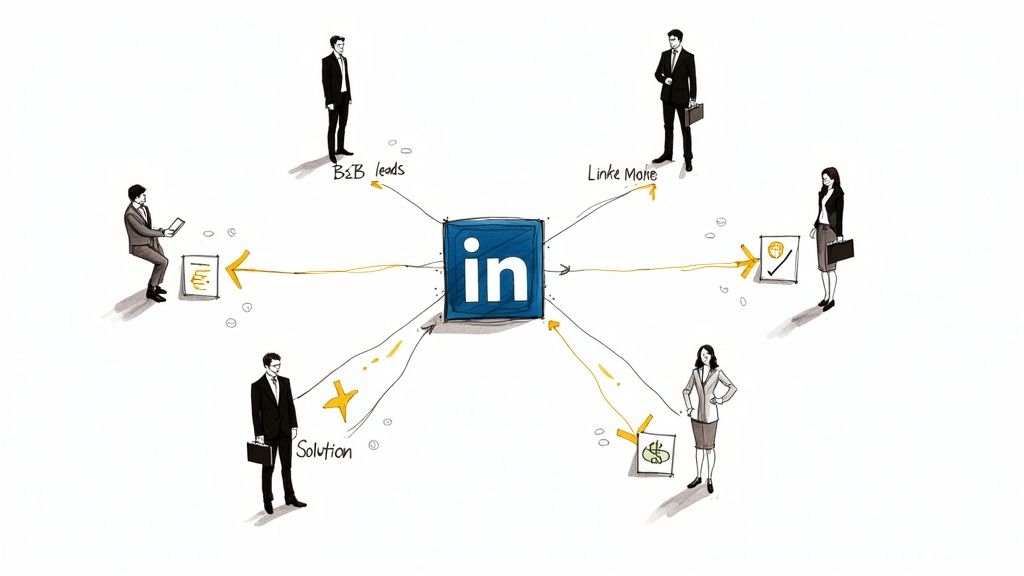
Let's get one thing straight: LinkedIn is no longer just a place to park your resume. It’s the single most effective platform for building professional relationships that actually drive revenue, especially in the B2B world.
Think about it. On other social media, people are scrolling for entertainment. On LinkedIn, they're in a business mindset. They're actively looking for solutions, connecting with peers, and scoping out potential partners. This is your opening to step in and show them you have the answers they need.
The Power of Professional Context
The entire platform is built for business, and that's its superpower. It cuts through the noise you find everywhere else, making every interaction more focused and valuable. The data backs this up—LinkedIn’s lead generation effectiveness is a massive 277% higher than Facebook and Twitter combined.
It's no surprise that 97% of B2B marketers now bake LinkedIn into their content strategy. It's simply where the conversations are happening.
The core mindset shift is seeing LinkedIn not as a place to sell, but as a place to solve. When you consistently offer solutions and insights, potential clients naturally gravitate toward you.
A Three-Part Playbook for Success
A winning LinkedIn strategy isn't about doing one thing well; it's about integrating three key pillars. When these elements work together, you create a reliable, predictable flow of inbound leads.
This guide will break down the entire playbook, step by step:
- Profile Transformation: We'll walk through how to overhaul your profile, shifting it from a backward-looking resume to a forward-looking landing page that speaks directly to your ideal customer’s problems.
- Content as Authority: You’ll learn exactly what to post to establish yourself as a thought leader, attracting high-quality prospects without a hard sell.
- Strategic Outreach: Forget those cringe-worthy, generic connection requests. We’ll give you frameworks for starting real conversations that build trust and lead to real business.
Mastering this system is the key to unlocking a consistent stream of qualified leads. For a broader overview of these strategies, this guide on How to Generate Leads on LinkedIn is an excellent resource. Now, let's get into the nitty-gritty of turning those connections into customers.
Your Profile is Your #1 Lead Generation Tool. Stop Treating It Like a Resume.
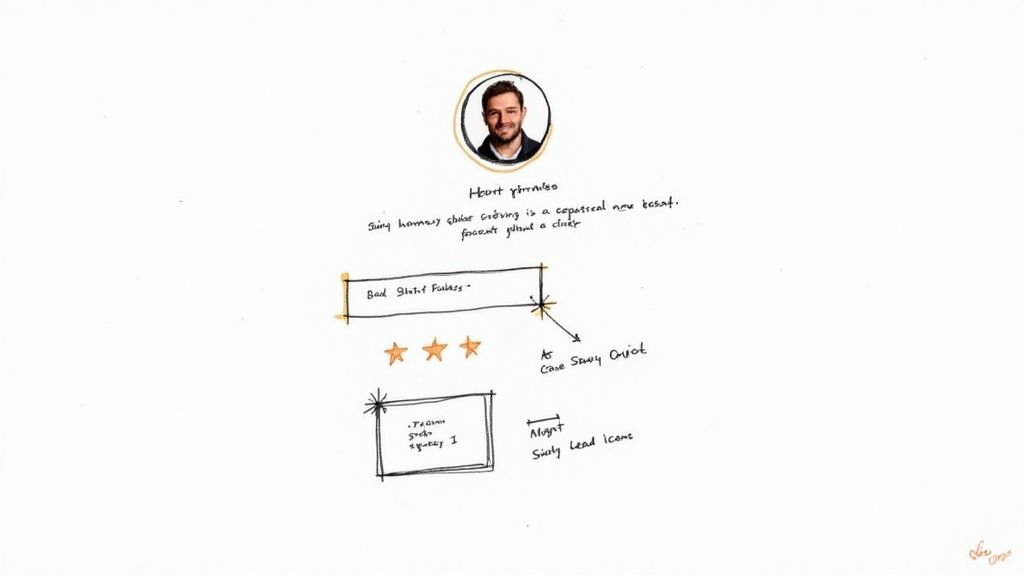
Let's get one thing straight: your LinkedIn profile is the most valuable piece of digital real estate you own for drumming up business. So many people get this wrong, treating it like a dusty, online resume that just lists past jobs. That's a massive mistake.
Think of your profile as a high-performance landing page. Its sole purpose is to speak directly to one person: your ideal client.
Every single element, from your banner down to your endorsements, needs to work in concert to answer two unspoken questions in your prospect’s mind: "Can you solve my problem?" and "Can I actually trust you?" When you get this right, your profile starts working for you around the clock, turning casual visitors into warm leads. Just adding a professional photo can get you 14 times more views, so imagine what a full optimization can do.
This shift in mindset is everything. Stop talking about yourself and start talking to your future clients.
Nail the Headline: It's Your Billboard
Your headline is the first thing anyone reads. It follows you everywhere—in search results, in the feed when you comment, and in every connection request you send. It has to do more than just say what your job title is. It has to scream value.
A headline like "Founder at ABC Company" is a completely wasted opportunity. A real, client-getting headline focuses on the outcome you deliver. It needs to hit on a pain point or a goal that makes your target audience stop scrolling and say, "Hey, that's me."
Just look at the difference:
- Before: Marketing Director at SaaS Corp
- After: I Help B2B SaaS Companies Cut Customer Acquisition Costs by 30% | Demand Generation & Content Strategy
The second one instantly tells a potential client exactly what you do and for whom. It’s a hook, and it’s compelling enough to make them click to learn more.
Your "About" Section is Where You Tell Your Story
This is your chance to build a real connection and prove you know your stuff. Please, stop writing it in the third person or just listing skills like a robot. Use this space to tell a story that walks a reader from their current, frustrating problem straight to your proven solution.
A great "About" section is a simple narrative. It goes something like this:
- The Hook: Kick things off with a bold statement that grabs your ideal client by the collar because it speaks to their biggest headache.
- The Empathy: Show them you get it. You understand their world, their industry, and the things that keep them up at night.
- The Solution: Briefly touch on your unique way of solving that problem. No need for jargon, just a clear explanation of your approach.
- The Proof: This is where you back it up. Mention specific results, a powerful client win, or a key accomplishment.
- The Call to Action: End with a simple, no-pressure next step. Invite them to connect, grab a free resource from your website, or book a quick, 15-minute chat.
Your "About" section isn't an autobiography. It's a sales page, and storytelling is your tool to build trust and nudge a prospect to take the next step.
Show, Don't Just Tell, with the Featured Section
The Featured section is your personal portfolio, sitting right at the top of your profile where no one can miss it. It’s the perfect spot to display concrete proof that you can do what you say you can do. Don't let this prime real estate sit empty.
Your goal here is simple: give prospects a compelling reason to believe the promises you made in your headline and "About" section.
Here are some powerful assets to feature:
- Case Studies: A detailed post or a short video breaking down how you helped a specific client get a fantastic result.
- Client Testimonials: Nothing beats a short video clip or a screenshot of a client singing your praises.
- Lead Magnets: Link directly to a valuable checklist, whitepaper, or webinar recording they can download. Give them value upfront.
- Your Greatest Hits: Pin your most insightful LinkedIn article or a post that blew up with engagement.
By using the Featured section strategically, you’re basically giving prospects a self-guided tour of why you're the expert they need. You're warming them up before you ever even think about sending a connection request, which makes your outreach infinitely more effective down the line.
Create a Content Strategy That Attracts Ideal Clients
Now that your profile is set up to convert visitors, it’s time to add the fuel. Content is the engine that drives inbound leads on LinkedIn, but only if you’re consistently putting out real value. Randomly posting what you had for lunch isn't going to cut it. You need a deliberate strategy designed to start meaningful conversations.
Forget about going viral. The real goal is much simpler: become the go-to resource for a very specific group of people who are dealing with a very specific set of problems. This means every single post, video, or comment you share should have a clear purpose—to educate, inspire, or solve a real challenge for your ideal client.
When you nail this, something powerful happens. You stop being a salesperson and become a trusted advisor. People start seeing you as an authority in your space because you consistently show up with helpful insights. They begin to trust you long before you ever send a connection request, which makes everything else you do on the platform that much easier.
Define Your Content Pillars
To avoid that dreaded "What on earth do I post today?" feeling, you need to anchor your strategy around three to five core content pillars. Think of these as the main themes you’re an expert in—the ones that directly tie back to what you sell. They’re your guardrails, keeping your content focused and relevant.
Let’s say you're a marketing consultant who helps SaaS startups. Your pillars might look something like this:
- Demand Generation: Practical tips on building a predictable pipeline.
- Content Marketing: Frameworks for creating content that actually converts.
- Early-Stage Growth: Real-world insights on scaling a brand new company.
- Founder Mindset: Personal stories and lessons learned from the entrepreneurial rollercoaster.
Having these pillars turns content creation from a chaotic mess into a repeatable system. It also trains your audience on what to expect from you, which is how you build a loyal following of potential clients who are genuinely interested in what you have to say.
The Give-Give-Give-Ask Framework
One of the biggest mistakes people make is constantly pushing their services. It’s a huge turn-off. A much better approach is to lead with generosity. I’m a big fan of the Give-Give-Give-Ask framework. It’s simple: you provide value in three posts for every one post where you make a small "ask."
- Give: Educational content, how-to guides, industry analysis, quick tips.
- Give: Personal stories, behind-the-scenes looks, lessons from your failures.
- Give: Client success stories, case studies, or shouting out others in your network.
- Ask: A soft call-to-action, like "DM me for the template," an invite to a webinar, or a brief mention of a new service you’re offering.
This rhythm builds an incredible amount of goodwill. It positions your eventual ask as a natural next step, not a jarring sales pitch. Of course, for this to work, you have to know your audience inside and out. A huge part of this is learning how to create buyer personas that truly resonate so that every piece of "give" content hits the mark.
Don't just share what you do; share how you think. People buy from experts they trust, and sharing your unique perspective, process, and even your mistakes is one of the fastest ways to build that trust.
Mix Up Your Content Formats
The LinkedIn algorithm loves variety. If you only post long text-based updates, you’re limiting your reach and your feed will start to feel stale. To keep people engaged, you need to mix different formats into your weekly content plan.
Formats to Prioritize:
- Text-Only Posts: Perfect for storytelling, sharing a strong opinion, or asking a question that gets people thinking. Just remember to keep your paragraphs short—one or two sentences is best for scannability on mobile.
- Image Posts: Carousels are fantastic for breaking down complex ideas into bite-sized, digestible slides. A single, powerful image with a compelling quote or stat can also stop the scroll.
- Video Content: Honestly, this is non-negotiable if you're serious about lead gen. Video posts on LinkedIn get five times more engagement than static ones, and live videos pull in a staggering 24 times more interaction.
- Polls: This is my favorite way to get quick engagement and do a little market research at the same time. The key is to always follow up with another post analyzing the results and sharing your take.
By rotating through these formats, you keep your content feeling fresh and appeal to the different ways people in your audience like to consume information. At the end of the day, it all comes back to consistency and a genuine commitment to providing value—the foundation of any successful strategy for organic social media growth. Do this right, and your LinkedIn feed transforms from a simple broadcast channel into a thriving community where leads become a natural byproduct of your authentic engagement.
Master Strategic Outreach and Prospecting
Having a polished profile and a steady stream of content is fantastic for pulling in leads. But if you want to really take control of your sales pipeline, you need to get good at proactive, outbound prospecting. This isn't about blindly blasting out connection requests. It's about starting real conversations with the right people when the time is right.
Effective outreach on LinkedIn is a game of quality over quantity. I've learned that a single, well-researched message to a perfect-fit prospect is worth a hundred generic ones. The real goal is to build a relationship first. When you establish that foundation of trust, the business opportunities just seem to follow naturally.
This is what separates the people who close deals on LinkedIn from those who just annoy everyone. When you get it right, your outreach feels less like a sales pitch and more like a helpful introduction between two professionals who can genuinely help each other out.
This simple flow captures the essence of a strategy that works—it’s about building your authority before you ever slide into someone’s DMs.
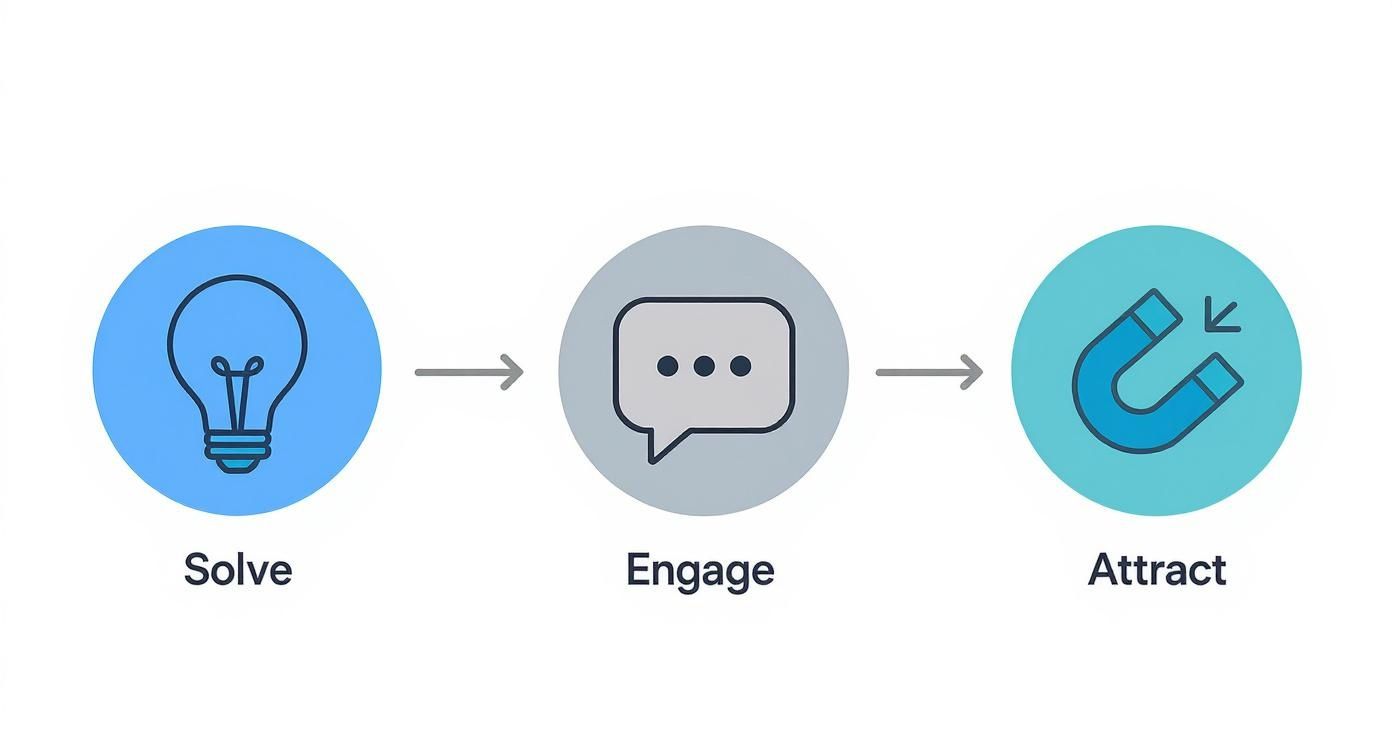
When you focus on solving problems and engaging authentically, you naturally attract the right clients. This makes them much more receptive when you do decide to reach out directly.
Crafting Connection Requests That Get Accepted
Your connection request note is your first impression. A blank request is a wasted chance, but a bad one is a nail in the coffin. Ditch the default "I'd like to add you to my professional network" and get personal.
The best notes are short, specific, and all about the other person. They immediately answer the question everyone has in their head: "Okay, why are you contacting me?"
Here are a few approaches I’ve seen work time and time again:
- Mention a Mutual Group: "Hi [Name], I saw we're both in the SaaS Growth Hackers group. Really enjoyed your comment on that thread about PLG models."
- Reference Their Content: "Hi [Name], your post on team management really hit home. Your point about asynchronous communication was spot on."
- Acknowledge a Company Win: "Hi [Name], congrats to you and the team at [Company Name] on the recent funding round. That’s huge news for the industry!"
Notice what's missing? Any mention of your product or service. The only objective here is to start a conversation by showing you’ve paid attention. That alone sets you apart from 99% of the noise in their inbox.
The Art of the Follow-Up Message
So, they accepted. Great! Now the real work starts. Don't ruin the moment by immediately launching into your sales pitch. That’s the fastest way to get ignored, or worse, removed as a connection.
Your first message after connecting should simply continue the conversation and offer some kind of value, no strings attached. For instance, if you connected over a shared interest in content marketing, you could share a link to a brilliant article you just read.
Your first interaction after connecting should be 100% about them. Ask a thoughtful question about their work, comment on something from their profile, or share something you think they'll find genuinely useful. This is a core tenet of effective social selling for B2B, where you build the relationship long before you ever talk business.
Sending Messages That Actually Start Conversations
The difference between a message that gets a reply and one that gets deleted often comes down to a few key details. Generic, self-serving messages are a dime a dozen. Value-driven, personalized notes are rare and appreciated.
Here’s a look at what separates the good from the bad.
Effective vs Ineffective LinkedIn Outreach Messages
| Element | Ineffective Approach (What to Avoid) | Effective Approach (What to Do) |
|---|---|---|
| Opener | "Hi, I'm a sales rep at..." | "Hey [Name], I noticed you..." (Reference a post, job change, or shared interest) |
| Focus | Me, my company, my product. | You, your company, your challenges. |
| Value Prop | A list of product features. | How you solve a specific problem they likely have. |
| Call to Action | "Are you free for a 15-min demo tomorrow?" | "Is [topic] something on your radar right now?" (A low-friction, open-ended question) |
| Personalization | "I see you work in [Industry]." | "Loved your recent article on [Specific Topic]. The point about X was brilliant." |
Ultimately, a good message feels like a conversation starter, not a transaction.
Building Hyper-Targeted Prospect Lists
Your outreach is only as good as your targeting. Sending the world's most perfect message to the wrong person is a complete waste of time. LinkedIn, especially with a Sales Navigator subscription, gives you an incredible toolkit to build laser-focused prospect lists.
Don't just filter by job title and industry. You have to go deeper to find people who are most likely to need what you offer right now.
Advanced Filters to Use:
- Posted Content: Find people who are actively talking about keywords related to the problems you solve.
- Company Headcount Growth: Target companies that are hiring. Growth often means they have a budget for new tools and services.
- Recent Job Changes: A newly hired executive is almost always looking to make a quick impact and bring in new solutions.
Building these specific lists makes personalization a breeze and will dramatically boost your response rates. With over 1 billion professionals on the platform, precision is your most valuable asset. The great news is, your effort will likely be rewarded. The average reply rate to LinkedIn messages is an impressive 85%—three times higher than email. It just goes to show that when you find the right person and send a relevant message, they are very likely to engage.
Nurture Leads by Engaging With Your Network
Getting someone to accept your connection request isn't the finish line; it's the starting gun. So many people drop the ball right here, letting a perfectly good connection turn cold. The real work—and where the opportunities are—is in what you do after you connect. It’s all about consistent, thoughtful nurturing.
This isn't about spamming their inbox with more messages. It’s about building a genuine professional relationship by showing up where your prospects are already spending their time. When you stay top-of-mind, your name is the first one they think of when a problem you can solve pops up.
The aim is to transform that cold connection into a warm lead—someone who already sees you as a credible expert before they even have a budget for your services. This value-first mindset is the secret to building a sustainable pipeline, not just chasing short-term wins.
Become a Fixture in Their Feed
One of the most effective ways to nurture connections is also one of the most overlooked: leaving insightful comments on their posts. Honestly, it can be more powerful than a DM because it’s public, it showcases your expertise to their entire network, and it proves you’re actually paying attention.
But please, don't just drop a "Great post!" and move on. That's a complete waste of a click. Your goal is to add real value to the conversation.
- Ask a smart follow-up question that gets them (and others) to think and elaborate.
- Share a quick, relevant story or personal experience that builds on their point.
- Tag someone else in your network who would genuinely benefit from the post, which adds value for everyone involved.
Doing this consistently signals that you're an active, helpful member of their professional world, not just another salesperson waiting to pounce.
Remember, the LinkedIn feed is where your prospects are learning, sharing, and thinking out loud. By consistently showing up in their conversations with valuable insights, you build trust and authority in the most authentic way possible.
Use Groups for Problem-Solving, Not Pitching
LinkedIn Groups can be an absolute goldmine, but most people treat them like a billboard. They jump in, drop a link to their latest article, and bounce. That’s the digital equivalent of running into a conference, yelling about your company, and running out. It doesn’t work.
Think of groups as a place to solve problems. Your strategy should be to find a handful of active groups where your ideal clients congregate and simply commit to being one of the most helpful people in the room.
A group strategy that actually works looks like this:
- Listen First: Before you post anything, spend some time just reading. Get a feel for the common challenges, frustrations, and questions people are asking.
- Answer Generously: When you spot a question you can answer, jump in with a detailed, genuinely helpful comment. Don't gatekeep your best advice.
- Spark Discussion: Post your own open-ended questions related to a common pain point you've observed. Get people talking.
When you establish yourself as a go-to resource, you’ll start seeing people reach out to you. It completely flips the script, turning your prospecting from outbound to inbound.
Build Goodwill Through Simple Gestures
Finally, never underestimate the impact of small, human touches. LinkedIn practically hands you opportunities to build goodwill every single day.
Take a few minutes to scroll through your notifications and acknowledge people’s career milestones. Congratulate someone on starting a new position, celebrate their work anniversary, or give a shout-out for a recent promotion. These tiny interactions take seconds but show you see the person behind the profile.
This is how you build a real network—one filled with people who know you, like you, and trust you. That's the foundation for every single lead you'll ever generate.
Turning LinkedIn Activity Into a Predictable Growth Engine
Getting leads is great. But building a predictable, scalable system that churns them out consistently? That's the real goal. All the profile tweaks, content writing, and outreach messages are just busy work unless you can actually measure what’s landing and what’s falling flat.
This is where we shift from just doing things on LinkedIn to building a data-driven machine. You don't need a spreadsheet with a hundred different metrics. In fact, that's a recipe for analysis paralysis. Instead, focus on a handful of key performance indicators (KPIs) that tell you the real story. This is how you stop guessing and start knowing what your audience actually wants.
The Metrics That Actually Matter
To get a clear picture of your lead generation funnel's health, you need to keep a close eye on a few critical numbers. Think of them as vital signs; they show you how effectively you’re moving prospects from strangers to interested leads.
- Connection Request Acceptance Rate: This is your first major hurdle. If you're seeing an acceptance rate over 30%, you know your targeting is on point and your personalized notes are hitting the mark. If it's dipping below that, it's time to re-evaluate who you're reaching out to or how you're doing it.
- Reply Rate to Your First Message: They accepted your request—now what? The percentage of people who reply to your initial follow-up message is a direct reflection of your opening. A low number here is a dead giveaway that you're probably pitching too hard, too soon, instead of just starting a genuine conversation.
- Content Engagement Rate: Don't just count the likes. Are people actually commenting, sharing, and sparking conversations on your posts? True engagement means your content is striking a chord and positioning you as someone who knows their stuff.
- Profile Views from Your Ideal Prospects: Take a look at the "Who's viewed your profile" section. Are you seeing job titles and companies that match your ideal customer profile? This is a crucial gut check to see if your content and engagement efforts are attracting the right kind of attention.
Keeping these numbers on your radar gives you a clear, honest look at your entire process. If you want to get serious about tracking, setting up a comprehensive social media analytics dashboard can help you organize these metrics and see the trends over time.
Scaling Smart: Human Touch vs. Automation
Once you start getting traction, you’ll quickly find there aren't enough hours in the day to manage everything by hand. You have to scale, but you have to do it smartly. This isn't about choosing between automation or a human approach; it’s about knowing where each one fits.
Automation is for efficiency. The human touch is for connection. Never confuse the two. Use tools to handle repetitive tasks so you can save your energy for the high-value, relationship-building conversations that actually close deals.
Here’s a practical way to divide the labor:
| Task | Best for Automation | Best for Human Touch |
|---|---|---|
| List Building | Yes. Tools like Sales Navigator are fantastic for quickly filtering and finding prospects based on specific criteria. | No. You still need a human to do a final quality check on those lists. Not every "perfect" profile is actually a good fit. |
| Connection Requests | No. This is non-negotiable. A generic, automated request gets ignored. A thoughtful, personalized note gets accepted. | Yes. Spend 60 seconds on their profile to find a genuine reason to connect. It makes all the difference. |
| Follow-Up Messages | No. Your first few messages have one job: start a real conversation. This requires empathy and tailoring, not a template. | Yes. This is where you uncover pain points, build trust, and have the actual dialogue that leads to a sale. |
| Content Scheduling | Yes. Absolutely. Use a scheduling tool to keep your posting consistent without having to live on LinkedIn. | No. The content itself—the ideas, the voice, the insights—has to come from you. That's what makes it authentic. |
This balanced approach lets you increase your activity without watering down the quality of your interactions. You can plug in a CRM to keep conversations organized so no one slips through the cracks, while focusing your personal time and energy on the moments that truly matter. By measuring your results and scaling intelligently, you’re no longer just "on LinkedIn"—you're building a sustainable engine for high-quality leads, month after month.
Ready to turn social media conversations into qualified leads without lifting a finger? Replymer uses real writers to find high-intent discussions about problems you solve and crafts authentic, helpful replies that recommend your product. Learn more and start growing on autopilot at https://replymer.com.