When we talk about organic social media growth, we're talking about growing your audience, engagement, and brand footprint on social platforms without paying for ads. It's about earning attention, not buying it. This is a deliberate, long-game strategy centered on building a real community through valuable content and genuine conversations.
The Real Value of Organic Social Growth
Let’s get straight to it. Organic social media growth isn’t just some passive exercise where you post and hope for the best. It's a strategic investment in building actual relationships. In a world where everyone is shouting to be heard through ads, a real connection is one of the most powerful assets a SaaS or B2B brand can have.
Think of it this way: paid ads are like hunting. You spend money to go out and capture a lead, right now. It works, but as soon as you stop spending, the hunt is over. Your visibility plummets.
Organic growth is more like farming. You’re carefully planting seeds of value, nurturing conversations, and consistently tending to your community. It’s slower, sure, but you're building a self-sustaining ecosystem where loyalty and trust can actually grow. The harvest is far more rewarding in the long run.
Why It Matters for B2B and SaaS
In the B2B and SaaS world, sales cycles are longer and more considered. Decisions aren't made on a whim; they're built on trust and credibility. This is exactly where an organic approach has the upper hand.
It’s about fostering the authentic connections you need to turn followers into advocates. This isn't just a theory; around 67% of businesses lean on organic content sharing on Facebook alone to build a digital presence that delivers lasting value. You can dig into more data on organic content strategies and their benefits.
Here’s a quick look at how organic and paid strategies stack up.
Organic Growth vs Paid Ads At a Glance
While both have their place, understanding their core differences is key to building a smart social media strategy. This table breaks down the essentials.
| Attribute | Organic Growth | Paid Ads |
|---|---|---|
| Approach | Community building, value exchange, and relationship nurturing. | Audience targeting, direct promotion, and conversion focus. |
| Cost | Time, creativity, and consistent effort (human resources). | Direct ad spend (PPC, CPM) and campaign management costs. |
| Time to Results | Slower, compounding returns over months or years. | Immediate, but results stop when spending stops. |
| Trust Factor | High. Builds credibility and authority over time. | Lower. Often perceived as a direct sales pitch. |
| Longevity | Evergreen. Content and community are long-term assets. | Temporary. Visibility is rented, not owned. |
| Audience | Builds a loyal, engaged community that chose to follow you. | Reaches a broad, targeted audience that may not know you. |
Ultimately, paid ads are great for a quick boost or reaching a new, specific audience. But organic growth is what builds the foundation for sustainable success.
This strategy gives you some serious advantages:
- Builds Lasting Trust: When you consistently show up with helpful content, you become a credible authority. That’s everything in high-stakes B2B decisions.
- Creates a Feedback Loop: A real community gives you an unfiltered line to customer pain points, feature ideas, and market chatter.
- Drives Qualified Leads: People who follow and engage with you organically are already invested. They make for much warmer, higher-quality leads.
- Offers Compounding Returns: Every post, every comment, every helpful interaction builds on the last. You create momentum that doesn’t just vanish when a campaign budget runs out.
The core difference is simple: Paid media rents an audience, while organic media builds one. For a sustainable business, ownership is always the better long-term play.
Investing in organic social growth means you're building a core asset for your company. It's the difference between a flash in the pan and a loyal following that will champion your brand for years.
How to Build a Winning Organic Growth Strategy
Let's get one thing straight: building a real organic growth engine on social media isn't about stumbling upon some "growth hack." It’s about building a solid, repeatable system based on a few core pillars that create genuine value and connection. This isn't about just posting into the void; it's about building a framework for growth that actually lasts.
The biggest mental shift you need to make is from monologue to dialogue. So many brands still use social media like a megaphone, just blasting out their marketing messages. A winning strategy treats it more like a town square—a place where listening is far more valuable than shouting.
Master Community Engagement
Real engagement is so much more than just replying to comments on your own posts. It means rolling up your sleeves and becoming an active participant in the online communities where your ideal customers are already hanging out. This is where you build trust and show off your expertise, not by selling, but by being genuinely helpful.
The goal is to become a familiar, trusted voice in the conversation. Nailing your B2B social media engagement strategies is absolutely fundamental to seeing any kind of sustained organic growth.
Here’s what that looks like in practice:
- Add Value, No Strings Attached: Jump into conversations to answer questions, offer a unique perspective, or share a helpful resource. Expect nothing in return.
- Be a Human: Let your brand's personality shine through. Be approachable, crack a joke, and connect with people on a personal level.
- Shine the Spotlight on Others: Celebrate your users' wins, congratulate peers on their successes, and amplify other great voices in your industry.
When you take this approach, you stop being an outsider trying to sell something and become a valued insider contributing to the community.
Embrace Conversation-Based Outreach
This is all about finding relevant conversations already happening across social platforms and jumping in at the right moment. You're meeting potential customers exactly where they are, right when they have a problem you can solve, instead of hoping they'll stumble across your website.
Think about someone on X (formerly Twitter) asking their network for recommendations on a new project management tool. A generic ad from a brand will likely get scrolled past. But a thoughtful, helpful reply from a real person can kickstart a meaningful conversation.
This requires keeping a close eye on keywords and phrases related to your industry and the pain points your customers face. To do this effectively, many teams rely on social media mention monitoring to make sure a golden opportunity never slips through the cracks.
The most powerful lead isn't one you captured with a form; it's one you earned through a helpful conversation. This is the essence of modern organic growth.
This visual perfectly illustrates the difference between the long-term, compounding nature of organic growth and the short-term, transactional feel of paid ads.
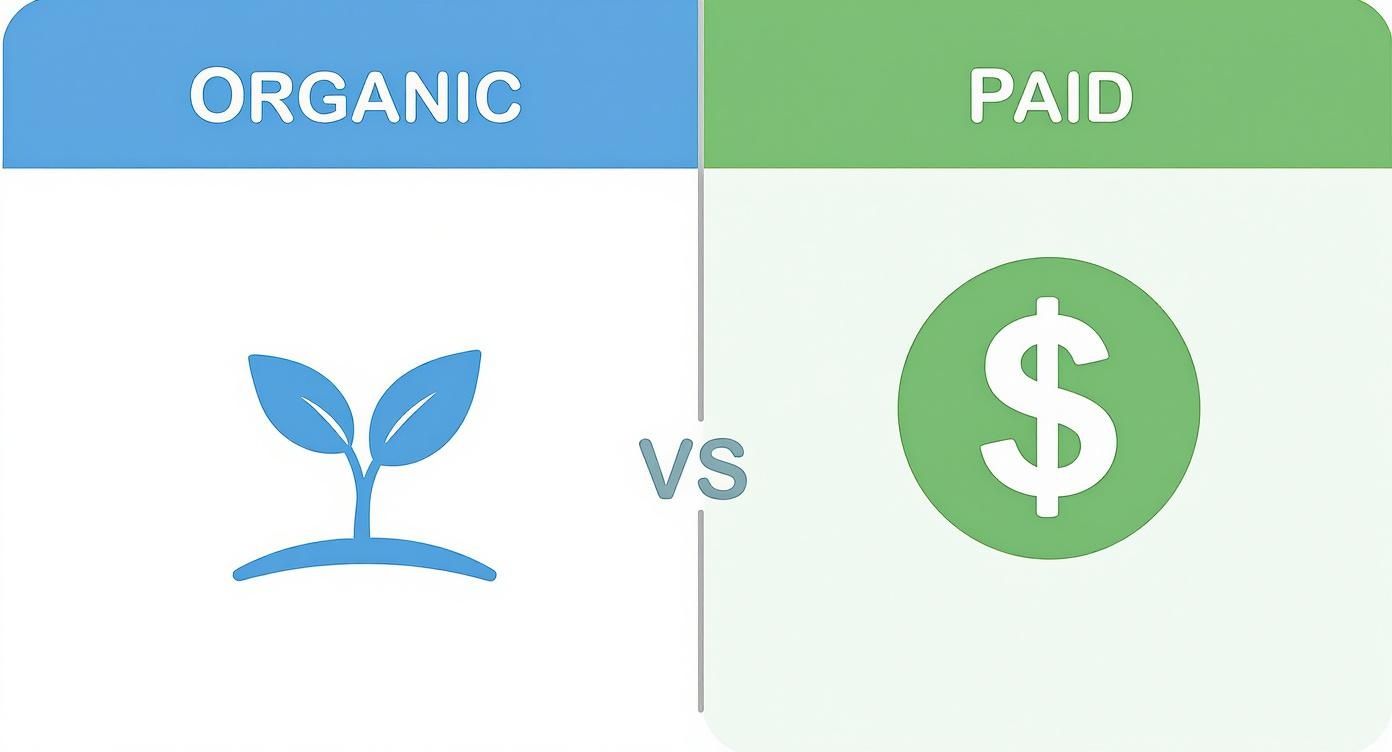
Organic efforts build assets—like your community, your brand's reputation, and a library of valuable content—that grow over time. Paid ads, on the other hand, stop working the second you turn off the spend.
Develop a Strategic Content Cadence
Consistency is the fuel for your organic growth engine. A strategic content cadence isn't just about posting a certain number of times per week. It’s about creating a predictable rhythm your audience can learn to expect, which keeps your brand top-of-mind.
A solid cadence is always built on content pillars—these are the 3-5 core themes your brand will own and talk about consistently. These pillars keep your content focused and prevent you from veering off into random topics that don't serve your audience or your business goals.
For a B2B SaaS company, the pillars might look something like this:
- Educational How-To's: Deeply practical advice that helps users solve a problem, ideally with your tool.
- Industry Analysis: Your unique take on market trends and what they mean for your audience.
- Customer Stories: Real-world proof of how your product helps people achieve their goals.
- Behind the Scenes: Content that humanizes your company and shows the people behind the product.
This structure puts an end to random acts of content and ensures every single post has a purpose.
Maximize Reach with Smart Repurposing
Creating one fantastic piece of content takes a ton of work. A smart repurposing strategy makes sure you squeeze every last drop of value out of that effort. You can take one big idea and atomize it into dozens of smaller pieces of content, each perfectly suited for a different platform.
Here’s a quick example of how one in-depth blog post can be spun into gold:
- X (Twitter) Thread: Distill the key arguments into a punchy, easy-to-digest thread.
- LinkedIn Carousel: Convert the main stats and takeaways into a visually compelling slide deck.
- Short-Form Video: Write a 60-second script summarizing the core message for a TikTok or Reel.
- Infographic: Visualize the key data points for Pinterest or to embed back into the original post.
This approach doesn't just save you a massive amount of time; it lets you meet different segments of your audience on the platforms where they actually want to consume content. By building these four pillars into your workflow, you create a powerful, holistic strategy for driving sustainable organic social media growth.
Measuring the Metrics That Actually Matter
It’s easy to get caught up in the follower count, watching that number tick up and feeling like you're winning. But in reality, a high follower count is often just a vanity metric. Real organic social media growth is measured by a much deeper set of numbers—ones that show your audience is healthy, genuinely connected, and actually impacting your business.
It’s time to stop counting followers and start measuring what truly moves the needle.
Think of it this way: a packed stadium looks impressive, but what's the point if no one is cheering, clapping, or even watching the game? Your social media metrics work the same way. A massive audience means nothing if they aren’t engaging with your content in meaningful ways.
Moving Beyond Surface-Level Numbers
The first step is a mental shift—from accumulation to action. Instead of asking, "How many followers did we gain?" start asking, "How many meaningful conversations did we start?" or "How many people clicked through to our website?" This simple reframe forces you to focus on metrics that signal genuine interest and intent.
True organic growth isn't about the size of your audience; it's about the quality and depth of the relationships you're building with them. High engagement from a small, dedicated community is infinitely more valuable than passive viewership from a massive, indifferent one.
To get a clear picture of what’s working, you need a solid way to track these KPIs. Bringing all your data into a well-organized analytics social media dashboard is the best way to spot trends and make smart decisions without getting buried in spreadsheets.
The KPIs That Signal True Growth
To really understand your organic success, you need to track a mix of metrics covering audience interaction, growth momentum, and business outcomes. Here are the core numbers every B2B and SaaS brand should have their eyes on:
- Engagement Rate: This is your north star. It's the percentage of your audience that interacts with your content (likes, comments, shares, saves). A high engagement rate is proof that your content is hitting the mark, no matter how big or small your audience is.
- Audience Growth Velocity: Don't just look at the total number of new followers. Track the rate of growth month-over-month. This tells you about your momentum and helps pinpoint which strategies are actually accelerating your reach.
- Website Referral Traffic: This metric ties your social media efforts directly to business goals. Use your analytics tools to see how many people are clicking from your social profiles and posts to your website. It’s a clear line connecting social activity to ROI.
- Comment Sentiment: It's not just about the number of comments; it's about what they're saying. Are people asking smart questions and praising your insights, or are the comments just generic "great post!" messages? Positive, thoughtful sentiment is a powerful sign of a healthy community.
Understanding Platform-Specific Engagement
Not all engagement is created equal. In the competitive world of 2025, a look at organic social metrics shows TikTok is in a league of its own. Creators with under 100,000 followers are seeing engagement rates as high as 7.5%, which blows Instagram's 3.65% out of the water. With 73% of businesses leaning on organic tactics, knowing these platform differences is crucial for deciding where to spend your time and effort.
This data makes it obvious why a one-size-fits-all strategy just doesn't work anymore. What's considered a "good" engagement rate on LinkedIn is completely different from a good one on X.
From Data to Actionable Insights
Collecting data is only half the battle. The real magic happens when you turn that data into action.
If you see a sudden spike in your growth rate, dig in. Did a specific X thread go viral? Did a particular LinkedIn carousel really connect with people? Find out what caused it, and then double down on what works. Tools for tracking followers and unfollowers on Twitter can also offer vital clues, helping you see which content and engagement tactics are attracting—or repelling—your ideal audience.
By focusing on these deeper metrics, you’ll shift from just reporting numbers to actively building a strategy that drives sustainable, meaningful organic social media growth.
In-House Team vs. Done-For-You Service: Who Should Handle Your Social Engagement?
So, your organic social strategy is working. The mentions, comments, and DMs are starting to pile up, which is great news! But it also brings you to a fork in the road.
The conversations are happening faster than you can keep up with. Do you hire more people internally to manage it all, or do you bring in a specialized done-for-you service to handle the replies? There’s no single right answer here—it really comes down to your company's stage, budget, and priorities. Let's break down which path makes the most sense for you.
The Case for an In-House Team
Keeping your social media engagement in-house has one huge, undeniable advantage: unmatched brand authenticity.
Your own employees live your company culture every day. They get the inside jokes, understand the product's tiniest details, and can speak with a passion that’s almost impossible for an outsider to fake. This is the perfect setup for early-stage companies or brands where the founder's personality is a massive part of the appeal. Every reply is guaranteed to be on-brand because it’s coming straight from the source.
The catch? It’s tough to scale. As your brand gets more attention, sifting through conversations and replying thoughtfully can quickly become a full-time job for one, two, or even more people. Hiring, training, and managing a dedicated social media team is a serious investment of both time and money.
The real power of an in-house team is its direct line to your brand’s DNA. The challenge is keeping that personal touch alive as the volume of conversations explodes, without burning out your people or letting quality slip.
When to Bring in a Done-For-You Service
A done-for-you service, on the other hand, is built from the ground up to handle scale. These are specialized teams of writers and strategists whose only job is to monitor online chatter, spot opportunities, and jump into conversations on your behalf.
This is the ideal solution for companies that are hitting an inflection point. You’re ready to double down on organic growth but just don’t have the internal bandwidth to manage the daily grind of replying to everyone. The biggest perks here are efficiency and expertise. A good service can keep an eye on thousands of conversations across multiple platforms around the clock—something most in-house teams can only dream of.
You get to plug into a fine-tuned engagement machine almost overnight, with predictable costs and no hiring headaches. This frees up your internal team to focus on the bigger picture, like creating amazing content or planning your next big campaign. The trick is to find a partner who can truly master your brand voice and sound genuinely human. To learn more about what this looks like, you can read up on what makes a great social media growth service.
Decision Matrix: In-House vs. Done-For-You Engagement
Still not sure which way to go? This little framework should help. Think about where your business is right now and see which column feels like a better fit.
| Factor | In-House Team | Done-For-You Service |
|---|---|---|
| Brand Voice Control | Perfect for highly personal or founder-led brands where the voice is complex and intuitive. | Works well for brands with a clearly defined voice that can be taught through style guides. |
| Scalability | Best suited for a lower, manageable volume of conversations where a small team can maintain quality. | Built for high-volume environments that require consistent, 24/7 monitoring and fast replies. |
| Cost Structure | An investment in full-time employee salaries, benefits, and overhead. | A predictable subscription cost that scales up or down as needed, without hiring commitments. |
| Speed to Implement | Slower ramp-up time due to the need for hiring, onboarding, and training new staff. | Very fast implementation—you can often be up and running in just a few days or weeks. |
| Team Focus | Best when social engagement is seen as a core, strategic role for a dedicated internal person. | Ideal when you want your internal marketing team to focus on content and strategy, not daily replies. |
Ultimately, the choice isn't about which option is objectively "better," but which one is better for you, right now. An in-house team gives you perfect brand alignment but can be hard to scale. A done-for-you service gives you that scale and efficiency, but it means placing your trust—and your brand's voice—in a partner's hands.
Common Mistakes That Sabotage Organic Growth
Ever feel like you’re spinning your wheels on social media? You put in the hours, create the content, and... crickets. This is an incredibly common frustration, and it usually boils down to a few critical mistakes that quietly sabotage all your hard work.
The truth is, organic growth isn't dead. Not by a long shot. But many brands are still using an old, broken playbook that focuses on shouting into the void instead of building real connections. Let's look at the most common ways companies get it wrong.
If you can spot these habits and sidestep them, you’ll be miles ahead of the competition.
Treating Social Media as a Megaphone
The single biggest mistake is using social media as a one-way broadcast channel. When your feed is nothing but promotional posts, product updates, and links to your website, you're not being social—you're just running an advertisement.
Think of it like this: you wouldn't walk into a networking event and just yell your sales pitch at everyone. You'd have conversations. Social media works the same way; growth is fueled by dialogue, not a monologue.
The Fix: Try the 80/20 rule. Make sure 80% of your activity is about providing genuine value—sharing insights, asking questions, and jumping into conversations. The other 20% can be for your promotional stuff. This simple shift turns your profile from a billboard into a place people actually want to hang out.
Posting Inconsistently
Vanishing for days or weeks at a time is the fastest way to kill your momentum. Social media algorithms are designed to promote active, reliable accounts. When you post sporadically, you're sending a signal that your account isn't a dependable source of content.
Inconsistency is the enemy of trust. When your audience doesn't know when to expect content from you, they eventually stop looking for it altogether. This makes achieving organic social media growth nearly impossible.
This erratic schedule doesn't just confuse your followers; it tells the platform to show your content to fewer people, shrinking your reach over time.
Ignoring Audience Conversations
Your audience is handing you free market research every single day in the comments and replies. Ignoring those conversations is like turning your back on a focus group that’s eager to help. When you don't engage, you're telling your community that their input doesn't matter, which is a surefire way to kill future interaction.
The Fix: Make community management a non-negotiable part of your day.
- Be quick to respond: Aim to answer comments and DMs as quickly as you can.
- Keep the chat going: Ask follow-up questions to turn a simple comment into a real conversation.
- Acknowledge all feedback: A simple "thanks for sharing this" goes a long way, even with criticism.
Using a One-Size-Fits-All Content Strategy
Copy-pasting the same content across LinkedIn, X (formerly Twitter), and Instagram is a recipe for failure. Each platform has its own culture, its own language, and its own content formats that work best. A deep-dive case study might crush it on LinkedIn but would be totally out of place on Instagram.
With the number of global social media users expected to hit 5.24 billion by 2025, you have to be smart about grabbing attention. Platform-specific behavior matters. For instance, LinkedIn engagement benchmarks hover around 6.5%, while Instagram's has fallen to just 0.61%, according to the latest social media user statistics. This huge difference shows just how much your strategy needs to adapt to where you're posting.
Avoiding these common traps is more than half the battle. By shifting from broadcasting to engaging, staying consistent, and respecting each platform’s unique style, you can build a solid foundation for real, lasting organic growth.
Organic Growth Success Stories
It's one thing to talk about strategy in theory, but seeing it work in the real world is where the lessons really stick. Let's look at a couple of brands that absolutely nailed organic growth by tossing out the old playbook.
These stories prove you don’t need a massive ad budget to make a huge splash. Instead, these companies focused on what really matters: building genuine communities and having real conversations.
https://www.youtube.com/embed/5iIx2mNWlTk
Case Study 1: How Glossier Built a Community-Powered Empire
The Challenge: Imagine launching a beauty brand in an industry packed with legacy giants. That was Glossier's reality. They had a shoestring budget and needed a clever way to build trust and get people buying without spending a fortune on traditional ads.
The Strategy: Glossier did something brilliant: they made their customers the stars of the show. Instead of pushing ads, they built their entire social media presence around user-generated content (UGC). They encouraged everyone to share photos of their own makeup looks using the hashtag #glossier.
Then, they featured those real, authentic customer photos all over their official social channels. This wasn't just about getting free content; it was about building a genuine community and celebrating the people who loved their products. They turned customers into passionate advocates.
Glossier didn't just market to their audience; they marketed with them. Their social feed became a living testament to their products, built on authentic stories from real users. That’s a level of trust paid ads simply can't buy.
The Results: The outcome was phenomenal. Glossier's Instagram following exploded, climbing into the millions. This wasn't just a vanity metric; this highly engaged community drove incredible brand loyalty and, most importantly, massive sales, carving out a dominant spot for Glossier in a cutthroat market.
Case Study 2: Wendy's Wins by Mastering the Roast
The Challenge: In the fast-food world, everyone is shouting to be heard. Wendy's was up against competitors with bottomless marketing budgets and needed a way to stand out, especially with younger customers who are notoriously hard to impress.
The Strategy: Wendy's decided to completely torch the corporate social media rulebook. They dropped the bland, safe marketing-speak and developed a personality on X (formerly Twitter) that was sharp, hilarious, and refreshingly bold.
They started roasting competitors, engaging in witty banter with followers, and dropping clever one-liners that felt less like a brand and more like your funniest friend. This wasn't just a gimmick; it was a masterclass in understanding the platform's culture and speaking its language.
The Results: It worked better than anyone could have imagined. Wendy's X account became legendary, attracting millions of followers and earning astronomical engagement. Their posts didn't just get likes; they became viral cultural moments.
This online fame translated directly into real-world results: soaring brand awareness, more people walking into their restaurants, and a significant boost in sales. It was definitive proof that a unique voice is one of the most powerful assets for organic social media growth.
Frequently Asked Questions
Even with the best playbook, you're bound to run into some common questions. Let's tackle the big ones I hear most often when it comes to growing on social media without a big ad budget.
How Long Does It Really Take to See Organic Growth?
Look, there’s no magic switch. You can expect to see real, compounding results from your organic efforts in about three to six months—if you're consistent.
Sure, you might see little wins sooner, like a spike in engagement on a great post within the first few weeks. But building a genuine community that actually impacts your bottom line? That's a marathon, not a sprint. Patience and consistency are your best friends here. Unlike paid ads, which buy you temporary attention, organic growth is like building a house brick by brick. Every valuable post and every real conversation makes your brand's foundation stronger.
What’s the Best Platform for Organic Growth?
Right now, TikTok has the most explosive potential for organic reach because its algorithm is all about discovery. But that doesn't automatically make it the "best" platform for you.
The real answer depends entirely on where your ideal customers hang out.
- LinkedIn: Non-negotiable for most B2B companies. This is where professional conversations and deep-dive content win.
- X (formerly Twitter): Unbeatable for jumping into real-time industry chats and executing conversation-based outreach.
- Instagram: Still a powerhouse for visual brands and building a community around a certain lifestyle, but be prepared—gaining organic traction is tougher than it used to be.
The smartest move isn’t to chase virality on the trendiest platform. It's to master the platform where your customers are already talking. Go there first.
Can You Actually Grow Without Paid Ads?
Absolutely. In fact, going all-in on organic is one of the best ways to build an authentic community of people who genuinely care about what you do. Paid ads are great for pouring fuel on a fire that’s already burning, but they aren't necessary to get the fire started.
Growing without an ad budget means you have to be exceptional at the fundamentals we’ve covered: give away massive value, have real conversations, and show up consistently. Brands like Glossier and Wendy's built their social media empires almost entirely on clever organic strategies. They proved it's not just possible—it's incredibly powerful.
How Do You Measure the ROI of Organic Social Media?
This is where many people get tripped up. The ROI of organic social isn't just about follower count. You have to connect your social activities to actual business goals.
Focus on the metrics that tell the real story:
- Website Referral Traffic: How many people are actually clicking through to your website from your social profiles?
- Lead Generation: Of that traffic, how many are signing up for a demo, downloading a lead magnet, or filling out a contact form?
- Conversion Rate: What percentage of those social media leads eventually become paying customers?
- Audience Engagement Rate: This is a crucial leading indicator. A highly engaged audience is a healthy audience, and healthy audiences are far more likely to convert down the road.
Ready to scale your organic growth without scaling your team? Replymer uses real human writers to find relevant conversations and post authentic, brand-voiced replies on X, Reddit, and LinkedIn. See how we turn online discussions into qualified leads for your business. Learn more at Replymer.