Think of your marketing less like a billboard and more like a dinner party. A billboard just shouts a message at anyone passing by, hoping a few people pay attention. A dinner party, on the other hand, is an invitation into your home. It’s a place where people can connect, share stories, and feel like they’re part of something real.
That’s the essence of community marketing. It’s a strategy built around fostering genuine connections and creating a shared space around your brand.
From Broadcasting to Belonging
Community marketing is a fundamental pivot away from one-way, top-down communication. Instead of just pushing messages out, you’re building a living network of relationships. It’s about creating a space where your customers and fans don't just buy from you—they belong with you.
This approach builds a sustainable ecosystem where value flows in every direction: from the brand to its members, and maybe even more importantly, between the members themselves. Instead of chasing short-term sales, the focus shifts to nurturing long-term advocacy. When you put your members first, you turn passive consumers into active participants who share ideas, help each other out, and become your most authentic champions. That creates a powerful, loyal base that competitors simply can't buy.
To really grasp the difference, let's compare the two approaches side-by-side.
Community Marketing vs Traditional Marketing at a Glance
This table breaks down the core differences in mindset, goals, and communication.
| Aspect | Traditional Marketing | Community Marketing |
|---|---|---|
| Primary Goal | Drive immediate transactions (sales, leads). | Foster long-term relationships and loyalty. |
| Communication | One-to-many (broadcasting). | Many-to-many (conversation). |
| Key Metric | Reach, impressions, conversion rate. | Engagement, retention, user-generated content. |
| Customer Role | Passive audience or consumer. | Active participant and co-creator. |
| Value Proposition | "Buy our product, it solves your problem." | "Join us, you belong here." |
As you can see, traditional marketing is about talking at people, while community marketing is about talking with them. It’s a shift from a transactional relationship to a relational one.
The Power of Deep Engagement
The real magic of this strategy lies in the quality of engagement, not just the raw number of followers. In a world of fleeting social media likes and follows, the depth of connection a community provides has a massive impact on brand growth.
The research is pretty staggering: one truly engaged community member generates the same level of engagement as 234 social media followers. That's a powerful reminder that depth beats breadth every time.
It doesn't stop there. Community members are also 6.2x more likely to share brand content than people who just follow you on social media. This creates a powerful word-of-mouth engine that can dramatically reduce your reliance on paid ads.
Modern Applications and Evolving Spaces
This customer-first philosophy isn't just for one type of business. It works for SaaS companies with user forums, direct-to-consumer brands with lively social groups, and everything in between. The core principles hold true whether your community lives on a dedicated platform like Discord or in newer, decentralized spaces.
For a look at how these ideas are being applied in cutting-edge environments, this guide on building a Web3 community program is a great resource. Ultimately, the key is to create a sense of shared identity and purpose that makes people feel like they’re part of something bigger than just a mailing list.
The 3 Pillars of a Thriving Community
A truly great community feels like magic, but it doesn't happen by accident. It's built on a solid foundation. Think of it like building a house—you need structural supports to hold everything up. A powerful community marketing strategy is no different; it rests on three core pillars. When these elements work in sync, they turn a simple audience into a loyal, self-sustaining ecosystem for your brand.
This graphic sums up the fundamental shift from old-school, one-way marketing to a modern, community-first approach.
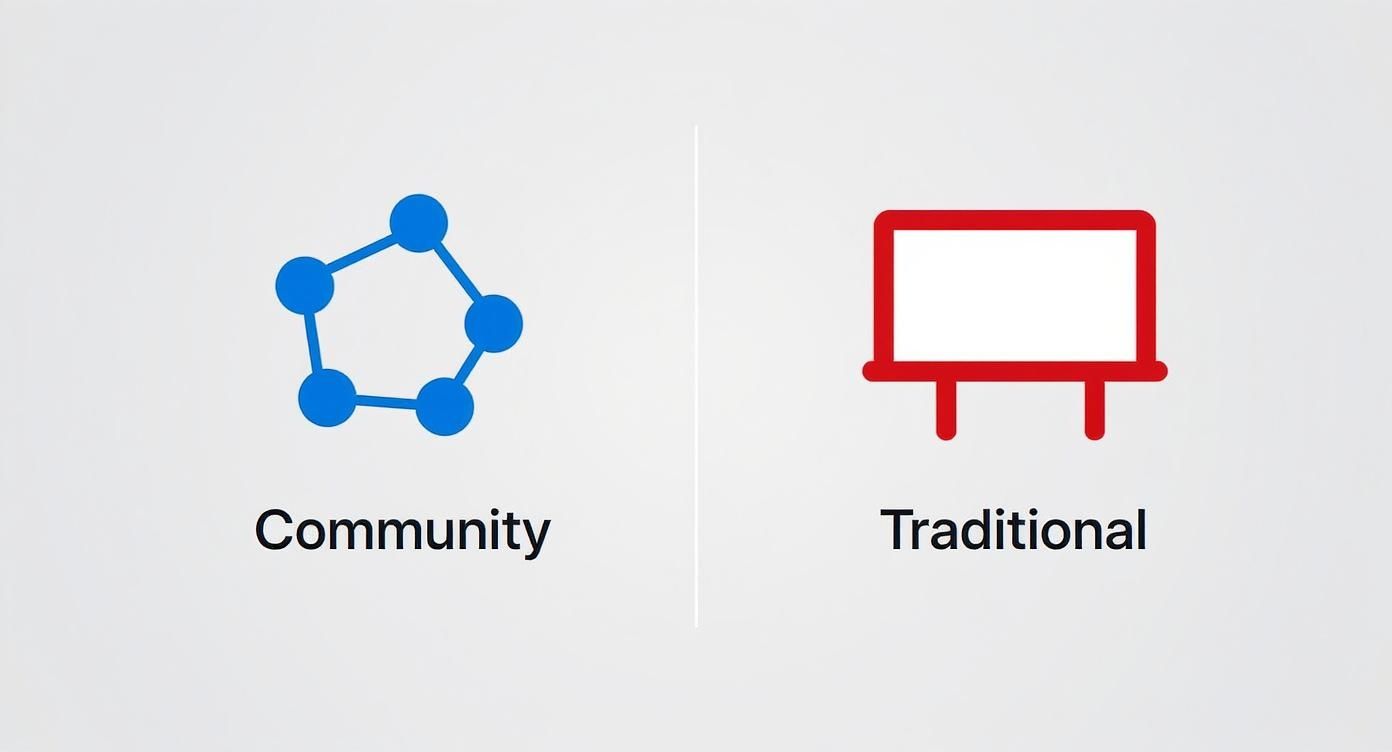
You can see the difference right away. We're moving away from the megaphone (where the brand just talks at people) and toward a connected network where value flows freely between everyone involved.
Pillar 1: Shared Identity
The first and most important pillar is a shared identity. This is the glue that holds everything together. It's the powerful "why" that unites your members and gives them a reason to connect with each other, not just with you. This is the common pain point, the shared passion, or the collective goal that makes someone feel like they’ve finally found their tribe.
For example, a SaaS company could build a community around the identity of "scrappy founders bootstrapping their way to their first million." That's way more magnetic than just "people who use our software." This kind of specific identity instantly creates a sense of belonging and mutual respect.
Pillar 2: Facilitating Connections
Once you've nailed the shared identity, the next step is facilitating connections. A community isn't just a list of people who like the same thing; it's a living network where those people actually talk to each other. Your job is to be the host of the party—to create the spaces and opportunities for those member-to-member interactions to spark.
This can happen in all sorts of ways:
- Digital Hangouts: A dedicated Slack channel, a lively Discord server, or a focused online forum.
- Regular Rituals: Think weekly Q&A sessions with experts, virtual coffee chats, or even member-led workshops.
- Thoughtful Intros: Proactively connecting new members with veterans who can show them the ropes.
The real goal here is to shift from a hub-and-spoke model (where every conversation has to go through the brand) to a true web of connections. When this happens, the community takes on a life of its own, generating value that goes way beyond anything you could create alone.
Pillar 3: Providing Value
The final pillar is providing value. This is the exclusive stuff—the content, access, or support that makes being part of your community a no-brainer. It’s the reward people get for showing up and the reason they keep coming back day after day. Critically, this value needs to be something they can't easily get anywhere else.
This pillar is what keeps the engine running. You might offer sneak peeks of new features, direct access to your product team for feedback, or exclusive guides and masterclasses. For a deeper dive, you can explore other proven community engagement best practices that help keep members hooked.
By consistently delivering on these three pillars—Shared Identity, Facilitating Connections, and Providing Value—you create something special. People join for the purpose, they stay for the relationships, and they become advocates because of the unique benefits they receive. That synergy is the secret sauce of community marketing.
Understanding Your Marketing Team Roles
To get community marketing right, you first need to understand where it fits in the bigger picture. People often toss around terms like "community marketing," "community management," and "influencer marketing" as if they're the same thing. They're not. Confusing them is a surefire way to muddle your strategy and burn through your budget.
Let's break it down with a simple analogy: building a house.
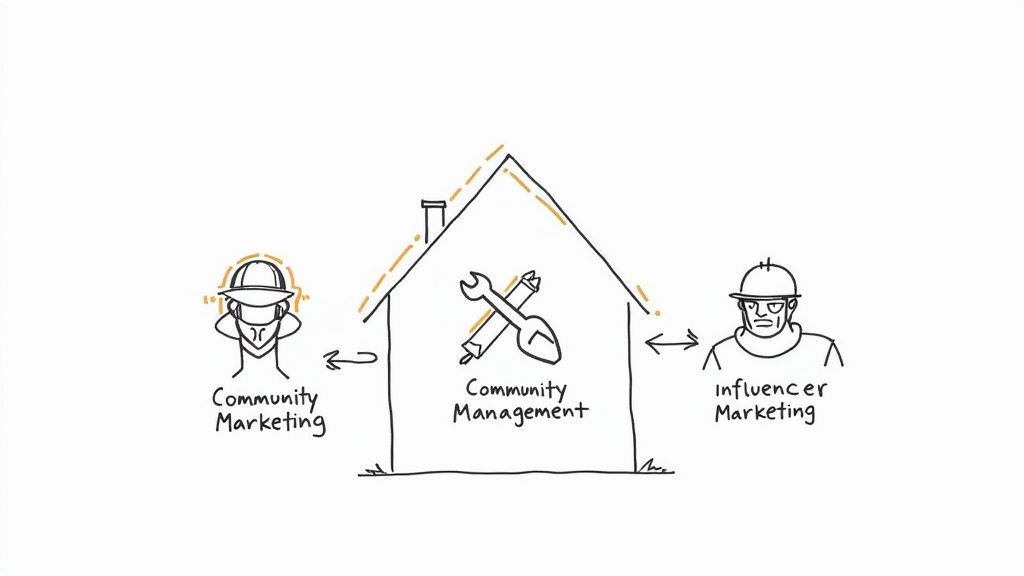
Each of these roles is essential to the project, but they all have very different jobs. Nailing these distinctions is the first step toward creating a growth strategy where every part works together, not against each other.
Community Marketing: The Architect
Think of community marketing as the architect. This is the strategic brain of the operation, the one who designs the entire blueprint with clear business goals in mind. The architect figures out why you’re building the house in the first place (maybe to boost customer retention), who it’s for (your ideal member), and what will make it a valuable place to be for years to come.
This work is all about high-level planning:
- Defining the community's purpose and connecting it directly to business results like lead generation or better product feedback.
- Pinpointing the target audience and figuring out which platforms and channels are the best places to find them.
- Crafting the long-term growth strategy for how you'll attract new members and keep them around.
Ultimately, community marketing is measured by its direct impact on the business—metrics like customer lifetime value (LTV), lower customer acquisition costs (CAC), and even new revenue.
Community Management: The General Contractor
If community marketing is the architect, then community management is the general contractor. They’re on the job site every single day, making sure the house is a safe, welcoming, and vibrant place to live. This role is deeply tactical and relational, focused on the daily health and happiness of the community members.
The general contractor builds relationships, makes sure everyone follows the house rules, and ensures day-to-day life runs smoothly according to the architect's plans.
Their daily to-do list is very hands-on:
- Welcoming new members and showing them around so they feel at home.
- Moderating conversations to keep discussions positive, helpful, and on-topic.
- Organizing events, Q&As, and challenges to spark conversations and boost engagement.
- Gathering feedback from members and funneling those insights back to the product, marketing, and success teams.
A great community manager is the heart of the community. Their success isn't just about the numbers; it's about fostering a genuine sense of belonging and making sure every member feels heard and valued.
Influencer Marketing: The Celebrity Designer
Finally, influencer marketing is like hiring a celebrity designer to stage and promote your newly built house. This is all about borrowing someone else’s credibility and audience to get the word out. You’re not building your own community here; you're paying for access to an established one.
It’s a transactional relationship focused on generating awareness and reach. The influencer promotes your brand to their followers for a fee, driving a short-term burst of attention. While it can be a powerful tactic to introduce people to your community, its main purpose is amplification, not deep, long-term relationship building.
Comparing Key Marketing Approaches
To make these distinctions even clearer, let's look at them side-by-side. The table below breaks down the primary goal, key activities, and success metrics for each discipline.
| Discipline | Primary Goal | Key Activities | Core KPI |
|---|---|---|---|
| Community Marketing | Drive business growth through a community | Strategic planning, audience research, content strategy, growth campaigns | Customer Lifetime Value (LTV), Leads Generated, Revenue Influence |
| Community Management | Foster relationships and engagement within the community | Moderation, event hosting, welcoming new members, gathering feedback | Engagement Rate, Member Retention, Member Satisfaction (NPS) |
| Influencer Marketing | Amplify reach and awareness | Partnering with creators, sponsored content, product reviews | Reach, Impressions, Referral Traffic, Conversions |
By understanding these separate but connected roles, you can assemble a team that works in harmony to build something truly valuable and sustainable for your customers and your business.
Choosing the Right Channels to Build Your Community
So, you've got your strategy sketched out. Now for the big question: where will your community actually live? Picking the right channels isn't about planting your flag everywhere you can. It's about finding the places your ideal members already hang out and feel comfortable. This decision is huge—it dictates the vibe, the kinds of conversations people have, and how your members connect with each other.
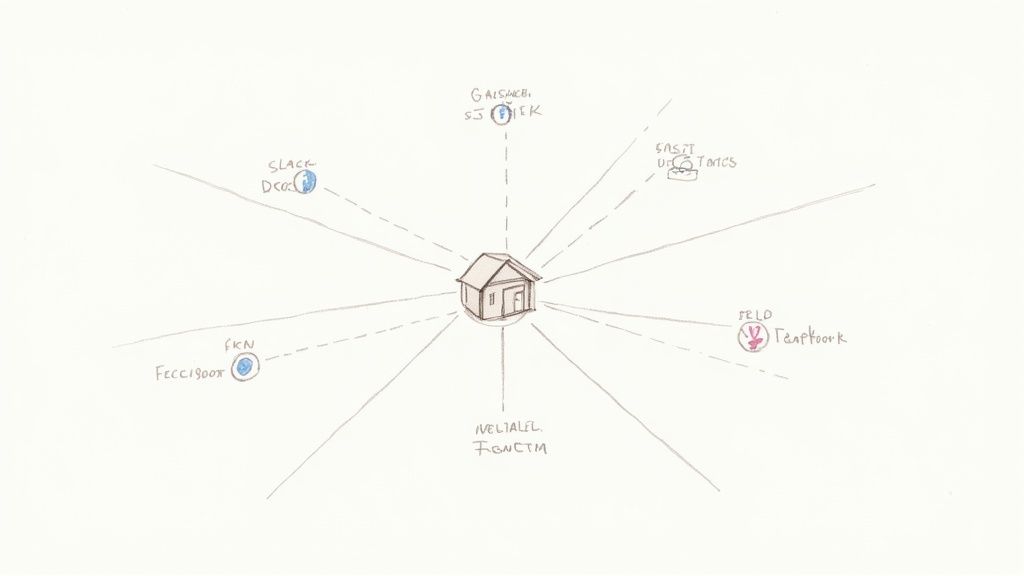
A great way to think about it is building a "home base" and setting up a few "outposts." Your home base is the central hub, the private space for your most dedicated people. The outposts are your presence on other platforms where you can meet new people and draw them into your world.
Owned Platforms vs. Rented Land
Your first major choice is whether to build on property you own or set up shop on someone else's turf. Both paths have their ups and downs, and the best one often depends on where you are in your community-building journey.
Owned platforms are digital spaces where you make all the rules.
- Think: A dedicated forum on your own website, a private Circle community, or a self-hosted Discourse instance.
- The upside: You control the experience from top to bottom. You own all the data, and you're not at the mercy of some algorithm change that kills your reach overnight.
- The downside: You have to get every single person to show up. It can feel like throwing a party and starting in an completely empty room.
Rented platforms mean you're using existing social networks.
- Think: A Facebook Group, a LinkedIn Group, a Discord server, or a Slack workspace.
- The upside: You get to tap into a massive, built-in audience. People are already there, which makes getting those first members much, much easier.
- The downside: You're basically a tenant. The landlord (the platform) can change the rules, algorithms can bury your content, and you’re constantly competing with a million other distractions.
For a lot of brands, a hybrid approach is the sweet spot. You could start a LinkedIn Group to get the ball rolling and build momentum. Then, once you’ve identified your most active members, you can invite them to an exclusive owned community with more perks.
Popular Community Channel Breakdown
The right channel mix is all about knowing your audience. A community for software developers will feel right at home on platforms that would feel totally alien to a group of creative entrepreneurs.
| Channel | Best For | Key Consideration |
|---|---|---|
| Slack/Discord | Tech-savvy crowds, real-time chat, and fast-paced, interactive groups. | Can get noisy and chaotic fast if you don't have good moderation. |
| Facebook/LinkedIn | Broader audiences, professional networking (LinkedIn), and tapping into existing social connections. | You’re fighting for attention against an endless scroll of baby photos and political rants. |
| Super-niche interests, honest (and anonymous) discussions, and specific subcultures. | You have to really get the culture. Show up like a marketer and you'll get roasted. | |
| Owned Forum | Building a lasting knowledge base with deep, searchable conversations. | It takes a serious, sustained effort to get the initial traffic and engagement going. |
Here’s the real challenge today: it's not just about picking a platform, but about creating real connection in a world that’s drowning in digital noise. With over 5.42 billion people on social media, you can’t just broadcast your message and hope for the best. You have to earn attention through quality interactions. This is exactly why the social listening market is expected to hit $18.43 billion by 2030—companies are finally investing in truly understanding and talking with their communities. You can dig into more of this data in the latest social media report on Sproutsocial.com.
Connecting Outposts to Your Home Base
Those outposts on platforms like Reddit or X (formerly Twitter) are your listening posts. They’re where you go to discover what people need. For example, by keeping an eye on the right subreddits, you can find people asking questions that your product is built to solve. Our guide on building a Reddit marketing strategy dives deep into how to do this without being spammy.
The game plan is to add real value to those conversations first, then gently point interested people back toward your main community hub. This "hub-and-spoke" model lets you meet people where they are, while systematically building a valuable, long-term asset that you actually control.
How to Measure Community Marketing ROI
So, how do you prove your community is more than just a lively chatroom? It’s all about moving past vanity metrics like member count and tying your efforts directly to real business results. Measuring the ROI of community marketing means showing a clear, undeniable line from community activity to revenue, retention, and even cost savings.
Think of it this way: you need to speak the language of the C-suite. A solid understanding of how to measure marketing ROI the right way gives you the perfect foundation. From there, you can zoom in on the specific activities driven by your community and show how that investment pays off.
Tying Community Activity to Business Goals
The first step is to organize your metrics around the business goals they actually support. This isn't just about tracking numbers; it's about building a narrative that shows how engagement creates tangible financial value. If you want a deeper dive into the specific formulas, our complete guide on how to calculate marketing ROI breaks it all down.
A straightforward way to frame this is to split your metrics into two buckets: Business Outcomes and Community Health.
Business Outcome Metrics (The "What")
These are the bottom-line numbers that grab everyone's attention. They answer the big question: "What financial impact is our community really having?"
- Improved Customer Retention: This is a big one. Compare the churn rate of customers who are active in your community against those who aren't. A 5% lower churn among community members is a massive win and a powerful proof point for ROI.
- Reduced Support Costs: Track how many support tickets are deflected because a customer found their answer in the community. You can calculate the savings by multiplying the number of deflected tickets by your average cost-per-ticket.
- Lead Generation: How many new leads or sales can you trace back to community discussions? Use tracking links in profiles or simply add a "How did you hear about us?" field to your signup forms to capture this.
- Increased Customer Lifetime Value (LTV): Is an active community member worth more to the business over time? Measure the average LTV of your community cohort and see how it stacks up against non-members.
Community Health Metrics (The "How")
Think of these as the vital signs of your community. They are leading indicators that give you a heads-up on future business outcomes. A healthy community today means better business results tomorrow.
- Active Member Ratio: What percentage of your members are actually posting, commenting, or reacting each month? A healthy, thriving community often sees a 10-20% active member ratio.
- User-Generated Content (UGC) Volume: Count the number of posts, replies, and helpful resources created by members. This is proof that the community is self-sustaining and providing value to itself.
- Response Rate and Time: How fast are members jumping in to answer each other's questions? Quick responses signal a highly engaged and supportive environment.
The most convincing ROI stories connect the "how" with the "what." For example: "This quarter, we grew our active member ratio by 15%. This directly contributed to a 20% reduction in support tickets and a 3% lift in customer retention." Now you've linked a health metric to both cost savings and revenue.
Your First 90 Days: A Practical Launch Plan
Launching a community can feel like a massive undertaking, but you don't have to boil the ocean. A 90-day plan breaks it all down into manageable chunks, letting you build momentum without getting overwhelmed.
The objective here isn't to build a perfect, bustling city overnight. It's about laying a solid foundation, brick by brick, for a community that will last.
Month 1: The Blueprint and Groundwork
Your first 30 days are all about preparation, not promotion. Before you even think about inviting people, you need to build the house. Your main job is to listen, plan, and get the essential framework in place.
Define Your "Why": Get crystal clear on the community's core purpose. What specific pain point are you solving for your members? How does that mission connect back to your business goals? If you can't answer this, stop and figure it out.
Pick a Platform: Where will your people gather? Don't just pick what's trendy. Go where your ideal members already are or where they'd feel most at home, whether that's Slack, Discord, or a dedicated forum platform.
Set the House Rules: Draft your community guidelines. Clear, simple rules about what's okay and what's not are non-negotiable. They create a safe space and prevent headaches down the road.
Month 2: The Soft Launch and First Conversations
With the foundation poured, it's time to open the doors—but only to a select few. This month is all about inviting your founding members and making them feel like the VIPs they are.
Your goal isn't a flood of new users; it's about sparking those first, crucial conversations with the right people.
Forget the mass email blast. Personally reach out and invite 15-20 of your best people—your most loyal customers, passionate beta testers, or biggest social media champions. These folks are your seed crystals; they'll set the tone and culture for everyone who follows.
Once they're in, your job is to be the host of the party. Ask open-ended questions, tag specific people for their expertise, and celebrate every single comment and post. This is where the hands-on work of community marketing really begins.
Month 3: Building Rituals and Scaling Smart
In the final phase of your launch, the focus shifts from just starting conversations to building the routines that keep them going. You're establishing the rituals and habits that turn a quiet group into a thriving, daily destination.
Now, you can start promoting the community a bit more widely. A great way to manage growth is by creating a simple application form. This lets you screen new members to ensure they’re a good fit, protecting the culture you’ve worked so hard to build as you prepare to scale.
Got Questions? Let's Talk Community Marketing
Even with the best game plan, a few practical questions always pop up. Here, we'll tackle the most common ones about what community marketing actually looks like in the real world, so you know what to expect in terms of investment and results.
How Much Does Community Marketing Cost?
Honestly, the cost can be all over the map. You can get started for practically nothing using a free Facebook Group or LinkedIn Group, which is a great way to test the waters without a big budget.
But if you're serious about creating a branded experience, dedicated platforms like Circle or premium Slack tiers will run you anywhere from hundreds to thousands of dollars a month. The biggest line item, though, is almost always time and talent. You'll need to budget for a great community manager who can build those genuine relationships. So, think about the platform costs, any tools for content, and maybe even an engagement service to keep the conversation flowing, especially when you're just starting out.
What’s the Real Difference Between an Audience and a Community?
This one is crucial. An audience listens, but a community talks back—and to each other. Think of your blog readers or social media followers; they're your audience, consuming your content in a one-way broadcast. They're observers.
A community, however, is a living, breathing network. The communication flows in every direction. Your members feel connected to your brand, but more importantly, they're connected to each other. It’s the fundamental shift from talking at people to creating a space where you can talk with them, and they can build their own relationships.
Think of it like this: An audience is a crowd watching a concert. A community is the jam session where everyone grabs an instrument and creates something together.
How Long Until I Actually See Results?
Patience is key here. Community marketing is a long game, not a get-rich-quick scheme. You'll likely see the first promising signs of life within the first 90 days—things like lively discussions, members helping each other out, and a general positive buzz.
But tying that activity to hard business results, like a jump in customer retention or a drop in acquisition costs? That usually takes 6-12 months of consistent, dedicated effort. You're building an asset that grows in value over time. In the beginning, keep your eyes on leading indicators like member activation rates and the quality of user-generated content to know you're on the right track.
Ready to turn online conversations into a predictable growth channel without all the manual work? Replymer uses real, human-written replies to recommend your product in the right discussions on Reddit, X, and LinkedIn. Start growing on autopilot today.