Getting more inbound leads isn't about some secret trick. It's a systematic process of attracting your ideal customers by creating content and experiences they genuinely find valuable. You're essentially shifting from chasing down prospects to building a magnetic brand that pulls them toward you. This is done primarily through great content, smart SEO, and being an authentic voice where your customers already hang out.
Building Your Foundation for Inbound Success

Before you write a single blog post or schedule a tweet, you have to lay the groundwork. So many teams get this wrong. They jump straight into tactics—blogging, social media, you name it—and then wonder why the results are so disappointing.
A successful inbound program isn’t built on random acts of marketing. It’s built on a deep, almost obsessive understanding of who you’re trying to reach. This means going way beyond surface-level demographics. You're trying to build a rich, three-dimensional picture of your Ideal Customer Profile (ICP), ensuring every dollar and hour you spend is aimed squarely at attracting high-quality leads.
Define Your Ideal Customer Profile with Precision
A generic ICP is useless. You need to get granular and really understand the human on the other side of the screen. Put on your investigative journalist hat and dig into the specifics of their day-to-day work life.
- What are their biggest daily frustrations? Don't settle for "needs more efficiency." What specific workflow is a constant bottleneck for them?
- What software is already open on their desktop? Knowing their existing tech stack gives you clues about their budget, technical comfort level, and what integrations they might need.
- Where do they go for advice? Are they active in niche LinkedIn groups, private Slack communities, or specific subreddits? This tells you exactly where to show up and engage.
A well-defined ICP acts as your north star for every marketing decision. It dictates what content to create, which channels to prioritize, and what messaging will hit home, preventing wasted effort on audiences that will never convert.
Map the Actual Buying Journey
Once you know who you're talking to, you need to understand how they actually buy. The B2B buyer’s journey is never a straight line from A to B. It’s a winding path filled with research, vendor comparisons, and lots of internal meetings.
Your job is to map out these key moments. What are the critical questions they’re asking at each stage, from "I think I have a problem" to "Which of these three vendors is best?" The information they need when they're just realizing an issue exists is completely different from what they need when they're deep in the comparison phase. This map becomes your content blueprint, ensuring you’re providing the right answers at the exact moment your ideal customer is looking for them.
This foundational work is critical, and a huge part of it involves implementing effective strategies to improve website traffic to get the right people in the door. After all, that initial traffic is the lifeblood of your entire inbound funnel.
The numbers don't lie. Inbound tactics consistently produce 54% more leads than old-school outbound methods. Companies that get this right often see their website conversion rates double, and the average cost per lead can plummet by as much as 80% after just five months of consistent effort.
Weaving SEO and Content into a Lead-Generating Machine
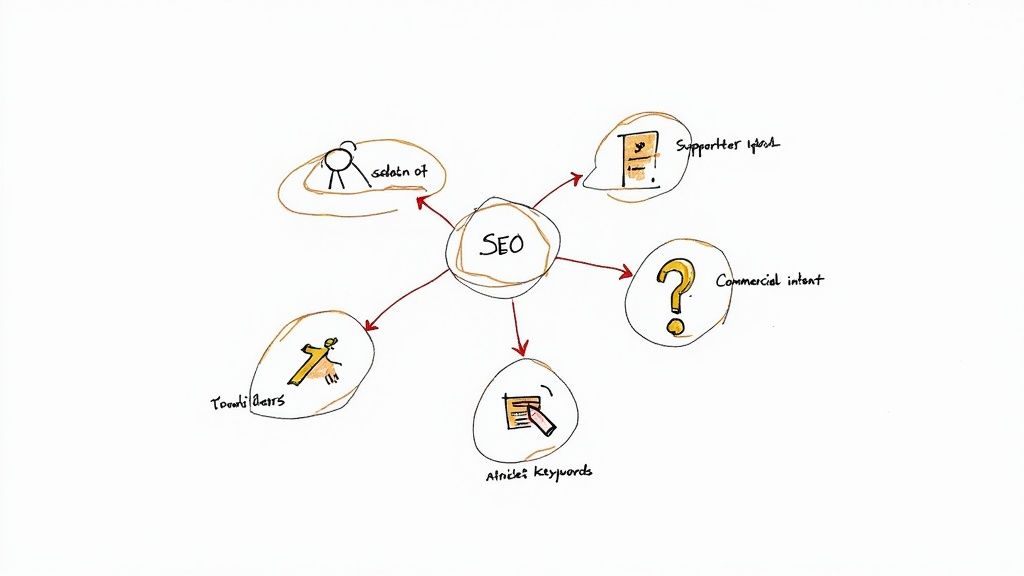
Let's be honest: great content is the engine of any inbound strategy, but without a smart SEO plan, that engine is just spinning its wheels in the mud. To really crank up your inbound lead flow, you need to build a content ecosystem that acts like a powerful magnet, pulling in your ideal buyers around the clock.
This isn't about pumping out random blog posts. The goal is to create a powerhouse content hub that cements your authority and helps you own the search results for your specific niche. The secret is tying your entire content strategy directly to what your buyers are actually searching for.
Hunt for Keywords with Commercial Intent
This is where so many people go wrong. Effective keyword research isn't about chasing massive search volumes; it's about uncovering the exact questions your prospects are asking right before they're ready to buy. This is the crucial difference between attracting window shoppers and attracting actual customers.
Think about the language someone uses when they're just kicking tires versus when they’re seriously solution-shopping.
- Informational Intent: "what is project management software"
- Commercial Intent: "best project management software for small teams" or "Asana vs Trello comparison"
By zeroing in on these commercial intent keywords, you ensure the traffic hitting your site is already primed to convert. It's the most direct path if you want to understand how to increase website traffic organically in a way that actually grows your revenue.
Your SEO strategy shouldn't just be about getting more traffic; it should be about getting the right traffic. Targeting users with commercial intent means you're attracting people who are actively evaluating solutions like yours, making them far easier to convert into inbound leads.
The numbers back this up, big time. For B2B companies, those who are consistent with their blogging generate a staggering 67% more leads than those who don’t. Even better, SEO leads have a close rate that’s seven times higher than outbound leads. Why? Because you're meeting a need instead of interrupting their day. It’s simply a more efficient way to grow.
Build Topic Clusters, Not Just Blog Posts
A topic cluster is a brilliant way to organize your content for both users and search engines. You create one massive, comprehensive piece of content—your "pillar page"—that covers a broad topic. Then, you surround it with several shorter articles—the "cluster content"—that dive deep into specific subtopics.
This structure is a game-changer for two reasons:
- It screams authority. When you cover a subject from every angle, you send a powerful signal to Google that you're the expert.
- It creates an internal linking powerhouse. Every cluster article links back to the main pillar page, which boosts the authority and ranking potential of the entire topic.
Imagine you're a SaaS company selling email marketing software. Your cluster might look like this:
- Pillar Page: The Ultimate Guide to Email Marketing Automation
- Cluster Content:
- How to Write Welcome Email Sequences That Convert
- 7 Email Segmentation Strategies for Higher Engagement
- Choosing the Best Email Marketing Automation Tool
With this methodical approach, your blog stops being a random collection of articles and becomes a strategic asset, built from the ground up to capture high-intent search traffic.
Create High-Impact Content Your Buyers Crave
While blog posts are your foundation, you can't stop there. Your audience has diverse preferences; some love to dig into a detailed guide, while others would rather see a product demo or download a handy template. Diversifying your formats is key.
The table below breaks down some of the most effective content types we've seen work for B2B lead generation.
High-Impact Content Formats for B2B Lead Generation
| Content Format | Primary Goal | Buyer's Journey Stage | Lead Gen Potential |
|---|---|---|---|
| Pillar Page Guides | Establish authority and rank for broad keywords. | Awareness / Consideration | High |
| Comparison Articles | Capture high-intent traffic actively comparing solutions. | Consideration / Decision | Very High |
| Case Studies | Build trust and provide social proof. | Decision | High |
| Webinar Recordings | Offer deep-dive educational content and capture emails. | Consideration | High |
| Free Templates/Tools | Provide immediate value and capture leads early. | Awareness / Consideration | Very High |
Each format gives a potential customer a new way to discover you and see your value.
By building out a rich content ecosystem around commercially relevant keywords, you’re not just generating traffic—you’re building a durable, long-term pipeline of qualified inbound leads who already see you as the go-to expert. This is how you finally stop chasing leads and start attracting them.
Creating Lead Magnets and Landing Pages That Convert

Getting traffic to your website is a great start, but it's only half the job. The real work—and where you see the biggest wins—is turning those visitors into actual leads. This is where your lead magnets and landing pages step into the spotlight. They are your most crucial conversion tools.
Think of a lead magnet as a valuable, can't-say-no offer you make in exchange for someone's contact info. It has to be so good that they feel like they're getting the better part of the bargain. A generic "subscribe to our newsletter" just doesn't work anymore.
Your landing page is where this value exchange takes place. It has one job and one job only: convince the visitor to hand over their details for your offer. Every single element on that page must build desire and make it incredibly easy for them to say yes.
Crafting Lead Magnets Your Audience Actually Wants
The best lead magnets solve a very specific, nagging problem for your ideal customer. They offer a quick win or a piece of insight that someone can use right away. This is the foundation of understanding how to generate B2B leads that are genuinely interested in what you have to say.
Don't just guess what people want. Look at your data and pay attention to the conversations happening online in your industry.
- Templates and Checklists: These are ridiculously effective because they’re so practical. A "Content Calendar Template" for marketers or a "SaaS Onboarding Checklist" for product managers is something they can use immediately.
- Industry Reports and Benchmarks: If you're sitting on unique data, package it up. A "State of B2B Social Selling Report" offers insights people can't get elsewhere, instantly positioning you as an authority.
- Webinars and On-Demand Training: Live or recorded training is a fantastic way to capture high-intent leads. We've seen that 20-40% of webinar attendees often turn into qualified leads because they're willing to invest their time to learn from an expert.
A great lead magnet isn't about what you want to promote; it's about what your prospect desperately needs to solve a problem. Focus on providing immediate utility, and the lead capture will follow naturally.
The real trick is to align the lead magnet's topic with a problem your product solves. This way, the people downloading your content are the same people who are likely to become customers down the road.
The Anatomy of a High-Converting Landing Page
Once you have a killer lead magnet, you need a landing page designed with a laser focus on conversion. Strip away all the distractions—no navigation bar, no social media links, no other calls to action. Every pixel should guide the visitor toward filling out that form.
A landing page that consistently delivers has a few non-negotiable elements.
Benefit-Driven Headlines
Your headline is the first thing people see, and it might be the only thing they read. Don't just say what your lead magnet is; tell them what it does for them.
- Weak: "Download Our Ebook on Social Media"
- Strong: "Stop Guessing: Get the 5-Step Framework to Double Your Social Media Engagement"
Trust-Building Social Proof
People trust other people far more than they trust brands. You need to build credibility and dial down their skepticism.
- Testimonials: Add a short quote from a happy customer or a well-known industry voice.
- Logos: Display the logos of well-known companies that use your service. It's a powerful visual shortcut for trust.
- Data Points: Use specific numbers like, "Join 15,000+ marketers who use this template."
Frictionless Forms
Every extra field you add to a form is another reason for someone to give up. Only ask for what you absolutely need right now. For a top-of-funnel offer, a first name and email are usually plenty. You can always gather more info later as you nurture the lead.
By optimizing each of these components, you can turn a simple webpage into a lead-generating machine. Always be testing—A/B test your headlines, your button copy, and your form length to see what moves the needle.
Broaden Your Horizons with Partnerships and Community
If you're only talking to your own audience, you're playing the long, slow game. The reality is, some of your best, most motivated leads are already hanging out in someone else's network. You just need a way to get in front of them without being intrusive.
That’s where smart partnerships and real community engagement come in. Instead of trying to build every ounce of trust from scratch, you can tap into networks where that trust already exists. This isn't about shouting from the rooftops; it's about adding value where your ideal customers are already listening.
Find Your Co-Marketing Power-Ups
Co-marketing is a classic for a reason—it works. You team up with a non-competing business that targets a similar audience, and you both promote something valuable to your respective networks. Just like that, you've doubled your reach and earned a warm introduction from a brand people already like.
The trick is to find the right dance partner. Look for companies whose products go hand-in-hand with yours. If you sell project management software, a time-tracking app makes a perfect ally.
Once you’ve found a potential match, pitch a project that gives both audiences something they actually want:
- Joint Webinars: Hosting a live training session together is a brilliant way to capture high-intent leads. These are people literally scheduling time on their calendar to learn from you.
- Co-authored Ebooks or Whitepapers: Combine your expertise and data to create a killer industry report. This move positions both of you as go-to experts and creates a lead magnet with serious authority.
- Content Swaps: A simple guest post or a feature in each other's newsletters can work wonders. It’s a low-effort way to get in front of a fresh, relevant group of people.
To really put this on rails, consider building a partner program around lead generation affiliate marketing. It's a scalable way to incentivize partners to consistently send qualified people your way.
The best partnerships feel less like a marketing tactic and more like a true collaboration. When you focus on creating something genuinely useful, the leads follow naturally.
Become the Go-To Expert in Online Communities
Your ideal customers are already talking about their pain points online. They're in Slack channels, LinkedIn Groups, and niche subreddits, asking for recommendations and sharing frustrations. Your job is to show up and be helpful, not to be a walking billboard.
This is a game of patience and authenticity. It’s the complete opposite of link-dropping. You need to earn your stripes and become a known, trusted voice first.
The process is straightforward but demands consistency:
- Find Your Watering Holes: Pinpoint 3-5 online communities where your ideal customer profile is genuinely active.
- Listen and Learn: For the first week or two, just be a fly on the wall. Get a feel for the vibe, the inside jokes, and the common problems people discuss.
- Offer Real Value: Jump in and answer questions where you have legitimate expertise. Share your insights. Help people out. Don't even think about mentioning your product.
- Mention, Don't Pitch: Once you’ve built some social capital, you can occasionally mention your solution, but only when it directly and perfectly solves the problem being discussed.
This people-first approach is the bedrock of a solid inbound strategy. For a more detailed playbook on this, our guide on community engagement best practices breaks it all down.
By consistently being present and helpful, you build a reputation that funnels interested people back to your site. They start seeking you out because they've seen you provide real value again and again. These are the kinds of leads who are already sold on your expertise before they even land on your homepage.
Nail Your Lead Capture and Qualification Process
Getting a ton of inbound interest feels great, but it’s only half the job. A huge list of unqualified leads is really just noise that will burn out your sales team and crush their productivity. The real win comes from building a smart, automated system to capture, qualify, and route leads to the right people.
This is about more than just slapping a "contact us" form on your site. We need to treat lead capture as a crucial step in the buyer's journey. Your goal is to make it ridiculously easy for the right prospects to get in touch, while simultaneously gathering the intel you need to know if they're a good fit. It’s a classic balancing act: reduce friction for the user, but enrich your CRM with data your sales team can actually use.
Design Lead Capture Forms That Actually Convert
The number of fields on your form directly kills your conversion rate. It's a simple truth: more fields create more friction, and that almost always means fewer leads. For a top-of-funnel offer like a checklist or an ebook, ask for the absolute bare minimum. A first name and a work email are usually all you need.
You can always ask for more information later. The first step is just to get the conversation started.
When you're dealing with a bottom-of-funnel request, like a demo or a pricing quote, you have more leeway. Here, you can justify asking for more detail—think company size, their role, or the specific challenge they're facing. The prospect’s intent is much higher at this stage, so they're far more willing to share.
One of the best ways to get around this friction is with progressive profiling. Instead of showing a returning visitor the same old form, smart forms can recognize them and ask for new pieces of information. It works like this:
- First Visit: You ask for their Name and Email.
- Second Visit: The form now asks for Company Size and their Role.
- Third Visit: Now you can ask for their Biggest Challenge or Budget.
This approach lets you build a rich, detailed profile of your leads over time without scaring them off with a giant form on the first date.
Automatically Qualify Leads With a Scoring System
Once a lead is in your system, the big question is: who should sales talk to first? This is where lead scoring comes into play. It's basically a system for assigning points to leads based on who they are and what they do, helping you separate the hot prospects from the tire-kickers.
This doesn't have to be some overly complicated beast. You can build a powerful model by focusing on just two key areas.
1. Demographic and Firmographic Fit (Are they the right kind of customer?)
- Job Title: C-level or Director gets +20, a Manager gets +10, and an Intern gets +1.
- Company Size: If they match your ICP of 50-200 employees, give them +15.
- Industry: If they're in a key vertical like SaaS or fintech, add +10.
2. Behavioral Engagement (Are they showing buying intent?)
- Visited the Pricing Page: This is a huge signal. Give it +25.
- Downloaded a Case Study: Shows they're in the consideration stage. That's a solid +15.
- Attended a Webinar: Worth +10.
- Opened 5+ Emails: Shows consistent engagement. Give it +5.
The next step is to set a threshold. For example, any lead with a score over 50 automatically becomes a Marketing Qualified Lead (MQL) and gets passed to sales. This creates an automated handoff, making sure your reps only spend their valuable time on prospects who are both a good fit and actively interested.
Strategic partnerships can be a fantastic source of high-quality leads that feed directly into this qualification funnel.
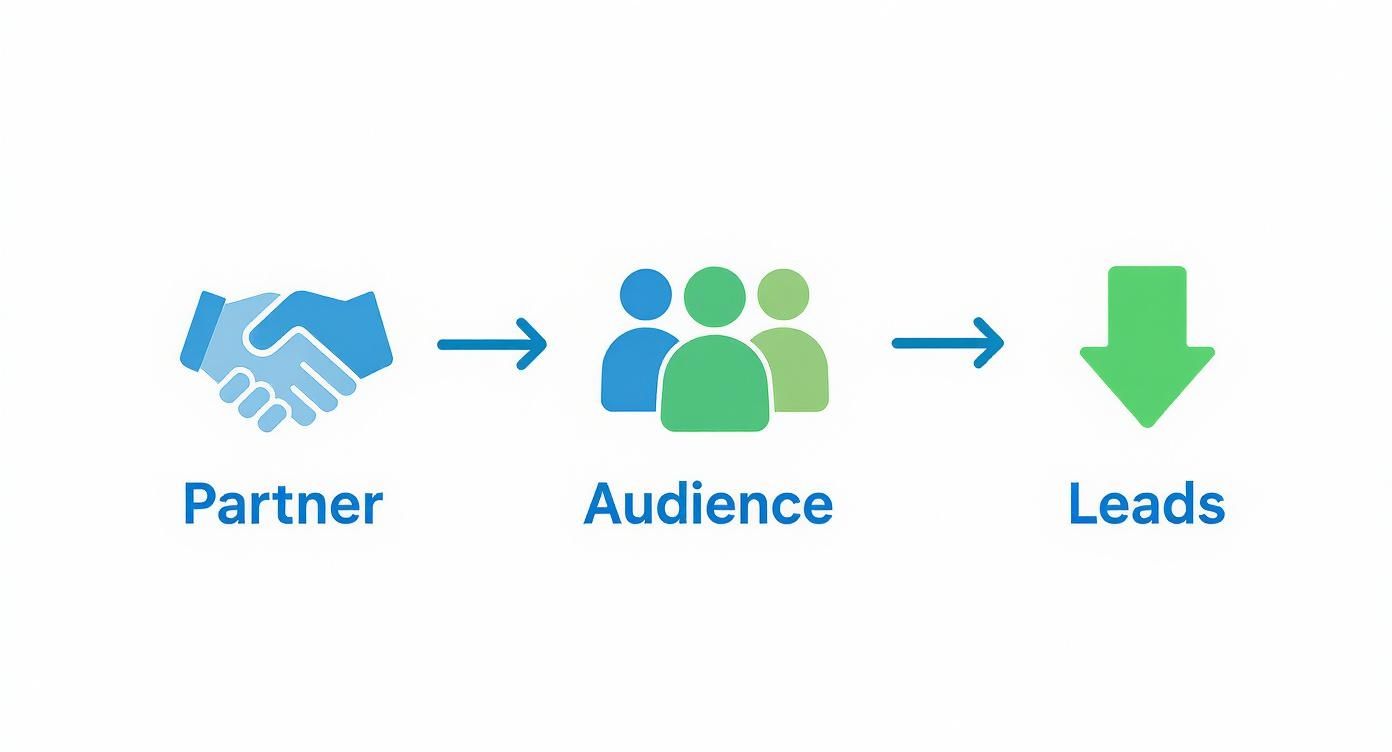
This simple flow shows how working with a partner gets you in front of their audience, which then becomes a new source of inbound leads for your system to capture and qualify.
By fine-tuning this whole process, you stop treating every lead the same and start focusing your energy where it will make the biggest difference. Not only does this make your sales team more efficient, but it will dramatically improve your close rates by getting them in front of the right person at exactly the right time.
Answering Your Toughest Inbound Lead Questions
Even with the best playbook, you're going to have questions. Inbound marketing is always shifting, and the tactics that crushed it last year might need a refresh today. Let's get into some of the most common hurdles and questions B2B marketers face when they're trying to crank up their inbound lead flow.
This isn't just a rehash of the basics. We're digging into the nuances that separate a decent inbound strategy from one that truly drives growth.
How Long Until I Actually See Inbound Leads?
This is the million-dollar question, isn't it? The honest answer is that it's not an overnight thing. Unlike flipping a switch on a paid ad campaign, inbound is all about building a long-term, compounding asset for your business.
Generally, you should start seeing a real, noticeable uptick in qualified leads within 4 to 6 months of consistent, focused effort. Here’s how that usually plays out:
- Months 1-2: The Foundation. You're deep in the trenches doing ICP research, mapping out your core topic clusters, and publishing those first few pillar pieces of content. Traffic will feel slow. That's normal. You're planting the seeds.
- Months 3-4: The First Sprouts. Your initial content starts getting picked up and indexed by search engines. A few organic leads might trickle in from your best-performing articles. This is a critical time to look at the early data and double down on what’s resonating.
- Months 5-6: Gaining Momentum. This is where things get exciting. Your domain authority is climbing, more content is starting to rank, and your lead flow becomes more consistent. You'll start to feel that "flywheel" effect kick in as your efforts compound.
Look, it's easy to get discouraged when you don't see a flood of leads in the first month. But inbound is a marathon, not a sprint. Every single article you publish is an asset that works for you 24/7, and the value of those assets grows exponentially over time.
Should I Focus on Lead Quality or Quantity?
Quality. Every single time. There is no debate here.
A list of 1,000 random leads who will never buy is a waste of everyone's time. It's actually worse than useless because it burns out your sales team and destroys their morale. Give me 50 highly-qualified leads who are a perfect fit for our solution any day of the week.
Focusing on quality means you have to be almost ruthless in your targeting and qualification process.
- Constantly Refine Your ICP: Your Ideal Customer Profile isn't a "set it and forget it" document. Revisit it quarterly. Is it still accurate? Are the leads coming in matching that profile?
- Use Lead Scoring: Get a system in place to automatically separate the hot prospects from the tire-kickers. This lets your sales team focus their energy where it counts.
- Talk to Sales. A Lot. This is non-negotiable. What are they hearing on calls? Which types of leads are closing, and what are their biggest pain points? That feedback is pure gold for refining your marketing.
A smaller, cleaner pipeline of high-intent leads will always, always generate more revenue than a massive pipeline full of noise.
What's the Single Most Overlooked Tactic?
This one is simple: content optimization and repurposing.
So many marketing teams are stuck on a content treadmill, obsessed with creating the next new thing. They completely forget that their existing content is a goldmine of untapped potential.
Instead of just brainstorming your next blog post, block off time every month to improve what you’ve already built.
Quick Wins with Existing Content:
- Update and Refresh: Go find your top 10 blog posts from last year. Update the stats, swap in new examples, and re-optimize them for keywords that are gaining traction now.
- Add "Content Upgrades": Find a high-traffic post and embed a super-specific lead magnet—like a checklist, script, or template directly related to the article's topic. We've seen this increase a single post's conversion rate by 200-300%.
- Repurpose Your Winners: Did a blog post kill it? Turn the key points into a short video for LinkedIn. Convert it into a deck for SlideShare. Break it down into a punchy Twitter thread. This gets your best ideas in front of entirely new audiences on different platforms.
This strategy lets you extract so much more value from the hard work you've already done. It's one of the most efficient ways to boost your inbound lead volume without having to constantly start from scratch.
At Replymer, we turn online conversations into qualified inbound leads for your business. Our team of real writers engages in relevant discussions across Reddit, X (Twitter), and LinkedIn to recommend your product authentically, driving high-intent traffic directly to you. Stop chasing leads and let them come to you.